Home
Class 12
PHYSICS
In the shown figure, there are two long ...

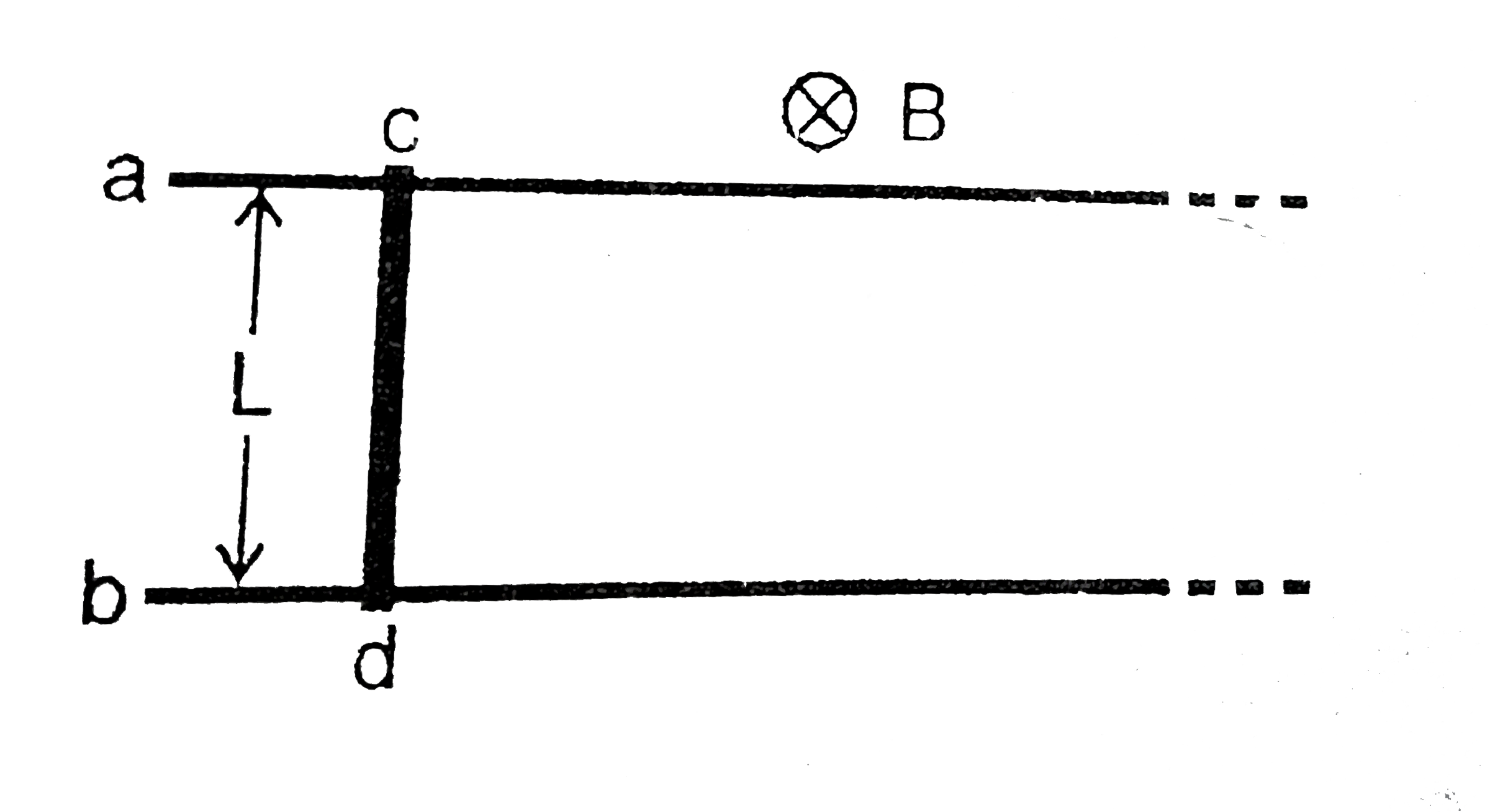
In the shown figure, there are two long fixed parallel conducting rails (having negligible resistance) and are separated by distance L.A uniform rod of resistance R and mass M is placed at rest on frictionless rails. Now at time t = 0, a capacitor having charge `Q_(0)` and capacitance C is connected across rails at ends a and b such that current in rod(cd) is from c towards d and the rod is released. A uniform and constant magnetic field having magnitude B exists normal to plane of paper as shown. (Neglect acceleration due to gravity)

When the acceleration of rod is zero, the speed of rod is :

A

`(B^(2)L^(2)CQ_(0))/(M+B^(2)L^(2)C)`

B

`(B^(2)R^(4)C^(3)Q_(0))/(M+B^(2)L^(2)C^(2))`

C

`(B^(2)R^(4)C^(3)Q_(0))/(M+B^(2)R^(4)C^(4))`

D

`(B^(2)L^(2)CQ_(0))/(M+B^(2)L^(2)C^(2))`

Text Solution

Verified by Experts

The correct Answer is:
A

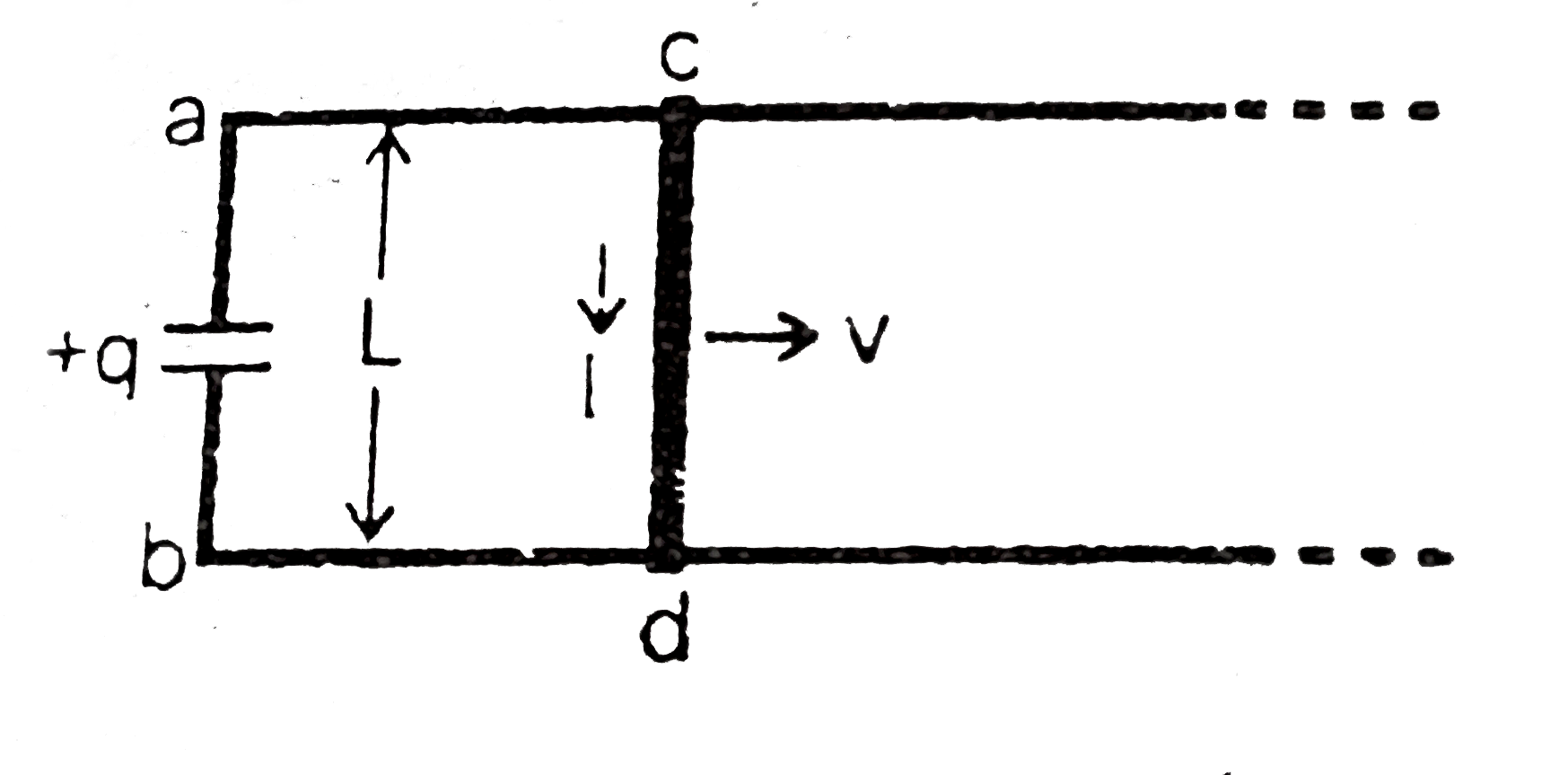
At any instant t, the charge on capacitor q velocity of rod v and the current `I` through rod are as shown

`:. m(dv)/(dt)=BIL=B((-dq)/(dt))L`......(1)
`rArr underset(0) overset(v)(int) mdv = - underset(Q_(0))overset(q)(int) BLdq`
solving we get
`q =Q_(0)-(Mv)/(BL)`....(2)
Also `(q)/(C)=BLV+IR =BLv-R(dq)/(dt)`......(3)
from equation (1) and (3)
`(q)/(C)=BLv+(mR)/(BL)(dv)/(dt)`....(4)
from (4) when `(dv)/(dt) =0`
`rArr (q)/(C) =BLv`....(5)
From (2) and (5). At instant acceleration is zero
`V=(Q_(0)LB)/(M+B^(2)L^(2)C) and q=(B^(2)L^(2)CQ_(0))/(M+B^(2)L^(2)C)`.
Promotional Banner

Topper's Solved these Questions

  • DAILY PRACTICE PROBLEM

    RESONANCE|Exercise DPP No.55|9 Videos
  • DAILY PRACTICE PROBLEM

    RESONANCE|Exercise DPP No.56|20 Videos
  • DAILY PRACTICE PROBLEM

    RESONANCE|Exercise DPP No.53|20 Videos
  • CURRENT ELECTRICITY

    RESONANCE|Exercise High Level Problems (HIP)|21 Videos
  • ELECTRO MAGNETIC WAVES

    RESONANCE|Exercise Exercise 3|27 Videos

Similar Questions

Explore conceptually related problems

In the shown figure, there are two long fixed parallel conducting rails (having negligible resistance) and are separated by distance L . A uniform rod of resistance R and mass M is placed at rest on frictionless rails. Now at time t = 0 , a capacitor having charge Q_(0) and capacitance C is connected across rails at ends a and b such that current in rod (c d) is from c towards d and the rod is released. A uniform and constant magnetic field having magnitude B exists normal to plane of paper as shown. (Neglect acceleration due to gravity) When the acceleration of rod is zero, the charge on capacitor is:

In the shown figure, there are two long fixed parallel conducting rails (having negligible resistance) and are separated by distance L . A uniform rod of resistance R and mass M is placed at rest on frictionless rails. Now at time t = 0 , a capacitor having charge Q_(0) and capacitance C is connected across rails at ends a and b such that current in rod (c d) is from c towards d and the rod is released. A uniform and constant magnetic field having magnitude B exists normal to plane of paper as shown. (Neglect acceleration due to gravity) When the speed of rod is v , the charge on capacitor is :

Two vertical conducting rails separted by distance 1.0m are placed parallel to z -axis as shown in figure. At z=0 , a capacitor of 0.15 F is connected between the rails and a metal rod of mass 100g placed across the rails slides down along the rails. if a constant magnetic fields of 2.0 T exists perpendicular to the plane of the rails, what is the acceleration of the rod?

As shown in figure, the two parallel conducting rails, in a horizontal plane, are connected at one end by an inductor of inductance L. A slider (metallic) of mass m, is imparted a Velocity v_(0) , upon the rails, as shown in figure. The period of oscillation of the conducting rod is

A pair of long, smooth, parallel, horizontal, conducting rails are joined to a cell at one end. There are no external electric or magnetic fields. A metal rod is placed on the rails. The rod will

Shows a rod of length l and resistance r moving on two rails shorted by a resistance R . A uniform magnetic field B is present normal to the plane of rod and rails. Show the electrical equivalence of each branch.

A pair of parallel horizontal conducting rails of negligible resistance shorted at one end is fixed on a table. The distance between the rails is L . A conducting massless rod of resistance R can slide on the rails frictionlessly. The rod is tied to a massless string which passes over a pulley fixed to the edge of the table. A mass m tied to the other end of the string hangs vertically. A constant magnetic field B exists perpendicular to the table. If the system is released from rest, calculate a. the terminal velocity achieved by the rod and b. The acceleration of the mass of the instant when the velocity of the rod is half the terminal velocity.

A pair of parallel horizontal conducting rails of negligible resistance shorted at one end is fixed on a table. The distance between the rails is L. A conducting massless rod of resistance R can slide on the rails frictionlessly. The rod is tied to a massless string which passes over a pulley fixed to the edge of the table, A mass m, tied to the other end of the string hanges vertically. A constant magnetic field B exists perpendicular to the table. If the system is released from rest, calculate. (i) the terminal velocity achieved by the rod, and the acceleration of the mass at the instant when the velocity of the rod is half the terminal velocity.

A metallic rod of mass m and resistance R is sliding over the 2 conducting frictionless rails as shown in Fig. An infinitely long wire carries a current I_(0) . The distance of the rails from the wire are b and a respectively. Find the value of F if the rod slides with constant velocity

