


Home
Class 11
PHYSICS
A particle starting from rest moves alon...

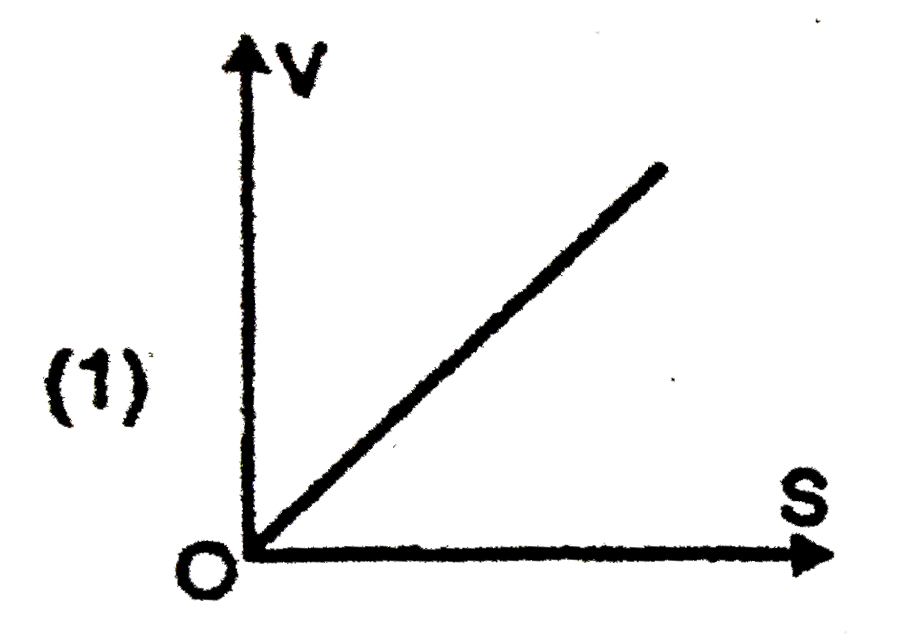
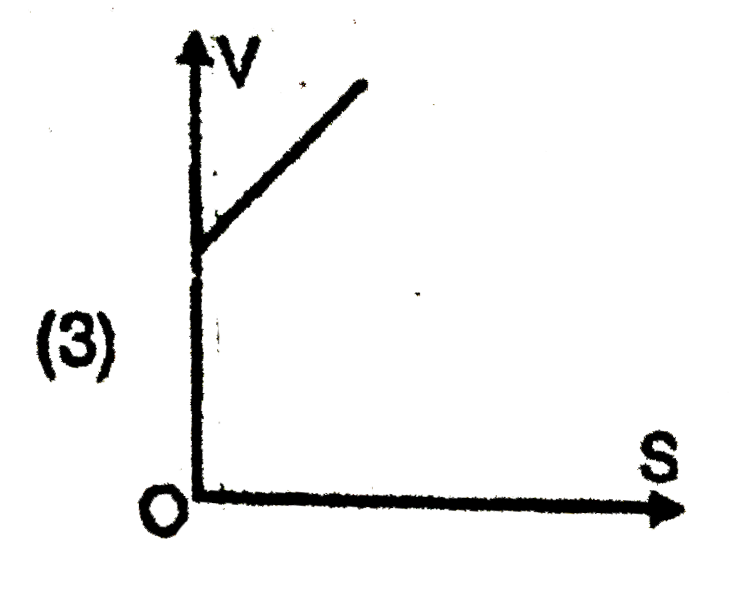
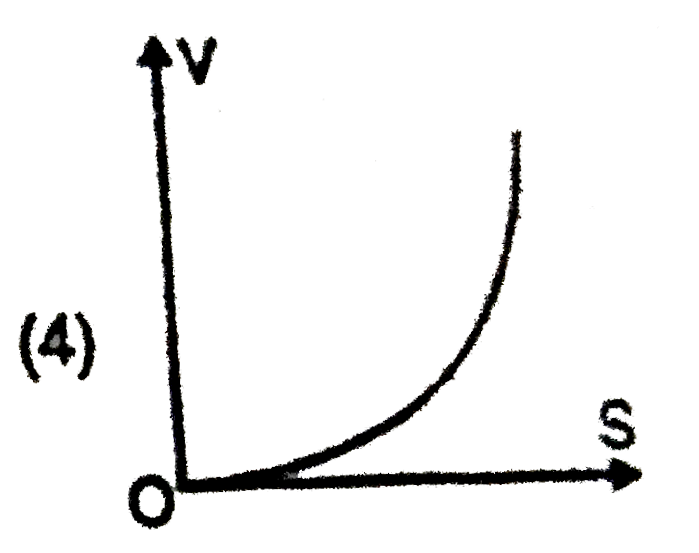
A particle starting from rest moves along a straight line with constant acceleration for this velocity displacement graph will have the form-

A

B

C

D

Text Solution

AI Generated Solution

The correct Answer is:
To determine the form of the velocity-displacement graph for a particle starting from rest and moving with constant acceleration, we can follow these steps: ### Step-by-Step Solution: 1. **Understand the Initial Conditions**: The particle starts from rest, which means its initial velocity \( U = 0 \). 2. **Use the Kinematic Equation**: For a particle moving with constant acceleration, the relationship between velocity \( V \), initial velocity \( U \), acceleration \( A \), and displacement \( S \) is given by the equation: \[ V^2 = U^2 + 2AS \] Since \( U = 0 \), the equation simplifies to: \[ V^2 = 2AS \] 3. **Rearranging the Equation**: We can rearrange this equation to express \( V \) in terms of \( S \): \[ V^2 = 2AS \implies V = \sqrt{2AS} \] This shows that \( V \) is proportional to the square root of \( S \). 4. **Identifying the Graph Type**: The equation \( V = \sqrt{2AS} \) indicates that the graph of \( V \) versus \( S \) will not be a straight line. Instead, it will be a curve. Specifically, since \( V \) increases with \( S \) and is proportional to the square root of \( S \), the graph will be a parabola opening upwards. 5. **Conclusion**: Therefore, the velocity-displacement graph for a particle starting from rest and moving with constant acceleration will have a parabolic shape that opens upwards. ### Final Answer: The velocity-displacement graph will be a parabola opening upwards. ---

To determine the form of the velocity-displacement graph for a particle starting from rest and moving with constant acceleration, we can follow these steps: ### Step-by-Step Solution: 1. **Understand the Initial Conditions**: The particle starts from rest, which means its initial velocity \( U = 0 \). 2. **Use the Kinematic Equation**: For a particle moving with constant acceleration, the relationship between velocity \( V \), initial velocity \( U \), acceleration \( A \), and displacement \( S \) is given by the equation: \[ ...
Promotional Banner

Topper's Solved these Questions

  • HEAT TRANSFER

    RESONANCE|Exercise Advancel Level Problems|17 Videos
  • KINETIC THEORY OF GASES AND THERMODYNAMICS

    RESONANCE|Exercise Exercise|64 Videos

Similar Questions

Explore conceptually related problems

A particle starts from rest and moves along a straight line with uniform acceleration. The ratio of distance travelled by the particle during the first three seconds to the distance travelled by the particle during the next three seconds is 3 о 2

A particle starts from rest and moves along a straight line with uniform acceleration. The ratio of distance travelled by the particle during the first three seconds to the distance travelled by the particle during the next three seconds is 3 о 2

A body starting from the the rest moves along a straight line with constant acceleration. Which one of the following graphs represents the variation of speed(v) and distance(s)?

A particle starts from rest and moves with constant acceleration. Then velocity displacement curve is:

A body starting from rest moves along a string line with a constant acceleration The variation of speed (v) with distance (s) is repressed by the graph

A particle starting from rest moves in a straight line with acceleration as shown in the a-t graph. Find the distance (in m) travelled by the particle in the first four seconds from start of its motion. Q

RESONANCE-KINEMATICS-Exercise
  1. A particle moving along a straight line with a constant acceleration o...

    Text Solution

    |

  2. A moving train is stopped by applying brakes. It stops after travellin...

    Text Solution

    |

  3. A particle starting from rest moves along a straight line with constan...

    Text Solution

    |

  4. A body starts from rest. What is the retio of the distance traveled by...

    Text Solution

    |

  5. The initial velocity of a body moving along a straight lines is 7m//s....

    Text Solution

    |

  6. Acceleration of a particle under projectile motion at the highest poin...

    Text Solution

    |

  7. A particle A is projected with speed V(A) from a point making an angle...

    Text Solution

    |

  8. A particle is projected from a horizontal floor with speed 10 m//s at ...

    Text Solution

    |

  9. A particle is projected up the inclined such that its component of vel...

    Text Solution

    |

  10. A particle P is projected from a point on the surface of smooth inclin...

    Text Solution

    |

  11. Velocity of a stone projected, 2 second bofore it reaches the maximum ...

    Text Solution

    |

  12. A stone projected at angle theta with horizontal from the roof of a ta...

    Text Solution

    |

  13. A stone projected at angle 53^(@) attains maximum height 25m during i...

    Text Solution

    |

  14. A particle is projected with speed 10 m//s at angle 60^(@) with the ho...

    Text Solution

    |

  15. A stone is projected with speed 20 m//s at angle 37^(@) with the horiz...

    Text Solution

    |

  16. The velocity at the maximum height of a projectile is half of its velo...

    Text Solution

    |

  17. Distance between a frog and an insect on a horizontal plane is 10m. Fr...

    Text Solution

    |

  18. A stone is projected from point A with speed u making an angle 60^@ wi...

    Text Solution

    |

  19. A projectile can have the same range 'R' for two angles of projection ...

    Text Solution

    |

  20. Two stones are projected from level ground. Trajectory of two stones a...

    Text Solution

    |