Home
Class 11
PHYSICS
In the given figure a plano-concave lens...

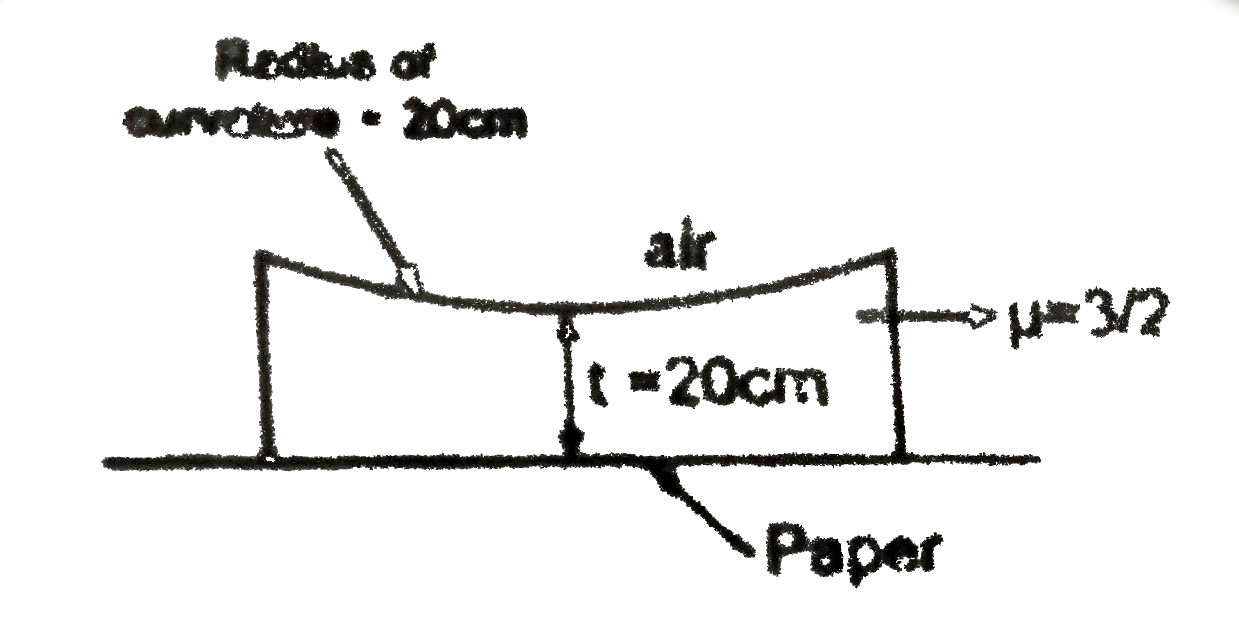
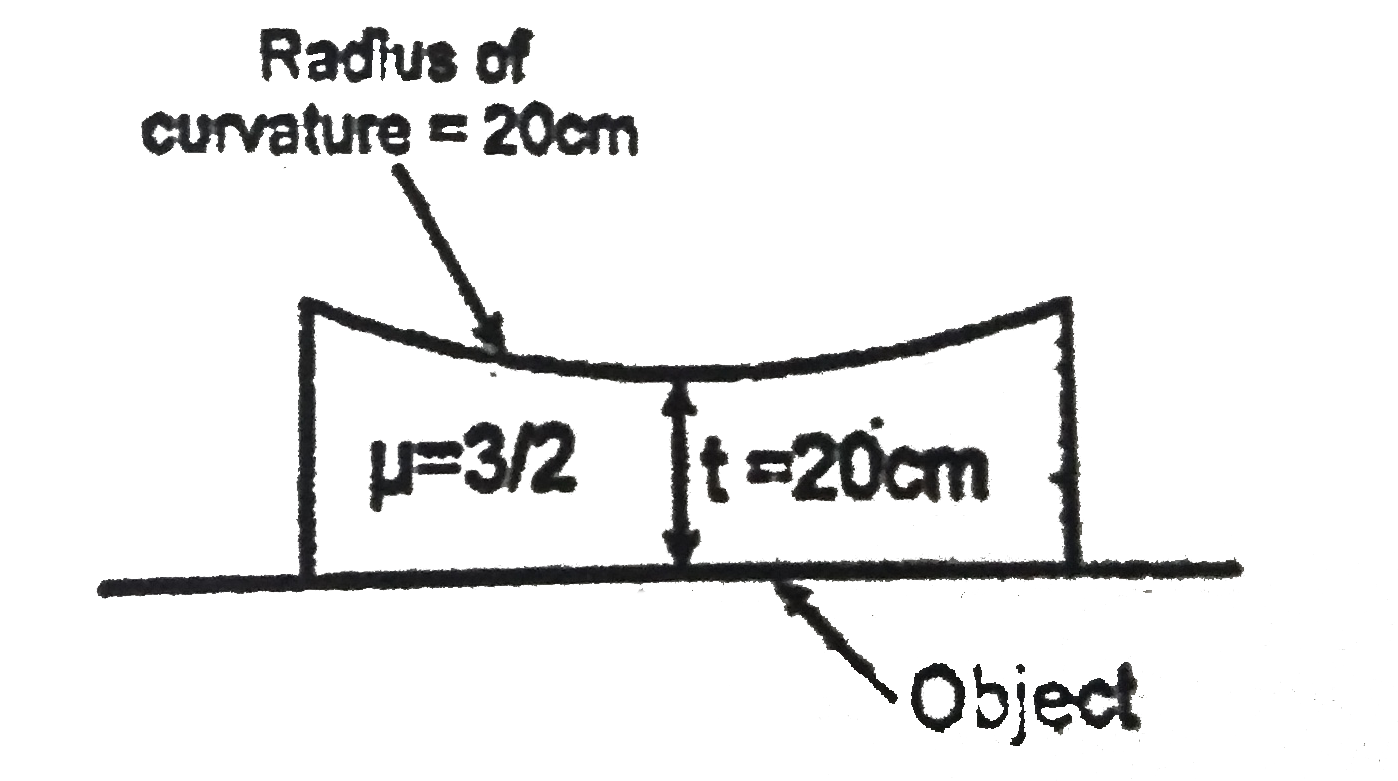
In the given figure a plano-concave lens is placed on a paper on which a flower is drawn. How far above its actual position does the flower appear to be ?

A

10 cm

B

15 cm

C

50 cm

D

none of these

Text Solution

Verified by Experts

The correct Answer is:
A


Considering refraction at the curved surface,
`u=-20 , mu_(2)=1`
`mu_(1)=3//2, R=+20`
applying `(mu_(2))/v-(mu_(1))/u=(mu_(2)-mu_(1))/R`
`rArr 1/v-(3//2)/(-20)=(1-3//2)/20 rArr v=-10`
i.e., 10 cm below the curved surface or 10cm above the actual position of flower.
Promotional Banner

Topper's Solved these Questions

Similar Questions

Explore conceptually related problems

In Figure, a fish watcher watches a fish through a 3.0 cm thick glass wall of a fish tank. The watcher is in level with the fish, the index of refraction of the glass is 8//5 and that of the water 4//3 . a. To the fish, how far away does the watcher appear to be ? b. To the watcher, how far away does the fish appear to be ?

The word ‘’KVPY’’ is written on a board and viewed through different lense such that board is at a distance beyond the focal length of the lens. lgnorging magnification effects, consider the following statements (I) Image (i) has been viewed from the planar side of a plano-convex lens and image (ii) from the convex side of a plano-convex lens. (II) Image (i) has been viewed from the concave side of a plano-concave lens and image (ii) from the planar side of a plano-convex lens. (iii) Image (i) has been viewed from the cocave side of a plano-concave lens and image (ii) from the planar side of a plano-convex lens. (iv) Image (i) has been viewed from the planar side of a plano-concave lens and image (ii) from the convex side of a plano-convex lens. Which of the above statements are correct ?

The word ‘’KVPY’’ is written on a board and viewed through different lense such that board is at a distance beyond the focal length of the lens. lgnorging magnification effects, consider the following statements (I) Image (i) has been viewed from the planar side of a plano-convex lens and image (ii) from the planar side of a plano-convex lens. (II) Image (i) has been viewed from the concave side of a plano-concave lens and image (ii) from the convex side of a plano-convex lens. (iii) Image (i) has been viewed from the cocave side of a plano-concave lens and image (ii) from the planar side of a plano-convex lens. (iv) Image (i) has been viewed from the planar side of a plano-concave lens and image (ii) from the convex side of a plano-convex lens. Which of the above statements are correct ?

The power of a plano-convex lens is P. If this lens is cut longitudinally along its principal axis into two equal parts and then they are joined as given in the figure. The power of combination will be :

A hemispherieal paper weight contains a small flower on its axis of symmetry at a distance of 4 cm from its flat surface. Where is the flower appears to an observer when he looks at it along the axis of symmetry from the top? (Index of refraction of glass = 1.5)

Where does triple fusion take place in a flowering plant? Why is it so called? Mention its significance.

In which part of the female flower does fertilisation take place?

RESONANCE-GEOMETRICAL OPTICS-Exercise
  1. A beam of light is converging towards a point I on a screen. A plane g...

    Text Solution

    |

  2. A prism having an apex angle of 4^@ and refractive index of 1.50 is lo...

    Text Solution

    |

  3. In the given figure a plano-concave lens is placed on a paper on which...

    Text Solution

    |

  4. A beam of diameter 'd' is incident on a glass hemisphere as shown in t...

    Text Solution

    |

  5. A light ray I is incident on a plane mirror M.The mirror is rotated in...

    Text Solution

    |

  6. The image (of a real object) formed by a concave mirror is twice the s...

    Text Solution

    |

  7. For the system as shown in the figure, the image formed by the concave...

    Text Solution

    |

  8. In the figure (a) the light is incident at an angle theta (slightly gr...

    Text Solution

    |

  9. An equilateral prism deviates a ray through 40^@ for two angles of inc...

    Text Solution

    |

  10. A man is sitting in a room at 2m from a wall W1, wants to see the full...

    Text Solution

    |

  11. A flint glass prism and a crown glass prism are to be combined in such...

    Text Solution

    |

  12. A plane mirror is moving with velocity 4 (hat i) + 4 (hat j) + 8 (hat ...

    Text Solution

    |

  13. A light wave travels from glass to water. The refractive index for gla...

    Text Solution

    |

  14. When a beam of light goes from denser medium (mud) to rarer medium (mu...

    Text Solution

    |

  15. The image for the converging beam after refraction through the curved ...

    Text Solution

    |

  16. A thin linear object of size 1mm is kept along the principal axis of a...

    Text Solution

    |

  17. A medium has nv = 1.56, nr=1.44. Then its dispersive power is:

    Text Solution

    |

  18. A Galileo telescope has an objective of focal length 100cm and magnif...

    Text Solution

    |

  19. A convex lens of focal length A and a concave lens of focal length B a...

    Text Solution

    |

  20. Two thin lenses of focal lengths 20cm and 25cm are placed in contact. ...

    Text Solution

    |

