Home
Class 11
PHYSICS
A wall has two layers A and B each made ...

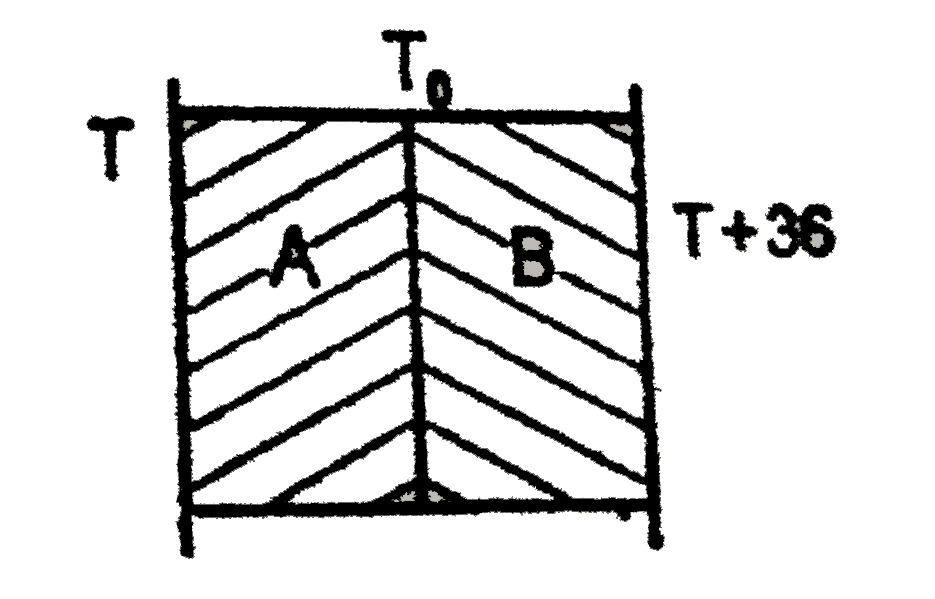
A wall has two layers A and B each made of different materials. Both the layers have the same thickness. The thermal conductivity of materials A is twice of B. Under thermal equilibrium temperature difference across the layer B is `36^@C`. The temperature difference across layer A is

A

`6^(@)C`

B

`9^(@)C`

C

`18^(@)C`

D

`27^(@)C`

Text Solution

Verified by Experts

The correct Answer is:
B

The two are in series.
`K_(A)=3K_(B)`
i.e., thermal resistance of A (say `R_(A)`) is one third that of B (say `R_(8)`)
i.e., `R_(B)=3R_(A)`
`:.` Thermal current =`36/(4R_(A))=9/(R_(A))`
`:.` Temperature difference across 'A' `=(9/(R_(A))).R_(A)=9^(@)C`
Promotional Banner

Topper's Solved these Questions

  • HEAT TRANSFER

    RESONANCE|Exercise Exercise-3|1 Videos
  • HEAT TRANSFER

    RESONANCE|Exercise Advancel Level Problems|17 Videos
  • HEAT TRANSFER

    RESONANCE|Exercise Exercise-2|1 Videos
  • GRAVITATION

    RESONANCE|Exercise Exercise|21 Videos
  • KINEMATICS

    RESONANCE|Exercise Exercise|65 Videos

Similar Questions

Explore conceptually related problems

A wall has two layers A and B, each made of different material. Both the layers have the same thickness. The thermal conductivity of the meterial of A is twice that of B . Under thermal equilibrium, the temperature difference across the wall is 36^@C. The temperature difference across the layer A is

A wall has two layers A and B, each made of different materials. Both layers are of same thickness. But, the thermal conductivity of material A is twice that of B. If, in the steady state, the temperature difference across the wall is 24^(@)C , then the temperature difference across the layer B is :

A wall has two layers A and B each made of different materials. The layer A is 10cm thick and B is 20 cm thick. The thermal conductivity of A is thrice that of B. Under thermal equilibrium temperature difference across the wall is 35^@C . The difference of temperature across the layer A is

A partition wall has two layers A and B, in contact, each made of a different material. They have the same thickness but the thermal conductivity of layer A is twice that of layer B. If the steady state temperature difference across the wall is 60 K, then the corresponding difference across the layer A is

A partition wall has two layers of different materials A and B in contact with each other. They have the same thickness but the thermal conductivity of layer A is twice that of layer B. At steady state the temperature difference across the layer B is 50 K, then the corresponding difference across the layer A is

A wall has two layers A and B each made of different materials. The thickness of both the layers is the same. The thermal conductivity of A, K_(A) = 3K_(B) . The temperature different across the wall is 20^(@)C in thermal equilibrium

A composite slab consists of two parts of equal thickness. The thermal conductivity of one is twice that of the other. What will be the ratio of temperature difference across the two layers in the state of equilibrium ?

The wall with a cavity consists of two layers of brick separated by a layer of air All three lay-ers have the same thickness and the thermal conductivity of the brick is much greater than that of air The left layer is at a higher temperature than the tight layer and steady state condition exists Which of the following graphs perdicts correctly the variation of temperature T with distance d inside the cavity ?.

RESONANCE-HEAT TRANSFER-Exercise
  1. The two ends of a rod of length L and a uniform cross-sectional area A...

    Text Solution

    |

  2. A cylindrical rod having temperature T(1) and T(2) at its ends. The ra...

    Text Solution

    |

  3. A wall has two layers A and B each made of different materials. Both t...

    Text Solution

    |

  4. All the rods have same conductance 'K' and same area of cross section ...

    Text Solution

    |

  5. Consider two rods of same length and different specific heats (S1 and ...

    Text Solution

    |

  6. Two plates each of area A, thickness L1 and L2 thermal conductivities ...

    Text Solution

    |

  7. Consider a compound slab consisting of two different material having e...

    Text Solution

    |

  8. A square is made of four rods of same material one of the diagonal of ...

    Text Solution

    |

  9. If the temperature difference on the two sides of a wall increases fro...

    Text Solution

    |

  10. The colour of a star indicates its

    Text Solution

    |

  11. The means of energy transfer in vacuum is:

    Text Solution

    |

  12. Which of the following is nearest to blackbody-

    Text Solution

    |

  13. Which of the following is true statement?

    Text Solution

    |

  14. For a black body at temperature 727^@C, its radiating power is 60 watt...

    Text Solution

    |

  15. According to Wien's law

    Text Solution

    |

  16. If lambda(m) denotes the wavelength at which the radiative emission fr...

    Text Solution

    |

  17. A black body at 1227^(@)C emits radiations with maximum intensity at a...

    Text Solution

    |

  18. The energy radiated by a black body is directly proportional to :

    Text Solution

    |

  19. If temperature becomes double, the emitted radiation will be :

    Text Solution

    |

  20. Prevost's theory of heat exchange tells that a body radiates thermal e...

    Text Solution

    |

