Home
Class 11
PHYSICS
Consider a compound slab consisting of t...

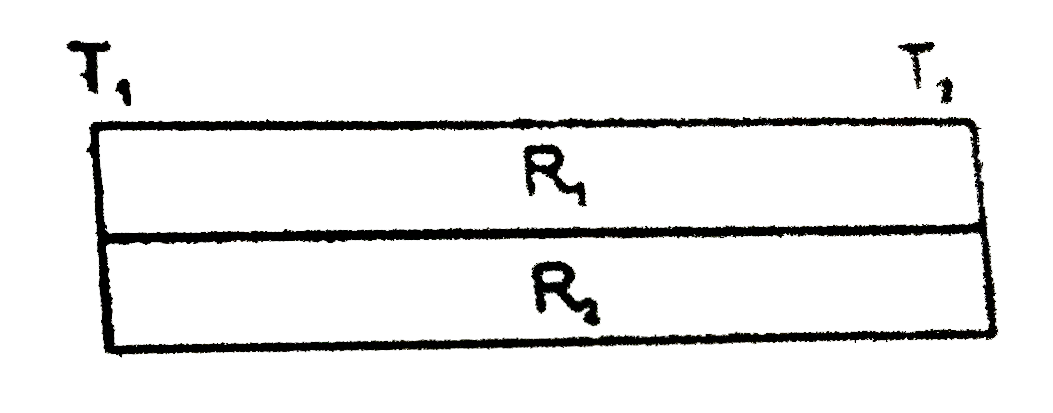
Consider a compound slab consisting of two different material having equal thickness and thermal conductivities `K` and `2K` respectively. The equivalent thermal conductivity of the slab is

A

`sqrt(2)`

B

3k

C

`(4)/(3) k`

D

`(2)/(3) k`

Text Solution

Verified by Experts

The correct Answer is:
C


Equivalent thermal circuit
`1/(R_(eq))=1/(R_(1))+1/(R_(2))rArr (K_(eq)xx2A)/l=(KA)/l+(2KA)/lrArr K_(eq) =3/2 K`
Promotional Banner

Topper's Solved these Questions

  • HEAT TRANSFER

    RESONANCE|Exercise Exercise-3|1 Videos
  • HEAT TRANSFER

    RESONANCE|Exercise Advancel Level Problems|17 Videos
  • HEAT TRANSFER

    RESONANCE|Exercise Exercise-2|1 Videos
  • GRAVITATION

    RESONANCE|Exercise Exercise|21 Videos
  • KINEMATICS

    RESONANCE|Exercise Exercise|65 Videos

Similar Questions

Explore conceptually related problems

A slab consists of two layers of different materials of the same thickness and having thermal conductivities K_(1) and K_(2) . The equivalent thermal conductivity of the slab is

A slab consists of two parallel layers of two different materials of same thickness having thermal conductivities K_(1) and K_(2) . The equivalent conductivity of the combination is

Two identical metal wires of thermal conductivities K_(1) and K_(2) respectively are connected in series. The effective thermal conductivity of the combination is :

Two rods of the same length and diameter, having thermal conductivities K_(1) and K_(2) , are joined in parallel. The equivalent thermal conductivity to the combinationk is

The temperature of the two outer surfaces of a composite slab, consisting of two materials having coefficients of thermal conductivity K and 2K and thickness x and 4x respectively. Temperatures on the opposite faces of composite slab are T_(1) and T_(2) where T_(2)gtT_(1) , as shown in fig. what is the rate of flow of heat through the slab in a steady state?

Two rods of equal length and diameter but of thermal conductivities 2 and 3 unites respectively are joined in parallel. The thermal conductivity of the combination is:

RESONANCE-HEAT TRANSFER-Exercise
  1. Consider two rods of same length and different specific heats (S1 and ...

    Text Solution

    |

  2. Two plates each of area A, thickness L1 and L2 thermal conductivities ...

    Text Solution

    |

  3. Consider a compound slab consisting of two different material having e...

    Text Solution

    |

  4. A square is made of four rods of same material one of the diagonal of ...

    Text Solution

    |

  5. If the temperature difference on the two sides of a wall increases fro...

    Text Solution

    |

  6. The colour of a star indicates its

    Text Solution

    |

  7. The means of energy transfer in vacuum is:

    Text Solution

    |

  8. Which of the following is nearest to blackbody-

    Text Solution

    |

  9. Which of the following is true statement?

    Text Solution

    |

  10. For a black body at temperature 727^@C, its radiating power is 60 watt...

    Text Solution

    |

  11. According to Wien's law

    Text Solution

    |

  12. If lambda(m) denotes the wavelength at which the radiative emission fr...

    Text Solution

    |

  13. A black body at 1227^(@)C emits radiations with maximum intensity at a...

    Text Solution

    |

  14. The energy radiated by a black body is directly proportional to :

    Text Solution

    |

  15. If temperature becomes double, the emitted radiation will be :

    Text Solution

    |

  16. Prevost's theory of heat exchange tells that a body radiates thermal e...

    Text Solution

    |

  17. Reflection and absorption coefficient of a given surface at 0^@C for a...

    Text Solution

    |

  18. A black metal foil is warmed by radiation from a small sphere at tempe...

    Text Solution

    |

  19. A body takes 10 min to cool douwn from 62^@C to 50^@C. If the temperat...

    Text Solution

    |

  20. Two circular disc A and B with equal radii are blackened. They are hea...

    Text Solution

    |