Home
Class 11
PHYSICS
If two conducting slabs of thickness d1 ...

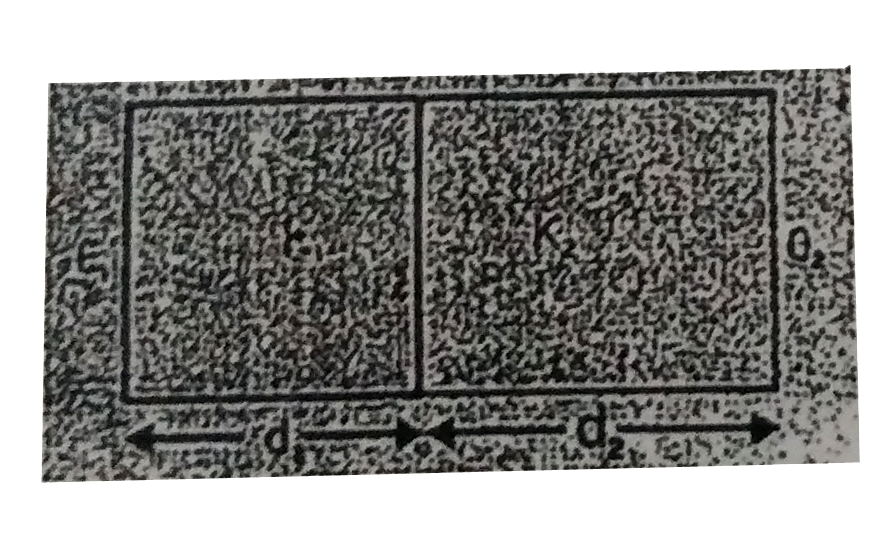
If two conducting slabs of thickness `d_1` and `d_2`, and thermal conductivity `K_1` and `K_2` are placed together face to face as shown in figure in the steady state temperature of outer surfaces are `theta_1` and `theta_2`. The temperature of common surface is-

A

`(K_(1) theta_(1) d_(1)+ K_(2) theta_(2) d_(2))/( K_(1)d_(1)+K_(2)d_(2))`

B

`(K_(1) theta_(1)+K_(2) theta_(2))/(K_(1)+K_(2))`

C

`(K_(1) theta_(1)+K_(2) theta_(2))/(theta_(1)+theta_(2))`

D

`(K_(1) theta_(1)d_(2)+K_(2) theta_(2)d_(1))/(K_(1) d_(2)+K_(2)d_(1))`

Text Solution

Verified by Experts

The correct Answer is:
D


`theta=theta_(1)-I_(omega)R_(th1)=theta_(1)-((theta_(1)-theta_(2))/(R_(Th1)-R_(Th2)))=theta_(1)-((theta_(2)-theta_(1))/((K_(1)A)/(d_(1))+(K_(2)A)/(d_(2)))xx(K_(1)A)/(d_(1)))`
`=theta_(1)-((theta_(2)-theta_(1))/((K_(1))/(d_(1))+(K_(2))/(d_(2)))xx(K_(1))/(d_(1)))=(K_(1)theta_(1)d_(2)+K_(2)theta_(2)d_(1))/(K_(1)d_(2)+K_(2)d_(1))`
Promotional Banner

Topper's Solved these Questions

Similar Questions

Explore conceptually related problems

Two walls of thicknes l_(1) and l_(2) and ther-mal condctivities K_(1) and K_(2) are in contact In the steady state, if the temperature at the outer faces are T_(1) and T_(2) find the temperature at the common wall .

Two walls of thickness d and d and thermal conductivities k and k are in contact. In the steady state, if the temperature at the outer T_(1) and T_(2) , the temperature at the common wall is

If two metallic plates of equal thickness and thermal conductivities K_(1) and K_(2) are put together face to face and a common plate is constructed, then the equivalent thermal conductivity of this plate will be

Two plates each of area A thickness L_(1) and L_(2) thermal conductivities K_(1) and K_(2) respectively are joined to from a single plate of thickness (L_(1)+L_(2)) If the temperatures of the free surfaces are theta_(1) and theta_(2) Calculate (a) Rate of flow of heat (b) Temperature of interface .

Two materials having coefficients of thermal conductivity ‘3 K’ and ‘K’ and thickness ‘d’ and ‘3 d’, respectively, are joined to form a slab as shown in the figure. The temperatures of the outer surfaces are theta_(2) and theta_(1) respectively, (theta_(2) gt theta_(1)) The temperature at the interface is:

Two identical rods are made of different materials whose thermal conductivities are K_(1) and K_(2) . They are placed end to end between two heat reservoirs at temperatures theta_(1) and theta_(2) . The temperature of the junction of the rod is

Two plates eachb of area A, thickness L_1 and L_2 thermal conductivities K_1 and K_2 respectively are joined to form a single plate of thickness (L_1+L_2) . If the temperatures of the free surfaces are T_1 and T_2 . Calculate. (a) rate of flow of heat (b) temperature of interface and (c) equivalent thermal conductivity.

Three rods of the same dimension have thermal conductivity 3K , 2K and K. They are arranged as shown in the figure below Then , the temperature of the junction in steady - state is

RESONANCE-FULL TEST 3-Exercise
  1. A ball is suspended from the top of a cart by a light string of length...

    Text Solution

    |

  2. When an expolsive shell travelling in a parabolic path under the effec...

    Text Solution

    |

  3. A space 2.5cm wide between two large plane surfaces is filled with oil...

    Text Solution

    |

  4. Two identical samples (same material and same amout) P and Q of a radi...

    Text Solution

    |

  5. If two conducting slabs of thickness d1 and d2, and thermal conductivi...

    Text Solution

    |

  6. Three coaxial circular wire loops and a stationary observer are positi...

    Text Solution

    |

  7. The frequency of oscillation of current in the inductor is:

    Text Solution

    |

  8. In the circuit diagram shown

    Text Solution

    |

  9. Find the effective value of current. i=2 sin 100 (pi)t + 2 cos (100 ...

    Text Solution

    |

  10. The electric intesity E, current density j and conductivity sigma are ...

    Text Solution

    |

  11. In the given electrical circuit, the potential difference between poin...

    Text Solution

    |

  12. Which of the following is (are) correct.

    Text Solution

    |

  13. A point source of light is used in a photoelectric effect. If the sour...

    Text Solution

    |

  14. The distance of n^(th) bright fringe to the (n+1)^(th) dark fringe in ...

    Text Solution

    |

  15. The escape velocity of a sphere of mass m is given by

    Text Solution

    |

  16. A uniform electric field in positive x-direction on exists in space. A...

    Text Solution

    |

  17. An electron is revolving around a proton. The total work done in one r...

    Text Solution

    |

  18. Four charges are rigidly fixed along the Y-axis as shown. A positive c...

    Text Solution

    |

  19. As the distance between the plates of a parallel plate capacitor decre...

    Text Solution

    |

  20. The direction of the field B at P is the V shaped wire is in x-y ...

    Text Solution

    |

