Home
Class 12
PHYSICS
Calculate the binding energy per nucleo...

Calculate the binding energy per nucleon of `._(20)^(40)Ca`. Given that mass of `._(20)^(40)Ca` nucleus `= 39.962589 u`, mass of proton `= 1.007825 u`. Mass of Neutron `= 1.008665 u` and `1 u` is equivalent to `931 MeV`.

Text Solution

Verified by Experts
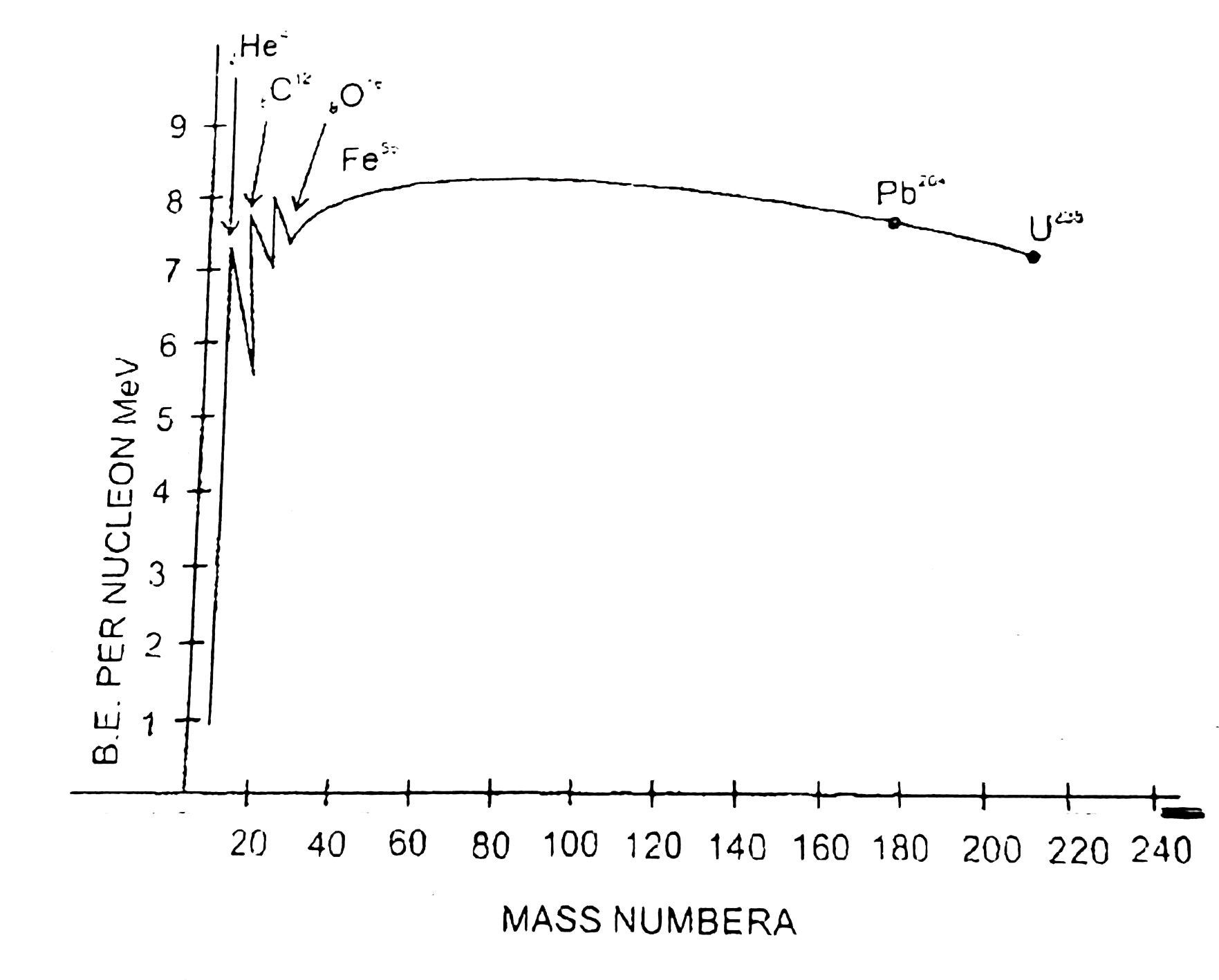
The graph showing the varitaiton of binding energy per nucleon with number of atomic nuclei s shown in below.

The nucleus `._(20)^(40)Ca` contains `20` protons and `20` neutrons.
Mass of `20` protons `=20xx1.007825`
`=20.1565 u`
Mass of `20` neutrons `=20xx1.008665`
`{:(=20.1733u),(=ul(40.3298u)):}`
Maa `._(20)^(40)Ca` nucleus `=39.962589 u`
Mass defect, `Delta m=0.367211u`
`B.E.-0.367211xx931=341.87 MeV`
`B.E.` per nucleon `=(341.87)/(40)=8.547MeV`
Promotional Banner

Topper's Solved these Questions

  • NUCLEAR PHYSICS

    RESONANCE|Exercise Advanced level solutions|16 Videos
  • NUCLEAR PHYSICS

    RESONANCE|Exercise Exercise-3 Part-II JEE (MAIN)|19 Videos
  • GRAVITATION

    RESONANCE|Exercise HIGH LEVEL PROBLEMS|16 Videos
  • REVISION DPP

    RESONANCE|Exercise All Questions|444 Videos

Similar Questions

Explore conceptually related problems

Calculate the binding energy per nucleon of ._26Fe^(56) nucleus. Given that mass of ._26Fe^(56)=55.934939u , mass of proton =1.007825u and mass of neutron =1.008665 u and 1u=931MeV .

Calculate the binding energy per nucleon of ._(20)Ca^(40) nucleus. Mass of (._(20)Ca^(40)) = 39.962591 am u .

Calculate the average binding energy per nucleon of ._(41)^(93)Nb having mass 9.2.906 u..

What is the binding energy per nucleon of _(6)C^(12) nucleus? Given , mass of C^(12) (m_(c))_(m) = 12.000 u Mass of proton m_(p) = 1.0078 u Mass of neutron m_(n) = 1.0087 u and 1 amu = 931.4 MeV

The binding energy per nucleon of ""_(7)N^(14) nucleus is: (Mass of ""_(7)N^(14) = 14.00307 u ) mass of proton = 1.007825 u mass of neutron = 1.008665 u

Calculate binding energy per nucleon of ._83Bi^(209) . Given that m (._83Bi^(209))=208.980388am u m("neutron") = 1.008665 am u m ("proton") = 1.007825 am u

Find the binding energy and the binding energy pernucleon of the nucleus of ._(8)^(16)O . Given atomic mass of ._(8)^(16)O(m)=15.994915 amu, mass of proton (m_(p))=1.007823 amu, mass of a neutron (m_(n))=1.008665 amu and 1 amu =931.5 MeV.

RESONANCE-NUCLEAR PHYSICS-Exercise -3 Part-III CBSE PROBLEMS (LAST 10 YEARS)
  1. Explain the concept of nuclear forces. Discuss their characterstic pro...

    Text Solution

    |

  2. State and explain the laws of radioactive disintergration. Hence defin...

    Text Solution

    |

  3. Calculate the binding energy per nucleon of .(20)^(40)Ca. Given that ...

    Text Solution

    |

  4. Calculate the amount of energy released during the alpha-decay of .(...

    Text Solution

    |

  5. A neutron is absorbed by a .(3)^(6)Li nucleus with the subsequent emis...

    Text Solution

    |

  6. What do you understand by isotopes, isobars and isotones? Explain with...

    Text Solution

    |

  7. The nucleus .^(23)Ne deacays by beta-emission into the nucleus .^(23)...

    Text Solution

    |

  8. Two nuclie have mass numbers in the ratio 1:2. What is the ration of t...

    Text Solution

    |

  9. A radiactive nucleus 'A' undergoes a series of decays according to the...

    Text Solution

    |

  10. Define the activity of a radionuclide. Write its SI unit. Give a plot ...

    Text Solution

    |

  11. Draw a plot of potential energy of a pair of nucleons as a function of...

    Text Solution

    |

  12. (a) Write symbolically the beta-decay process of ""(15)^(32)P. (b) ...

    Text Solution

    |

  13. How is the size of nucleus experimentally determined ? Write the relat...

    Text Solution

    |

  14. State the law of redioactive decay. Plot a graph showing the number (N...

    Text Solution

    |

  15. What is the effect on neutron to proton ratio in a nucleus when (i) an...

    Text Solution

    |

  16. A nucleus undertgoes beta-decay. How does its (i) mass number (ii) at...

    Text Solution

    |

  17. How is the radius of a nucleus related to its mass number ?

    Text Solution

    |

  18. (a) Derive the law of radioavtive decay, viz. N=N(0)e^(-lambda t) ...

    Text Solution

    |

  19. (a) Why photoelectric effect cannot be explained on the basis of wave ...

    Text Solution

    |

  20. An element A decays into element C by a two-step process : A rarr B ...

    Text Solution

    |

