Home
Class 12
PHYSICS
Draw a plot of potential energy of a pai...

Draw a plot of potential energy of a pair of nucleons as a function of their separation . Write two important conclusions which you can draw regarding the nature of nuclear forces .

Text Solution

Verified by Experts
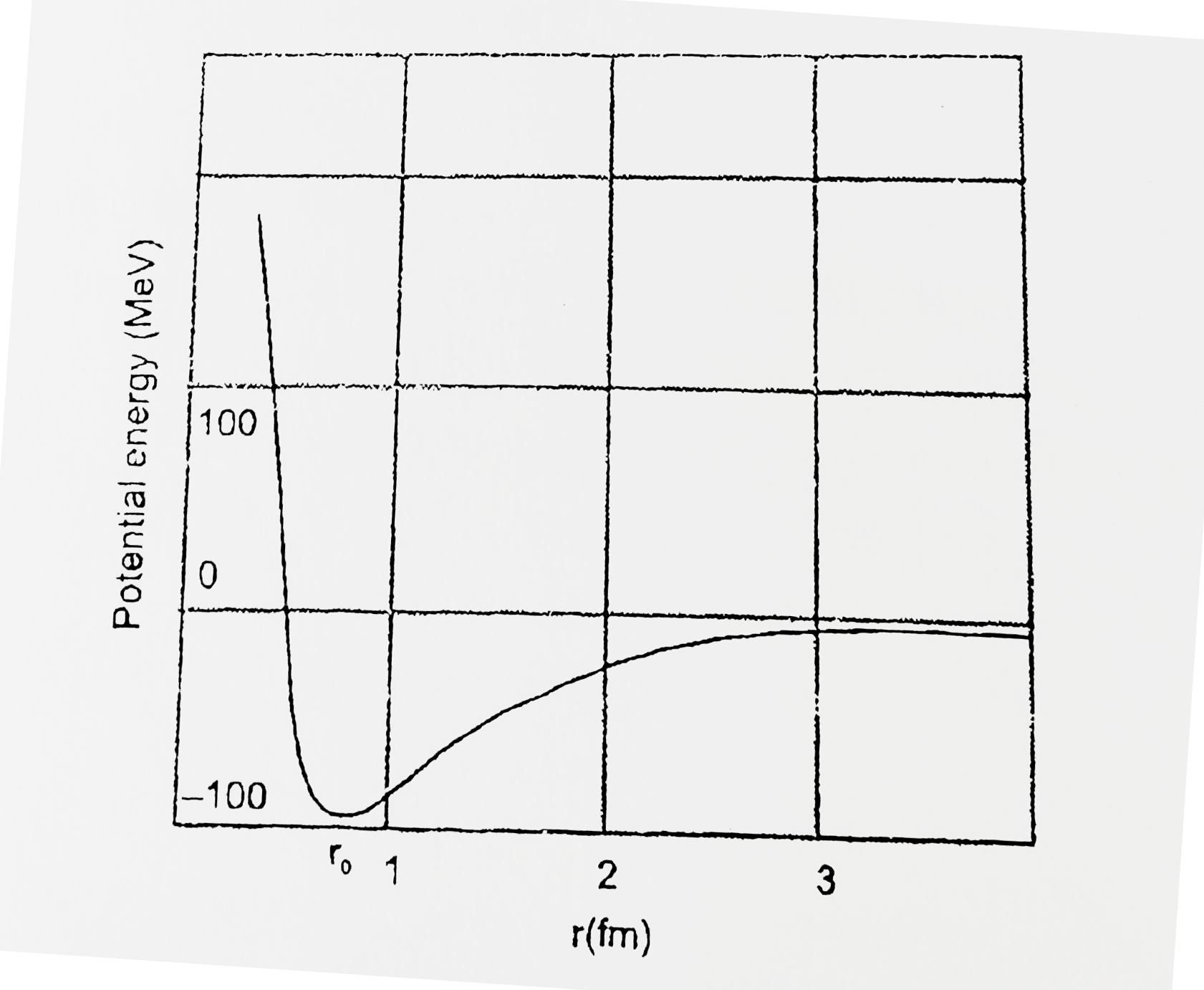
Plot of potential of a pair of nucleons as a function of their separation is given in fig.

The potential is minimum at a distance `r_(0) (~~0.8 fm)`. Following may be drawn from this graph:
(i) The nuclear force is much stronger than the Coulomb force acting between charges or the gravitational forces between masses.
(ii) The nuclear force between two nucleons falls rapidly to zero as theri ditance is mroe then a few femtometers.
(iii) For a separation greater than `r_(0)`, the force is force is attractive and for separations less than `r_(0)` force is repulsive.
Promotional Banner

Topper's Solved these Questions

  • NUCLEAR PHYSICS

    RESONANCE|Exercise Advanced level solutions|16 Videos
  • NUCLEAR PHYSICS

    RESONANCE|Exercise Exercise-3 Part-II JEE (MAIN)|19 Videos
  • GRAVITATION

    RESONANCE|Exercise HIGH LEVEL PROBLEMS|16 Videos
  • REVISION DPP

    RESONANCE|Exercise All Questions|444 Videos

Similar Questions

Explore conceptually related problems

Draw the plot of binding energy per nucleon as a function of mass number and write two important conclusion obtained from the graph.

(a) Draw a plot showing the variation of potential energy of a pair of nucleons as a function of their separation . Mark the regions where the nuclear force is : (i) attractive and (ii) repulsive. (b) In the nuclear reaction n+underset(92)(235_(Uto))underset(54" ")(a_(Xe+))underset(b" ")(94_(Sr+2n)) determine the values of a and b .

Draw a graph between potential energy of a pair of nucleons and separation between them. Also write its main features.

(a) In a nuclear reaction ""_(2)^(3)He +""_(2)^(3)He to ""_(2)^(4)He+""_(1)^(1)H +""_(1)^(1)H +12.86 MeV, though the number of nucleons is conserved on both sides of the reaction, yet the energy is released. How? Explain. (b) Draw a plot of potential energy between a pair of nucleons as a function of their separation. Mark the regions where potential energy is (i) positive and (ii) negative.

RESONANCE-NUCLEAR PHYSICS-Exercise -3 Part-III CBSE PROBLEMS (LAST 10 YEARS)
  1. A neutron is absorbed by a .(3)^(6)Li nucleus with the subsequent emis...

    Text Solution

    |

  2. What do you understand by isotopes, isobars and isotones? Explain with...

    Text Solution

    |

  3. The nucleus .^(23)Ne deacays by beta-emission into the nucleus .^(23)...

    Text Solution

    |

  4. Two nuclie have mass numbers in the ratio 1:2. What is the ration of t...

    Text Solution

    |

  5. A radiactive nucleus 'A' undergoes a series of decays according to the...

    Text Solution

    |

  6. Define the activity of a radionuclide. Write its SI unit. Give a plot ...

    Text Solution

    |

  7. Draw a plot of potential energy of a pair of nucleons as a function of...

    Text Solution

    |

  8. (a) Write symbolically the beta-decay process of ""(15)^(32)P. (b) ...

    Text Solution

    |

  9. How is the size of nucleus experimentally determined ? Write the relat...

    Text Solution

    |

  10. State the law of redioactive decay. Plot a graph showing the number (N...

    Text Solution

    |

  11. What is the effect on neutron to proton ratio in a nucleus when (i) an...

    Text Solution

    |

  12. A nucleus undertgoes beta-decay. How does its (i) mass number (ii) at...

    Text Solution

    |

  13. How is the radius of a nucleus related to its mass number ?

    Text Solution

    |

  14. (a) Derive the law of radioavtive decay, viz. N=N(0)e^(-lambda t) ...

    Text Solution

    |

  15. (a) Why photoelectric effect cannot be explained on the basis of wave ...

    Text Solution

    |

  16. An element A decays into element C by a two-step process : A rarr B ...

    Text Solution

    |

  17. Write the law of radioavtive decay. Decay constant of a radioactive su...

    Text Solution

    |

  18. For the past some time, Aarti had been observing some erratic body mov...

    Text Solution

    |

  19. The decay constant of a radioactive substance is 0.693 per minute. Wha...

    Text Solution

    |

  20. from the relation R=R0A^(1//3), where R0 is a constant and A is the ma...

    Text Solution

    |

