Home
Class 12
PHYSICS
A diatomic molecule is made of two masse...

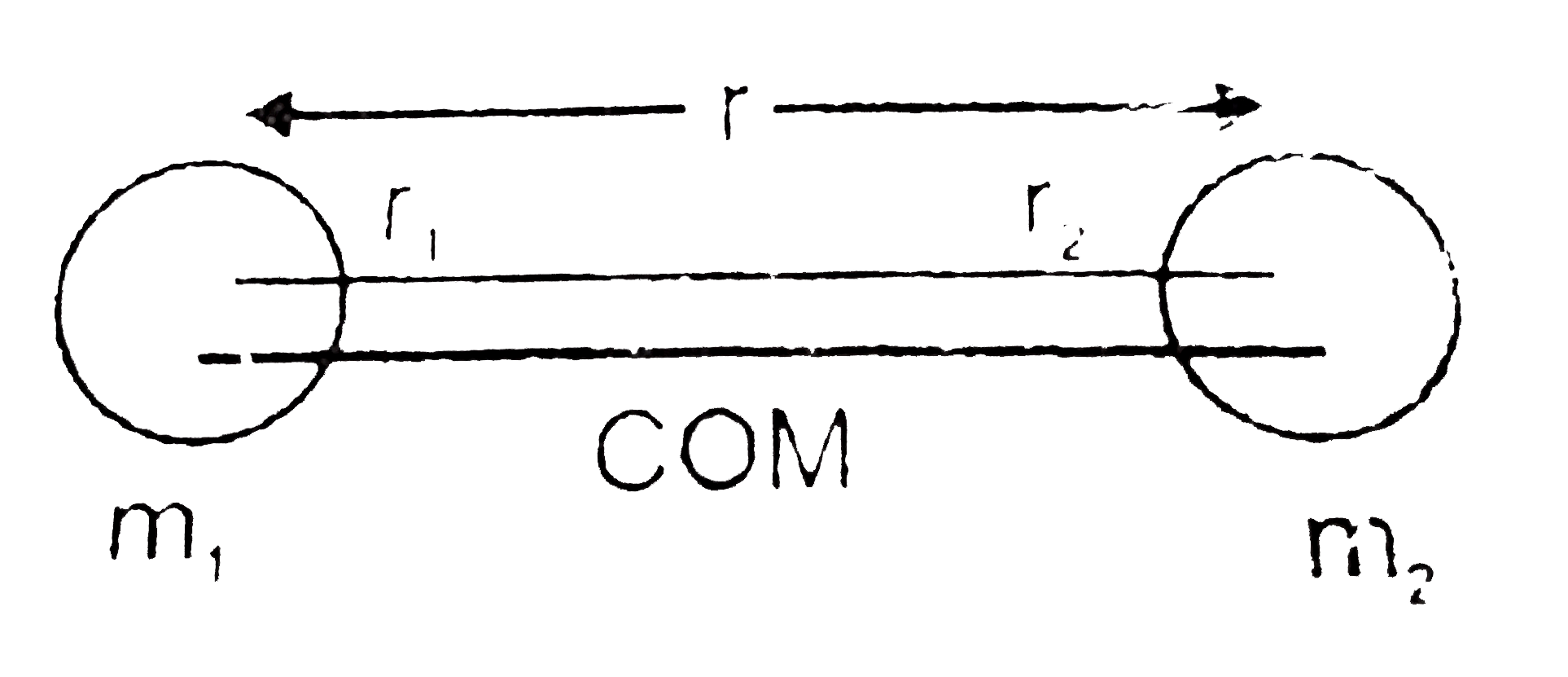
A diatomic molecule is made of two masses `m_(1) and m_(2)` which are separated by a distance `r` . If we calculate its rotational energy by applying Bohr's rule of angular momentum quantization it energy will be ( n is an integer )

A

`((m_(1)_m_(2))^(2)n^(2)h^(2))/(2m_(1)^(2)m_(2)^(2)r^(2))`

B

`(n^(2)h^(2))/(2(m_(1)+m_(2))r^(2))`

C

`(2n^(2)h^(2))/((m_(1)+m_(2))r^(2))`

D

`((m_(1)+m_(2))n^(2)h^(2))/(2m_(1)m_(2)r^(2))`

Text Solution

Verified by Experts

The correct Answer is:
D

`m_(1)r_(1)=m_(2)r_(2)`
`r_(1)+r_(2)=r`
`:. r_(1)=(m_(2)r)/(m_(1)+m_(2))`
`:. epsilon=(1)/(2)omega^(2)`
`=(1)/(2)(m_(1)r_(1)^(2)+m_(2)r_(2)^(2)).omega^(2)`.......(i)
`mvr=(h)/(2pi)=Iomega`
`omega=(nh)/(2piI)`
`:. epsilon=(1)/(2)I. (n^(2)h^(2))/(4pi^(2)I^(2))=(n^(2)h^(2))/(8pi^(2))(1)/((m_(1)r_(1)^(2)+m_(2)r_(2)^(2)))`
`=(n^(2)h^(2))/(8pi^(2))(1)/((,_(2)^(2)r_(0)^(2))/((m_(1)+m_(2))^(2)))+m_(2)(m_(1)^(2)r^(2))/((m_(1)+m_(2))^(2))`
`=(n^(2)h^(2))/(8pi^(2)r^(2))((m_(1)+m_(2))^(2))/(m_(1)m_(2)(m_(1)+m_(2)))=((m_(1)+m_(2))n^(2)h^(2))/(8pi^(2)r^(2)m_(1)m_(2))`
Promotional Banner

Topper's Solved these Questions

  • ATOMIC PHYSICS

    RESONANCE|Exercise Advanved level problems|17 Videos
  • ATOMIC PHYSICS

    RESONANCE|Exercise Exercise-2 Part-III : Comprehension|12 Videos
  • ALTERNATING CURRENT

    RESONANCE|Exercise HIGH LEVEL PROBLEMS|11 Videos
  • CAPACITANCE

    RESONANCE|Exercise High Level Problems|16 Videos

Similar Questions

Explore conceptually related problems

A diatomic molecule is madde of two masses m_(1) and m_(2) which are separated by a distance r . If we calculate its rotational energy by appliying Bohr's rule of angular momemtum quantization it energy will be ( n is an integer )

Two bodies of masses m_(1) and m_(2) are separated by a distance R. The distance of the centre of mass of the bodies from the mass m_(1) is

Two spheres each of mass 104 kg are separated by a distance of 100 m. What will be the gravitationel potential energy of the system?

A molecule consists of two atoms each of mass m and separated by a distance d. If K is the average rotational K.E. of the molecule at particular temperature, then its angular frequency is

Two bodies of masses m_(1) and m_(2) have same kinetic energy. The ratio of their momentum is

In a double star system, two stars of masses m_1 and m_2 separated by a distance x rotate about their centre of mass. Find the common angular velocity and Time period of revolution.

Two bodies of masses m_1 and m_2 have the same linear momentum. What is the ratio of their kinetic energies?

RESONANCE-ATOMIC PHYSICS-Exercise -3 part -I JEE (Advanced)
  1. After absorbing a slowly moving neutrons of mass m(N) (momentum ~0) a...

    Text Solution

    |

  2. Hydrogen atom is excieted from ground state to another state with prin...

    Text Solution

    |

  3. A diatomic molecule is made of two masses m(1) and m(2) which are sepa...

    Text Solution

    |

  4. The anode voltage of photocellis kept fixed. The wavelength lambda of ...

    Text Solution

    |

  5. In a hydrogen like atom electron make transition from an energy level ...

    Text Solution

    |

  6. Hydrogen (.(1)H^(1)), Deuterum (.(1)H^(2)), singly ionised Hellium (....

    Text Solution

    |

  7. As an electron makes a transition from an excited state to the ground ...

    Text Solution

    |

  8. Ultraviolet light is incident on two photosensitive materials having w...

    Text Solution

    |

  9. Mention the significance of Davisson-Germer experiment. An alpha-parti...

    Text Solution

    |

  10. de Broglie wavelength associated with an electron acclerated through a...

    Text Solution

    |

  11. A hydrogen atom initially in the ground level absorbs a photon , which...

    Text Solution

    |

  12. Ultraviolet radiations of different frequencies v(1)are incident on tw...

    Text Solution

    |

  13. Draw a schematic diagram of the experiment used by. Davisson and Germe...

    Text Solution

    |

  14. The two lines A and B in fig. show the photo electron of de Broglie wa...

    Text Solution

    |

  15. Fig. shows the variation of stopping potential V0 with the frequency v...

    Text Solution

    |

  16. The ground state energy of hydrogen atom is -13.6 e V. a. What is th...

    Text Solution

    |

  17. The stopping potential in an experiment on a photo electric effect is ...

    Text Solution

    |

  18. Define ionisation energy. What is the value for a hydrogen atom?

    Text Solution

    |

  19. Write Einstein's photoelectric equation. State clearly any two salient...

    Text Solution

    |

  20. Deduce an expression for the magnetic dipole moment of an electron orb...

    Text Solution

    |

