
Home
Class 12
PHYSICS
The anode voltage of photocellis kept fi...

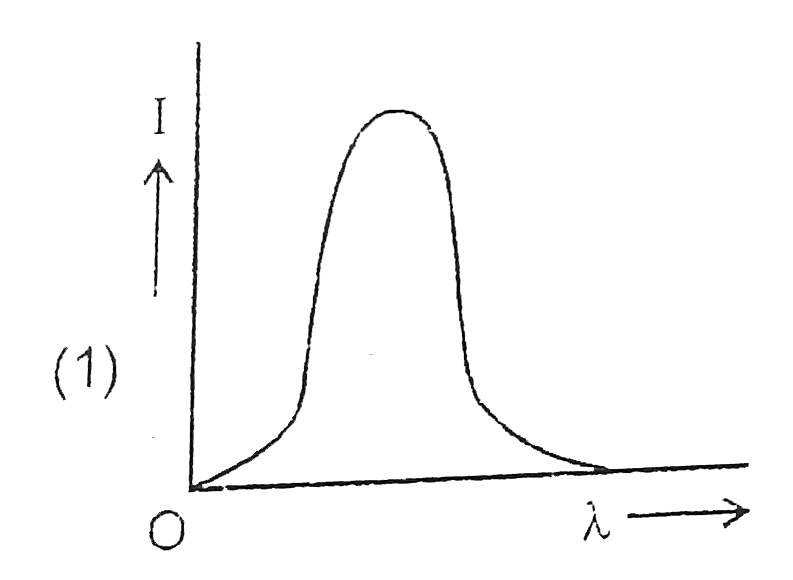
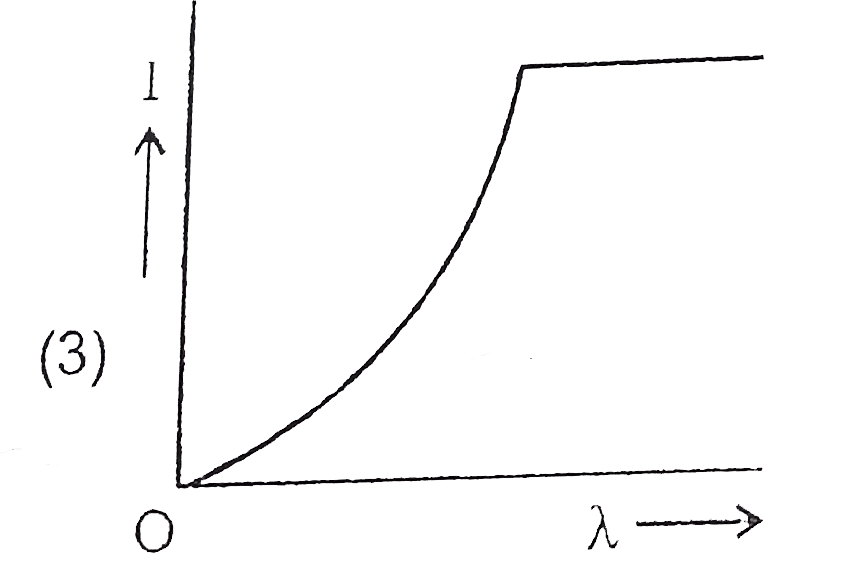
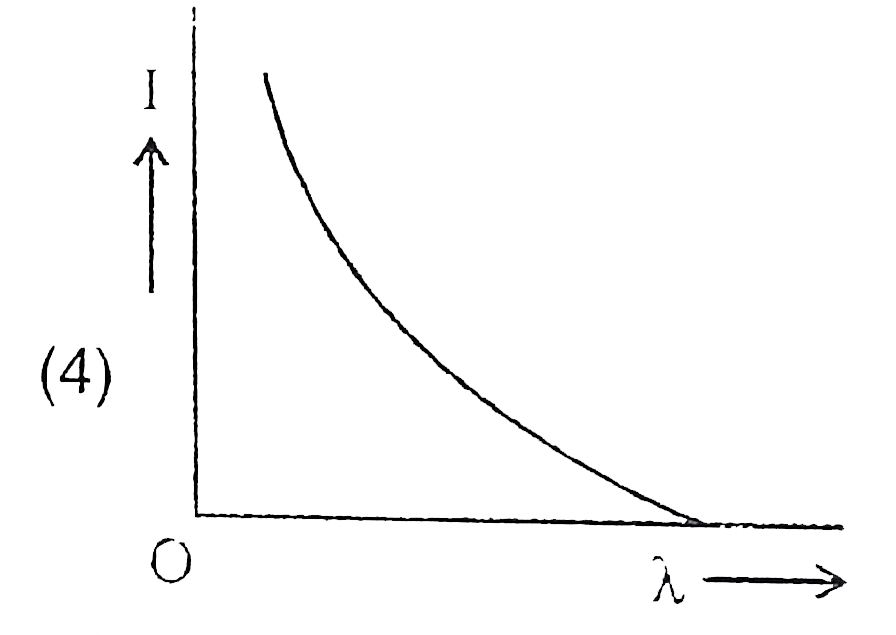
The anode voltage of photocellis kept fixed. The wavelength `lambda` of the light falling on the cathode is gradually changed. The plate current `I` of the photocell varies as follows:

A

B

C

D

Text Solution

Verified by Experts

The correct Answer is:

D

As `lambda` is increased, there will be a value of `lambda` above which photoelectrons will be cease to come out so photocurrent will beocme zero. Hence `(4)` is correct answer.
Promotional Banner

Topper's Solved these Questions

  • ATOMIC PHYSICS

    RESONANCE|Exercise Advanved level problems|17 Videos
  • ATOMIC PHYSICS

    RESONANCE|Exercise Exercise-2 Part-III : Comprehension|12 Videos
  • ALTERNATING CURRENT

    RESONANCE|Exercise HIGH LEVEL PROBLEMS|11 Videos
  • CAPACITANCE

    RESONANCE|Exercise High Level Problems|16 Videos

Similar Questions

Explore conceptually related problems

The anode vollage of a photocell is kept fixed . The wavelength lambda of the light falling on the cathode varies as follows

Find the thickness of a plate which will produce a change in opticle path equal to half the wavelength lambda of the light passing through it normally. The refractive index of the plate is mu .

The stopping potential in a photoelectric experiment is linearly related to the inverse of the wavelength (1/lambda) of the light falling on the cathode. The potential difference applied across an X-ray tube is linearly related to the inverse of the cutoff wavelength (1/lambda) of the X-ray emitted. Show that the slopes of the lines in the two cases are equal and find its value.

In the experimental setup for a photocell, the wavelength of the light incident on the cathod is initially 0.6 times the threshold wavelength for the material of the cathode. Certain change in the experimental setup are given in column A and their possibel effects are given in column B. {:("Column A","Column B"),((i)"The intensity of the incident light is doubled but the frequency remains unaltered",(a)"Photocurrent remains the same"),((ii)"Both the intensity and wavelength of the incident light are doubled",(b)"Photcurrent falls to zero"),((iii)"The intensity of the incident light is doubled and its wavelength is made half",(c)"Stopping potential increase"),((iv)"The intensity of the incident light ramains the same and the wavelength is made half",(d) "Photocurrent increases"):}

A vacuum photocell consists of a central cathode and an anode. The internal surface is silver of work function 4.5 eV. The contact potential difference between the electrodes equals to 0.6 V. The photocell is illuminated by light of wavelength 2.3xx10^-7 m. a. What retrading potential difference should be applied between electrodes of the photocell for the photocurrent to drop to zero? b. If a retarding potential of 1V is applied between electrodes at what limiting wavelength lamda of light incident on the cathode will on the cathode will the photoelectric effect begin?

Two identical metal plates show photoelectric effect. Light of wavelength lamda_A falls on plate A and lamda_B fall on plate B lama_A=2lamda_B , The maximum KE of the photoelectrons are K_A and K_B , respectively, Which one of the following is true?

In the following figure gives the stopping voltage V versus the wavelength lambda of light for three different materials. Rank the materials according to their work function, greatest first.

RESONANCE-ATOMIC PHYSICS-Exercise -3 part -I JEE (Advanced)
  1. Hydrogen atom is excieted from ground state to another state with prin...

    Text Solution

    |

  2. A diatomic molecule is made of two masses m(1) and m(2) which are sepa...

    Text Solution

    |

  3. The anode voltage of photocellis kept fixed. The wavelength lambda of ...

    Text Solution

    |

  4. In a hydrogen like atom electron make transition from an energy level ...

    Text Solution

    |

  5. Hydrogen (.(1)H^(1)), Deuterum (.(1)H^(2)), singly ionised Hellium (....

    Text Solution

    |

  6. As an electron makes a transition from an excited state to the ground ...

    Text Solution

    |

  7. Ultraviolet light is incident on two photosensitive materials having w...

    Text Solution

    |

  8. Mention the significance of Davisson-Germer experiment. An alpha-parti...

    Text Solution

    |

  9. de Broglie wavelength associated with an electron acclerated through a...

    Text Solution

    |

  10. A hydrogen atom initially in the ground level absorbs a photon , which...

    Text Solution

    |

  11. Ultraviolet radiations of different frequencies v(1)are incident on tw...

    Text Solution

    |

  12. Draw a schematic diagram of the experiment used by. Davisson and Germe...

    Text Solution

    |

  13. The two lines A and B in fig. show the photo electron of de Broglie wa...

    Text Solution

    |

  14. Fig. shows the variation of stopping potential V0 with the frequency v...

    Text Solution

    |

  15. The ground state energy of hydrogen atom is -13.6 e V. a. What is th...

    Text Solution

    |

  16. The stopping potential in an experiment on a photo electric effect is ...

    Text Solution

    |

  17. Define ionisation energy. What is the value for a hydrogen atom?

    Text Solution

    |

  18. Write Einstein's photoelectric equation. State clearly any two salient...

    Text Solution

    |

  19. Deduce an expression for the magnetic dipole moment of an electron orb...

    Text Solution

    |

  20. Define the term 'stopping potential' in relation to photoelectric effe...

    Text Solution

    |
