Home
Class 12
PHYSICS
The two lines A and B in fig. show the p...


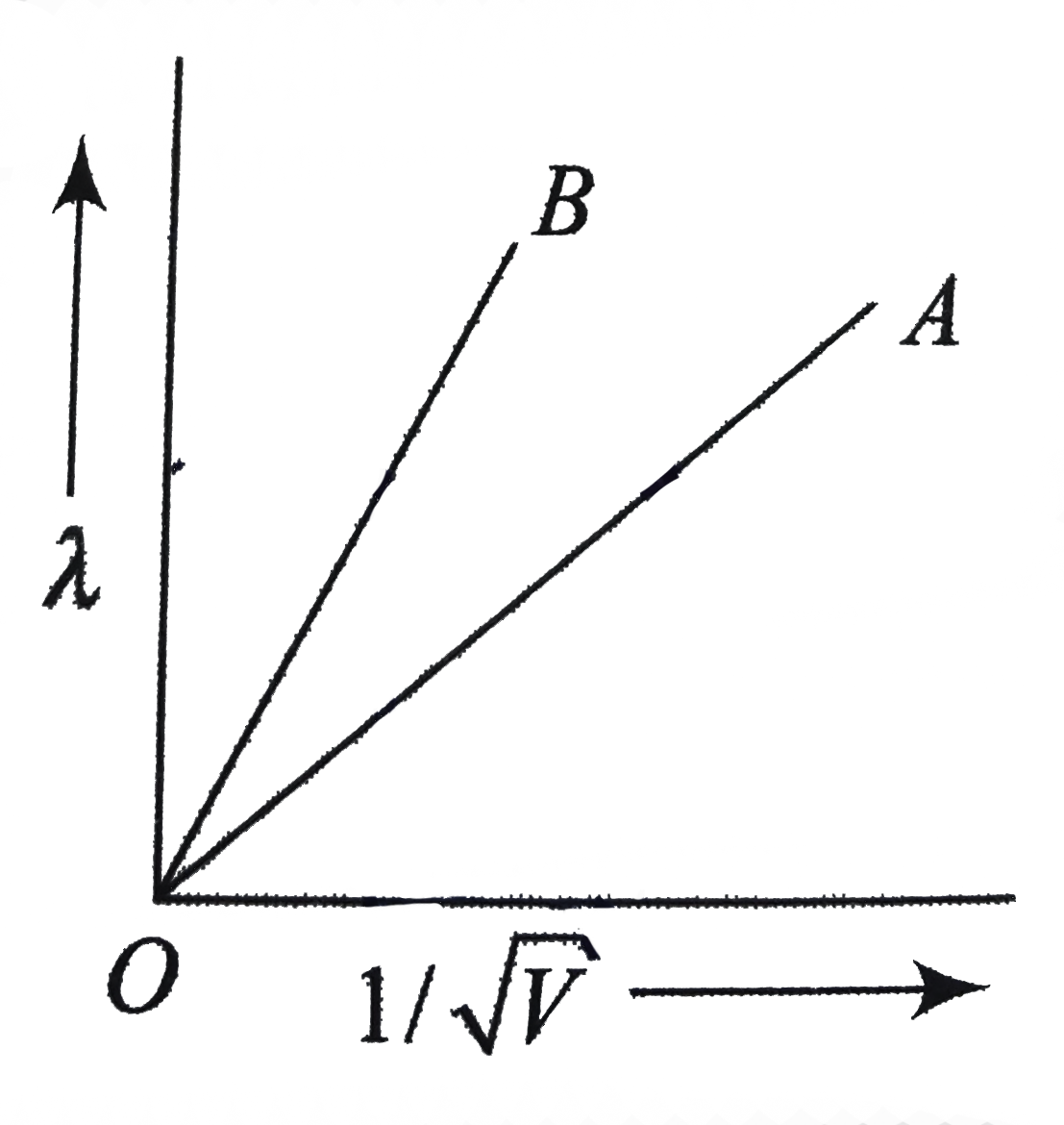
The two lines A and B in fig. show the photo electron of de Broglie wavelength `(lamda)` as a function of `(1)/(sqrtV) `(V is the accelerating potential) for two particles having the same charge. Which of the two represents the particle of heavier mass?

Text Solution

Verified by Experts

`:. lambda=(h)/(sqrt(2meV))rArrlambda=(h)/(sqrt(m.)sqrt(2e)).(1)/(sqrt(V))`
`because` Slope of `B gt` Slope of `A`
`(1)/(sqrt(m_(B))) gt (1)/(sqrt(m_(A)))rArr sqrt(m_(B)) lt sqrt(m_(A))`
`:. m_(B) lt m_(A)`
Therefore, line `B` represents a particle of smaller mass.
Promotional Banner

Topper's Solved these Questions

  • ATOMIC PHYSICS

    RESONANCE|Exercise Advanved level problems|17 Videos
  • ATOMIC PHYSICS

    RESONANCE|Exercise Exercise-2 Part-III : Comprehension|12 Videos
  • ALTERNATING CURRENT

    RESONANCE|Exercise HIGH LEVEL PROBLEMS|11 Videos
  • CAPACITANCE

    RESONANCE|Exercise High Level Problems|16 Videos

Similar Questions

Explore conceptually related problems

The two lines A and B in fig. shoe the phot of de Broglie wavelength (lamda) as a function of (1)/(sqrtV) (V is the accelerating potential) for teo particles having the same charge. Which of the two represents the particle of heavier mass?

Two lines, A and B, in the plot given below show the variation of de-Broglie wavelength, lambda versus 1//sqrt(V) , where V is the accelerating potential difference, for two particles carrying the same charge. Which one of two represents a particle of smaller mass?

Plot a graph showing variation of de-broglie wavelength lambda versus 1//sqrtV , where V is accelerating potential for two particle A and P carrying same charge but of masses m_1 and m_2(m_1gtm_2) . Which one of the two represents a particle of smaller mass and why?

de Broglie wavelengths of two particles A and B are plotted against (1/sqrtV) , where V is the potential on the particles. Which of the following relation is correct about the mass of the particles ?

The de Broglie wavelength lamda of an electron accelerated through a potential V in volts is

Draw a graph showing the variation of de Broglie wavelength of a particle of charge q and mass m with accelerating potential. Proton and deuteron have the same de Broglie wavelengths. Explain which has more kinetic energy.

RESONANCE-ATOMIC PHYSICS-Exercise -3 part -I JEE (Advanced)
  1. Ultraviolet radiations of different frequencies v(1)are incident on tw...

    Text Solution

    |

  2. Draw a schematic diagram of the experiment used by. Davisson and Germe...

    Text Solution

    |

  3. The two lines A and B in fig. show the photo electron of de Broglie wa...

    Text Solution

    |

  4. Fig. shows the variation of stopping potential V0 with the frequency v...

    Text Solution

    |

  5. The ground state energy of hydrogen atom is -13.6 e V. a. What is th...

    Text Solution

    |

  6. The stopping potential in an experiment on a photo electric effect is ...

    Text Solution

    |

  7. Define ionisation energy. What is the value for a hydrogen atom?

    Text Solution

    |

  8. Write Einstein's photoelectric equation. State clearly any two salient...

    Text Solution

    |

  9. Deduce an expression for the magnetic dipole moment of an electron orb...

    Text Solution

    |

  10. Define the term 'stopping potential' in relation to photoelectric effe...

    Text Solution

    |

  11. (a) Using de Broglie's hypothesis, explain with the help of a suitable...

    Text Solution

    |

  12. A proton and an electron have same velocity. Which one has greater de-...

    Text Solution

    |

  13. Using Einstein's photoelectric equation show how the cut -off voltage ...

    Text Solution

    |

  14. A nuclear fusion reaction is given by .(1)H^(2)+.(1)H^(2)rarr.(1)He^...

    Text Solution

    |

  15. Using Bohr's postulates, obtain the expression for the total energy of...

    Text Solution

    |

  16. Define the following in photoelectric effect phenomenon (a) (i) work...

    Text Solution

    |

  17. Calculate de Broglie wavelength associated with an electron, accelerat...

    Text Solution

    |

  18. Write Bohr's any two postulates for hydrogen atom.

    Text Solution

    |

  19. The graph shows variation of stopping potential V(0) versus frequency ...

    Text Solution

    |

  20. Why is it found experimentally difficult to detect neutrinos in nuclea...

    Text Solution

    |
