Home
Class 12
PHYSICS
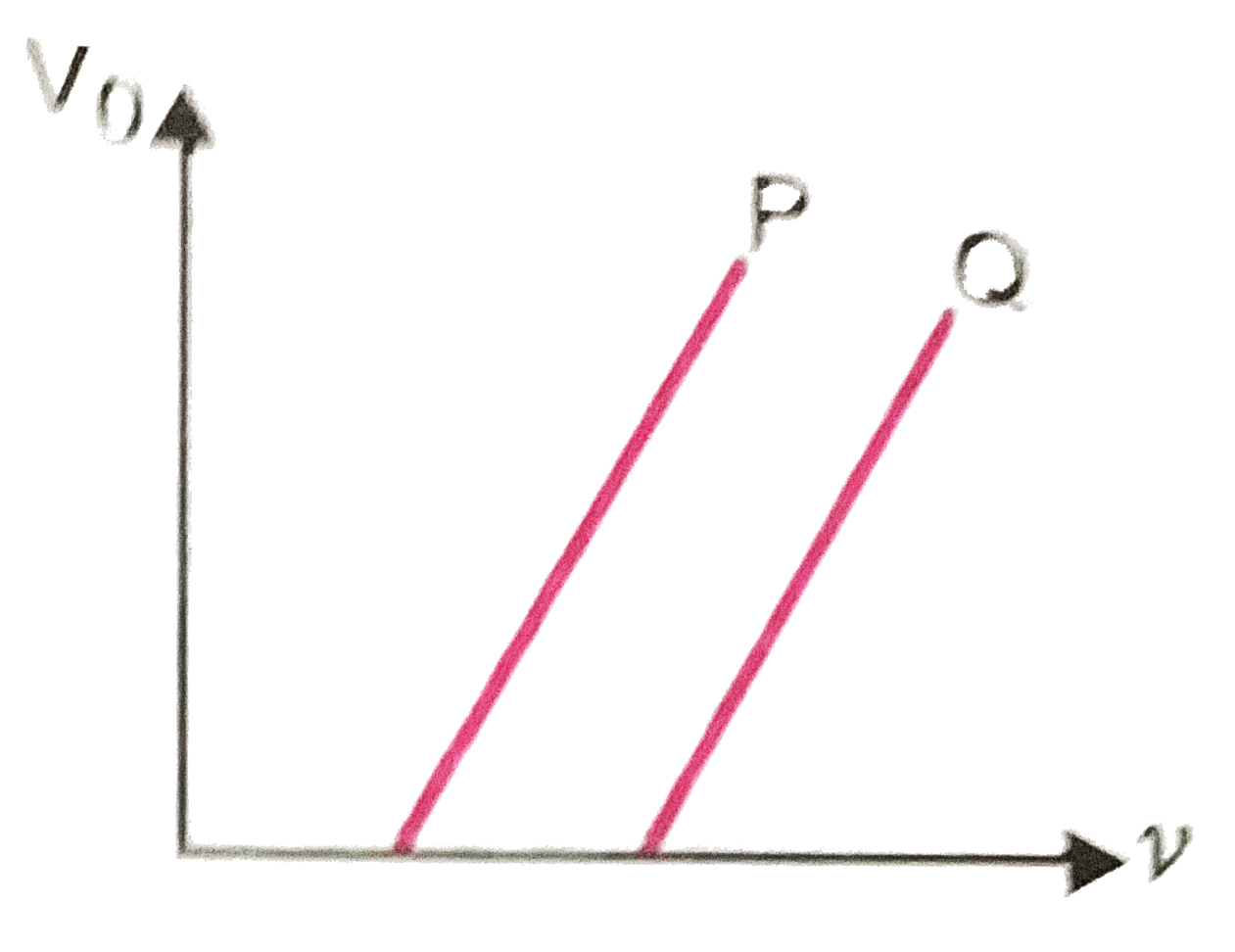
Fig. shows the variation of stopping pot...

Fig. shows the variation of stopping potential `V_0` with the frequency v of the incident radiation for two photosensitive metal P and Q:
(i) Explain which metal has smaller threshold wavelength

(ii) Explain, giving reason, which metal emits photoelectrons having smaller kinetic energy, for the same wavelength of incident radiation.
(iii) If the distance between the light source and metal P is doubled, how will the stopping potential change.

Text Solution

Verified by Experts

`:. upsilon_(0) gt upsilon'_(0)`
`:. upsilon_(0)=(c )/(lambda_(0))rArr(c )/(lambda_(0)) gt lambda_(0) lt lambda'_(0)`
Therefore, metal `X` has larger threshold wavelength
(ii) Since `E= h upsilon_(0) rArr K.E.= E-hupsilon_(0)`
Therefore, metal `x` has larger Kinetic energy
(iii) `K.E= eV_(0)`
`:.` Kinetic energy of the emitted photoelectron is independent of the intensity of the incident light, hence `K.E`. fo the emitted phot-electrons remains unchanged if the intensity of the incident radiation is halved.
Promotional Banner

Topper's Solved these Questions

  • ATOMIC PHYSICS

    RESONANCE|Exercise Advanved level problems|17 Videos
  • ATOMIC PHYSICS

    RESONANCE|Exercise Exercise-2 Part-III : Comprehension|12 Videos
  • ALTERNATING CURRENT

    RESONANCE|Exercise HIGH LEVEL PROBLEMS|11 Videos
  • CAPACITANCE

    RESONANCE|Exercise High Level Problems|16 Videos

Similar Questions

Explore conceptually related problems

The following graph shows the variation of stopping potential V_0 with the frequency v of the incident radiation for two photosensitive metals X and Y. (i) Which metal has larger threshold wavelength ? Give reason. (ii) Explain giving reason , which metal gives out electrons , having larger kinetic energy , for same wavelength of the incident radiation. (iii) If the distance between the light source and metal X is halved , how will the kinetic energy of electrons emitted from it change ? Given reason.

The figure shows the variation of stopping potential V_(Q) with the frequency v of the incident radiations for two photosensitive metals P and Which metal has smaller threshold wavelength ? Justify your answer.

The graph shows variation of stopping potential V_(0) versus frequency of incident radiation v for two photosensitive metals A and B . Which of two metals has higher threshold frequency and why?

fig. shows variation of stopping potential (V_0) with frequency (v) for two photosenstive matrials M_1 and M_2 . (i) why is the slope same for both lines? (ii) For which material will the emitted electrons have greater kinetic energy for the incident radiations of the same frequency? Justify your answer.

The stopping potential (v_0) varies linearly with the frequency (v)of the incident radiation for a given photosensitive surface with the slope remaining the same for different surface . Given reason.

The stopping potential for acertain photosensitive metal is Vq when the frequency of incident radiation is V_(0) When the frequency of the incident radiations is doubled, what will be the stopping potential ?

The graph between the stopping potential V_(0) and frequency v for two different metal plates P and Q are shown in the figure. Which of the metals has greater threshold wavelength and work function.

RESONANCE-ATOMIC PHYSICS-Exercise -3 part -I JEE (Advanced)
  1. Draw a schematic diagram of the experiment used by. Davisson and Germe...

    Text Solution

    |

  2. The two lines A and B in fig. show the photo electron of de Broglie wa...

    Text Solution

    |

  3. Fig. shows the variation of stopping potential V0 with the frequency v...

    Text Solution

    |

  4. The ground state energy of hydrogen atom is -13.6 e V. a. What is th...

    Text Solution

    |

  5. The stopping potential in an experiment on a photo electric effect is ...

    Text Solution

    |

  6. Define ionisation energy. What is the value for a hydrogen atom?

    Text Solution

    |

  7. Write Einstein's photoelectric equation. State clearly any two salient...

    Text Solution

    |

  8. Deduce an expression for the magnetic dipole moment of an electron orb...

    Text Solution

    |

  9. Define the term 'stopping potential' in relation to photoelectric effe...

    Text Solution

    |

  10. (a) Using de Broglie's hypothesis, explain with the help of a suitable...

    Text Solution

    |

  11. A proton and an electron have same velocity. Which one has greater de-...

    Text Solution

    |

  12. Using Einstein's photoelectric equation show how the cut -off voltage ...

    Text Solution

    |

  13. A nuclear fusion reaction is given by .(1)H^(2)+.(1)H^(2)rarr.(1)He^...

    Text Solution

    |

  14. Using Bohr's postulates, obtain the expression for the total energy of...

    Text Solution

    |

  15. Define the following in photoelectric effect phenomenon (a) (i) work...

    Text Solution

    |

  16. Calculate de Broglie wavelength associated with an electron, accelerat...

    Text Solution

    |

  17. Write Bohr's any two postulates for hydrogen atom.

    Text Solution

    |

  18. The graph shows variation of stopping potential V(0) versus frequency ...

    Text Solution

    |

  19. Why is it found experimentally difficult to detect neutrinos in nuclea...

    Text Solution

    |

  20. Using Rautherfold model of the atom, derive the expression for the tot...

    Text Solution

    |
