Home
Class 12
PHYSICS
Using Einstein's photoelectric equation ...

Using Einstein's photoelectric equation show how the cut -off voltage and threshold frequency for a given photosensitive material can be determined with the help of a suitable plot/graph.

Text Solution

Verified by Experts
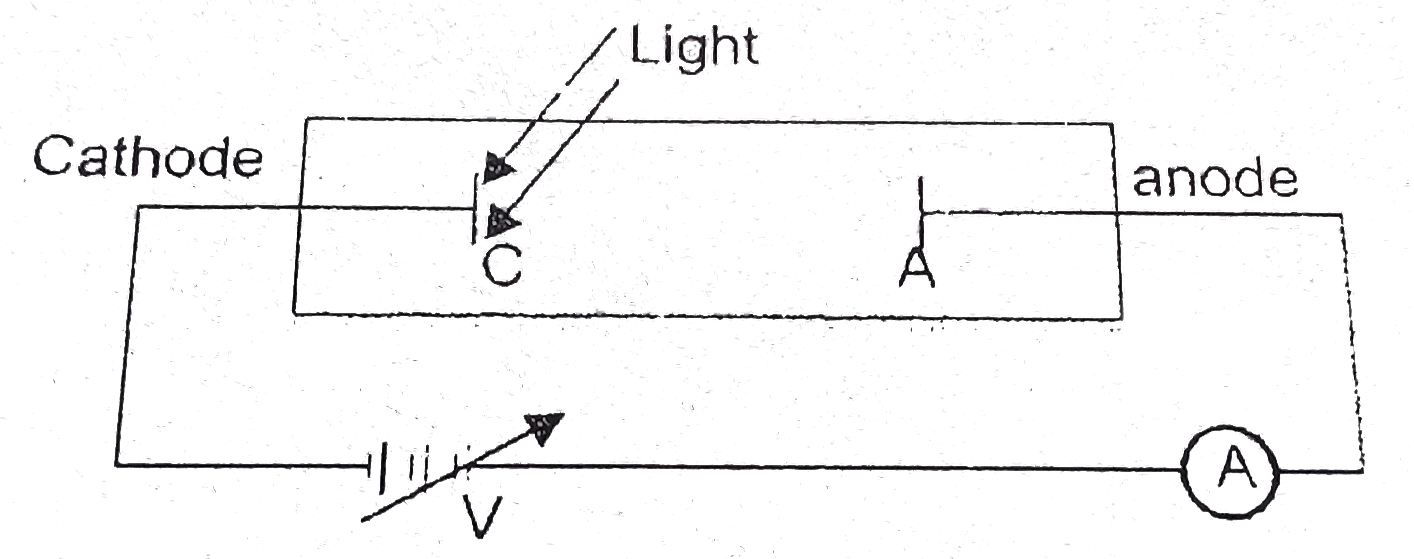
When light of sufficiently small wavelength is incident on a metal surface, electrons are ejected from the metal. This phenomenon is called the photoelectric effcect.

(i) The cathode is illminated with light of some fixed frequency `v` and fixed Intensity `I_(1)`. A small photoelectric current is observed due to few electron that reach anode just because they have sufficiently large velocity of emision. If we made the potential of the anode negative with respect to cathode then the eelctrons emitted by cathode then the electorns emiited by cathode are repelled. Some electrons even go back to the cathode so that the current decreases. At a certain value of this negative potential, the current is completely stopped. Then least value of this anode potential which just stops the photocurrent is called cut off potential or stopping potential.
(ii) For a given material, there is a certain minimum frequency that if the incident has a frequency below this threshold, no photoeelctirc emiision will take place, how so ever intense the radiation may be falling.
(iii) According to Einstein's photoelectric equation, maximum `K.E.` is given as
`K.E_("max") = (h c)/(lambda)-phi`
Where `lambda` is wavelength and `v` is corresponding frequency and `phi` is work function.
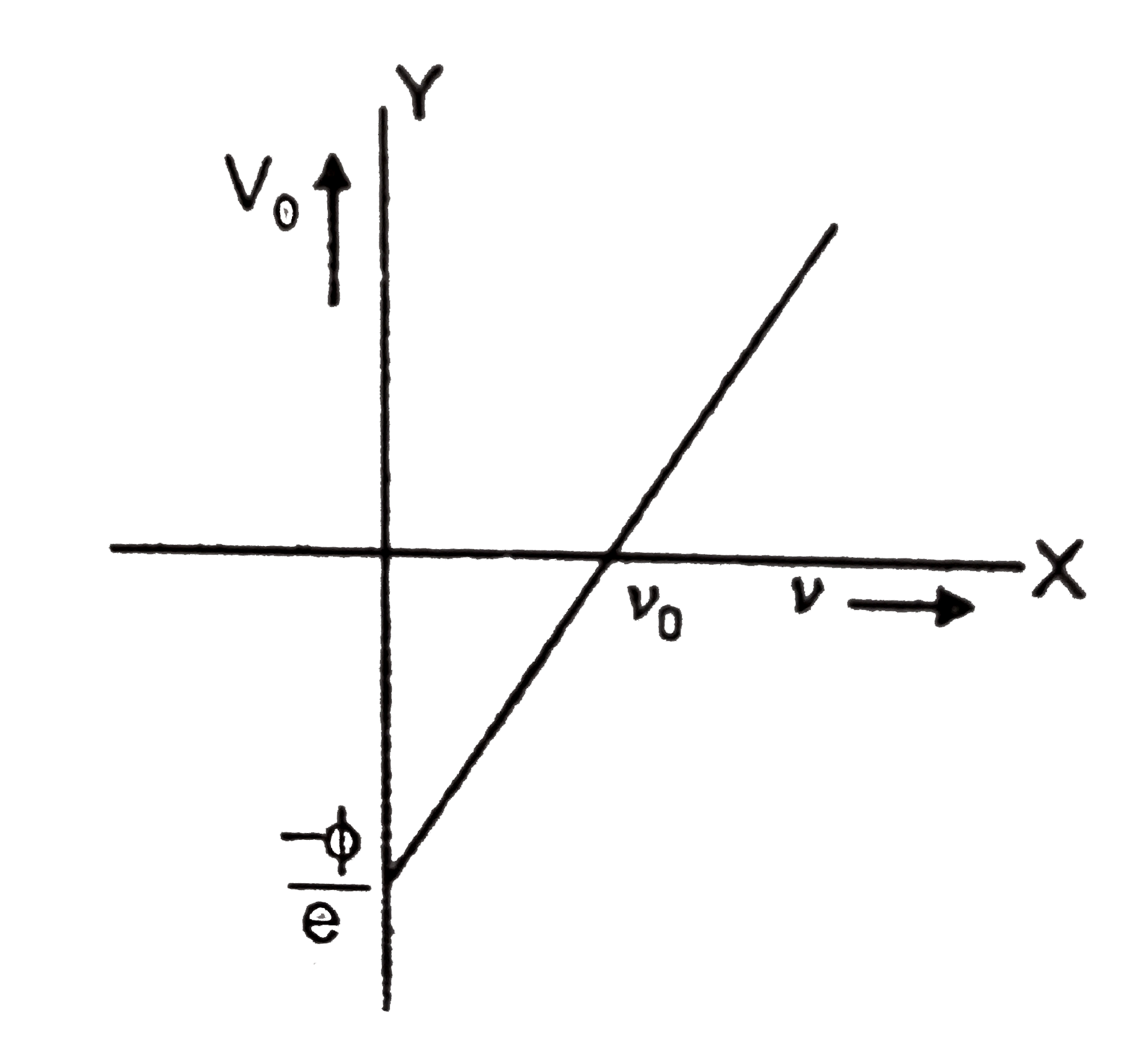
We expose a material to lights of various frequencies and thus photoelectric current is observed and cut off potential needed to reduce this curretn to Zero is noted. A graph is plotted and that is stright line. ltbgt At `v_(0)` the stopping potential is zero this means this frequency the incident light not able to eject electrons this is threshold frequency. Extended this line gives the cut off potential to make the phob current zero which is `(-phi)/(e )`
Promotional Banner

Topper's Solved these Questions

  • ATOMIC PHYSICS

    RESONANCE|Exercise Advanved level problems|17 Videos
  • ATOMIC PHYSICS

    RESONANCE|Exercise Exercise-2 Part-III : Comprehension|12 Videos
  • ALTERNATING CURRENT

    RESONANCE|Exercise HIGH LEVEL PROBLEMS|11 Videos
  • CAPACITANCE

    RESONANCE|Exercise High Level Problems|16 Videos

Similar Questions

Explore conceptually related problems

Using Einstein's photoelectric equation show how the cut -off voltage and threshold frequency for a given photosenstive material can be determined with the help of a suitable plot/graph.

For a photoelectric cell, the graph shown the variation of cut off voltage ( V_0 ) with frequency (v) of incident light is

For photoelectric effect in sodium, fig. shows the plot of cut-off voltage versus frequency of the incident radiation. Caclculate: (i) the threshold frequency (ii) the work function for sodium. (Use h=6.6xx10^(-34)Js )

What is photoelectric effect? Give any two practical applications of this effect. Write Einstein's photoelectric equation and use it to explain (i) independence of maximum energy of the emitted photoelectrons from intensity of incident light (ii) existence of a threshold frequency of the emitted photoelectrons from intensity of incident light.

The graph of Fig. shows the variation of photoelectric current (I) versus applied voltage (V) for the two different photosensitive materials for two different intensities of the incident radiation. Identify the pairs of curves that correspond to different materials but same intensity of incident radiation.

RESONANCE-ATOMIC PHYSICS-Exercise -3 part -I JEE (Advanced)
  1. Define ionisation energy. What is the value for a hydrogen atom?

    Text Solution

    |

  2. Write Einstein's photoelectric equation. State clearly any two salient...

    Text Solution

    |

  3. Deduce an expression for the magnetic dipole moment of an electron orb...

    Text Solution

    |

  4. Define the term 'stopping potential' in relation to photoelectric effe...

    Text Solution

    |

  5. (a) Using de Broglie's hypothesis, explain with the help of a suitable...

    Text Solution

    |

  6. A proton and an electron have same velocity. Which one has greater de-...

    Text Solution

    |

  7. Using Einstein's photoelectric equation show how the cut -off voltage ...

    Text Solution

    |

  8. A nuclear fusion reaction is given by .(1)H^(2)+.(1)H^(2)rarr.(1)He^...

    Text Solution

    |

  9. Using Bohr's postulates, obtain the expression for the total energy of...

    Text Solution

    |

  10. Define the following in photoelectric effect phenomenon (a) (i) work...

    Text Solution

    |

  11. Calculate de Broglie wavelength associated with an electron, accelerat...

    Text Solution

    |

  12. Write Bohr's any two postulates for hydrogen atom.

    Text Solution

    |

  13. The graph shows variation of stopping potential V(0) versus frequency ...

    Text Solution

    |

  14. Why is it found experimentally difficult to detect neutrinos in nuclea...

    Text Solution

    |

  15. Using Rautherfold model of the atom, derive the expression for the tot...

    Text Solution

    |

  16. An electron microscope uses electrons accelerated by a voltage of 50kV...

    Text Solution

    |

  17. A ball of mass 0.12 kg is moving with a speed 20 m//s. Calculate the d...

    Text Solution

    |

  18. The graph between the stopping potential V(0) and frequency v for two ...

    Text Solution

    |

  19. A monochromatic light source of frequency 6xx10^(14)Hz is emitting ene...

    Text Solution

    |

  20. The ground state energy of hydrogen atom is-13.6 eV. What are the kine...

    Text Solution

    |