Home
Class 12
PHYSICS
An object kept near a convex lens of foc...

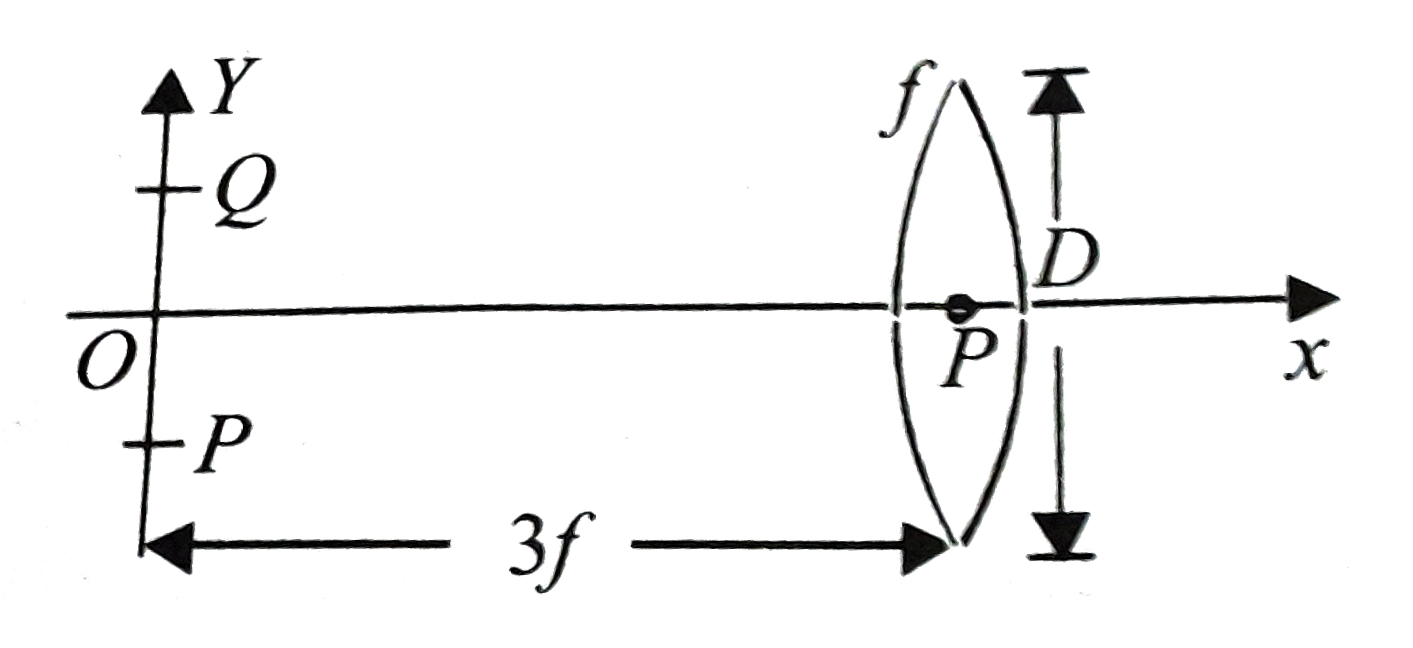
An object kept near a convex lens of focal length f, executes SHM between P and Q according to the equation `y=A sinomegat`, O being the mean position. Take x-axis as the principal axis of the lens and `A lt lt D` to answer the following questions:

Q. The amplitude of oscillation of the image is

A

Amplitude of oscillation of its image is `2A`

B

Amplitude of oscillations of its image is `(A)/(2)`

C

Phase difference between the object and its image is `pi`.

D

Phase difference between the object and its image is zero.

Text Solution

Verified by Experts

The correct Answer is:

B, C

`(1)/(v)-(1)/((-3f))=(1)/(f)`
`v=(3f)/(2)`
`(h_(i))/(h_(0))=(v)/((-3f))`
`h_(i)=-(h_(0))/(2)`
Amplitude `=(A)/(2)`
Phase differnece is `pi`.
Promotional Banner

Topper's Solved these Questions

  • TEST PAPERS

    RESONANCE|Exercise PT-01|30 Videos
  • TEST PAPERS

    RESONANCE|Exercise Pt-02|30 Videos
  • TEST PAPERS

    RESONANCE|Exercise PART - II PHYSICS|107 Videos
  • SIMPLE HARMONIC MOTION

    RESONANCE|Exercise Advanced Level Problems|13 Videos
  • TEST SERIES

    RESONANCE|Exercise PHYSICS|127 Videos

Similar Questions

Explore conceptually related problems

An object kept near a convex lens of focal length f, executes SHM between P and Q according to the equation y=A sinomegat , O being the mean position. Take x-axis as the principal axis of the lens and A lt lt D to answer the following questions: Q. The velocity of the image when the object crosses the mean position and goes toward Q is

An object kept near a convex lens of focal length f, executes SHM between P and Q according to the equation y=A sinomegat , O being the mean position. Take x-axis as the principal axis of the lens and A lt lt D to answer the following questions: Q. The phase difference between the object and the image oscillations is

In YDSE set up (see fig.), the light sources executes SHM between P and Q according to the equation x = A sin omega t , S being the mean position. Assume d rarr 0 and A lt lt L . omega is small enough to neglect Doppler effect. If the sources were stationary at S, intenstiy at O would be I_(0) Read the paragraph carefully and answer the following questions. When the source comes toward the point Q,

In YDSE set up (see fig.), the light sources executes SHM between P and Q according to the equation x = A sin omega t , S being the mean position. Assume d rarr 0 and A lt lt L . omega is small enough to neglect Doppler effect. If the sources were stationary at S, intenstiy at O would be I_(0) Read the paragraph carefully and answer the following questions. The fractional change in intensity of the central maximum as function of time is

In YDSE set up (see fig.), the light sources executes SHM between P and Q according to the equation x = A sin omega t , S being the mean position. Assume d rarr 0 and A lt lt L . omega is small enough to neglect Doppler effect. If the sources were stationary at S, intenstiy at O would be I_(0) Read the paragraph carefully and answer the following questions. The fringe width beta can be expressed as

A thin linear object of size 1mm is kept along the principal axis of a convex lens of focal length 10cm. The object is at 15cm from the lens. The length of the image is:

A point object is placed on the optic axis of a convex lens of focal length f at a distance of 2f to the left of it. the diameter of the lens is 'd' . An eye is placed at a distance of 3f to the right of the lens and a distance h below the optic axis. The maximum value of h to see the image is

A 5 cm tall object is placed on the principal axis of convex lens of focal length 50 cm at a distance of 40 cm from it. Find the nature, position and size of the image.

A convex lens of focal length f and a plane mirror are y distance apart. An object O is kept on the principal axis of the lens at a distance x from the lens. The values of x and y for the final image of O to fall exactly (position and size) on the object O are :

RESONANCE-TEST PAPERS-Physics
  1. Consider one mole of an ideal gas whose volume changes with temeperatu...

    Text Solution

    |

  2. An ideal gas expands from V to 2V in 4 separate processes. Where proce...

    Text Solution

    |

  3. An object kept near a convex lens of focal length f, executes SHM betw...

    Text Solution

    |

  4. Monoatomic , diatomic and triatomic gases whose initial volume and pre...

    Text Solution

    |

  5. n moles of a monoatomic gas undergoes a cyclic process ABCDA as shown....

    Text Solution

    |

  6. Heat supplied to an ideal gas sample at constant Pressure :

    Text Solution

    |

  7. A gas is enclosed in a vessel at a constant temperature at a pressure ...

    Text Solution

    |

  8. A converging mirror forms real image of object AB on screen. Now a hol...

    Text Solution

    |

  9. When object O moves towards a fixed lens mirror combination, select co...

    Text Solution

    |

  10. Pressure versus temperature graph of an ideal gas of equal number of m...

    Text Solution

    |

  11. A ray of light is incident normally on one face of a prism as shown in...

    Text Solution

    |

  12. There are three optical media 1,2 and 3 with their refractive index mu...

    Text Solution

    |

  13. The concave and convex surface of a thin concavo-convex lens of refrac...

    Text Solution

    |

  14. A thermodynamics system is taken through the cyclic process abca as sh...

    Text Solution

    |

  15. In a thermodynamic process, pressure of a fixed mass of gas is changed...

    Text Solution

    |

  16. A point object is placed at a distance R from the convex surface AB of...

    Text Solution

    |

  17. A gas is enclosed in a vessel at a constant temperature and at a press...

    Text Solution

    |

  18. The relation between the internal energy (U) versus temeperature (T) f...

    Text Solution

    |

  19. N molecules, each of mass m of gas A and 2 N molecules each of mass 2m...

    Text Solution

    |

  20. Plane surface of a thin planoconvex lens reflects 50% of light, while ...

    Text Solution

    |
