Home
Class 12
MATHS
in the given figure y=x^(2)+bx+c is a qu...


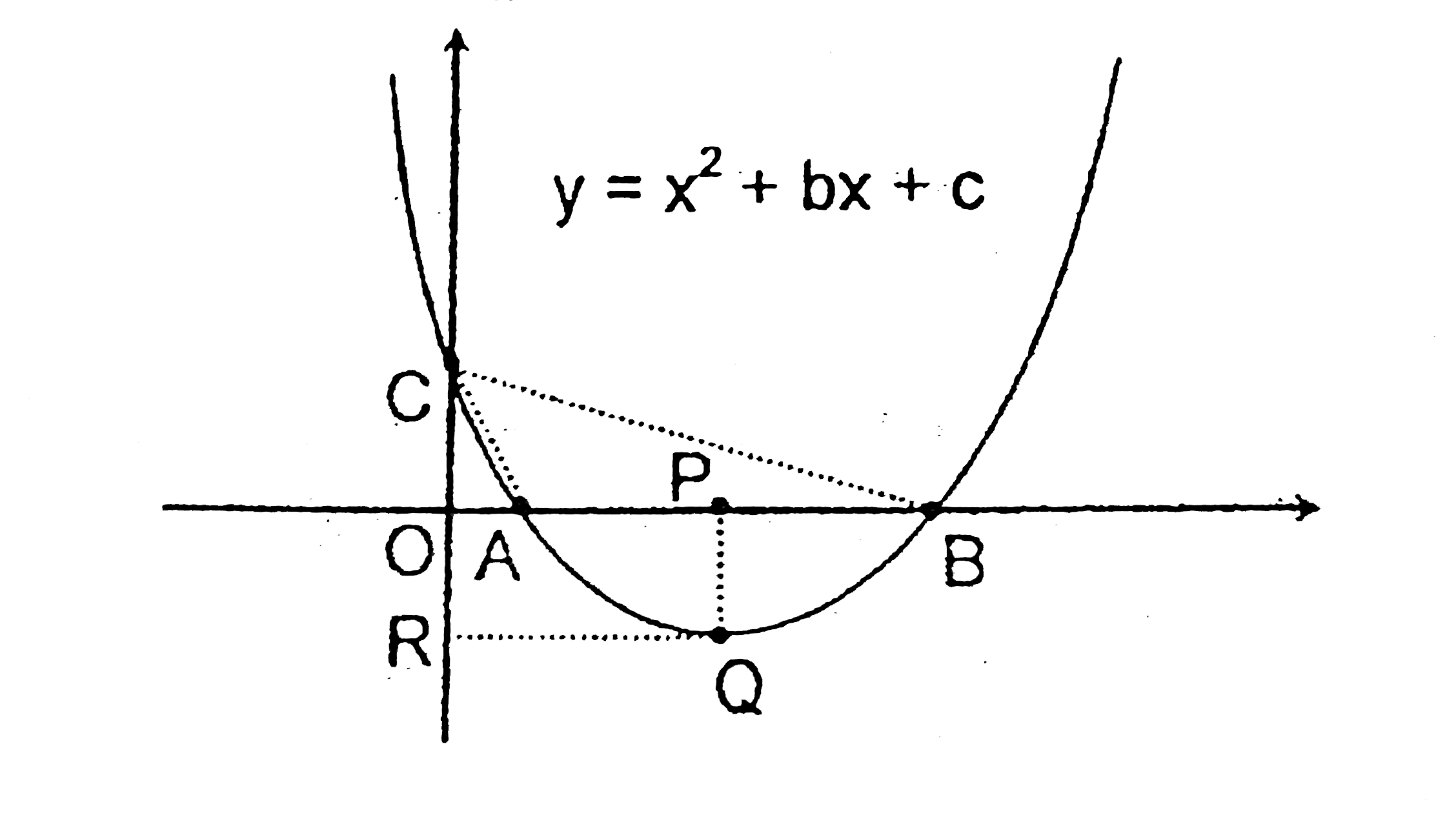
in the given figure `y=x^(2)+bx+c` is a quadratic polynomial which meets x-axis at A and B and y-axis at C Q is vertex of quadratic polynomial and foot of perpendicular from Q to x-axis and y-axis are P and R respectively. Then answer the following questions.
Q. if two circles passing through A and B touches y-axis at C and R respectively then

A

`b^(2)=2c`

B

`b^(2)=3c`

C

`b^(2)=4c`

D

`b^(2)=8c`

Text Solution

Verified by Experts

The correct Answer is:

C

`OA.OB=OC^(2)`
`alpha.beta=c^(2)` & `((b^(2)-4c)/(4))^(2)=alphabeta`
`(b^(2)-4)^(2)=16`
`c=c^(2)` `b^(2)-4=4`
`c=1` `b^(2)=8`
Promotional Banner

Topper's Solved these Questions

  • TEST PAPERS

    RESONANCE|Exercise MATHEMATICS|263 Videos
  • TEST PAPERS

    RESONANCE|Exercise PART - I MATHMATICS|84 Videos
  • TEST PAPER

    RESONANCE|Exercise CHEMISTRY|37 Videos
  • TEST SERIES

    RESONANCE|Exercise MATHEMATICS|131 Videos

Similar Questions

Explore conceptually related problems

The curve which represents a quadratic polynomial meets the x axis at (2,0) and (-2,0). Form the quadratic polynomial.

Find the length of the foot of perpendicular drawn from the point P(a, b, c) on x-axis, y-axis and z-axis respectively.

A quadratic polynomial maps from [-2, 3] onto [0, 3] and touches x-axis at x = 3, then the polynomial is

The line 2x+3y=12 meets the x-axis at A and y-axis at B. The line through (5,5) perpendicular to AB meets the x-axis and the line AB at C and E respectively. If O is the origin of coordinates, find the area of figure OCEB.

A line cuts the x-axis at A (7, 0) and the y-axis at B(0, - 5) A variable line PQ is drawn perpendicular to AB cutting the x-axis in P and the y-axis in Q. If AQ and BP intersect at R, find the locus of R

Line 3x + 2y =24 meets x-axis at A and y- axis at B and perpending bisector of AB meets the line passing through (0,1) and parallel to x-axis at C. Area of Delta ABC is

Among the lines passing through C (3,1), BA is farthest from the origin and cuts the x -axis and y -axis at A and B respectively. Then BC/CA is........

From the point (4, 3) a perpendicular is dropped on the x-axis well as on the y-axis. If the lengths of perpendiculars are p, q respectively, then which one of the following is correct ?

RESONANCE-TEST PAPERS-Math
  1. if alpha+(1)/(alpha) and 2-beta-(1)/(beta)(alpha,betage0) are the root...

    Text Solution

    |

  2. in the given figure y=x^(2)+bx+c is a quadratic polynomial which meets...

    Text Solution

    |

  3. in the given figure y=x^(2)+bx+c is a quadratic polynomial which meets...

    Text Solution

    |

  4. All possible roots of polynomial with integral coefficients can be ide...

    Text Solution

    |

  5. All possible roots of polynomial with integral coefficients can be ide...

    Text Solution

    |

  6. Suppose a series of n terms given by S(n)=t(1)+t(2)+t(3)+. . . .+t(n) ...

    Text Solution

    |

  7. Suppose a series of n terms given by S(n)=t(1)+t(2)+t(3)+. . ..+t(n) ...

    Text Solution

    |

  8. A homogeneous polynomial of the second degree in n variables i.e., the...

    Text Solution

    |

  9. A homogeneous polynomial of the second degree in n variables i.e., the...

    Text Solution

    |

  10. Cosider f(x)=1-e^((1)/(x)-1) Q. If D is the set of all real x such t...

    Text Solution

    |

  11. Cosider f(x)=1-e^((1)/(x)-1) Q. If S is the range of f(x), then S is

    Text Solution

    |

  12. If a f(x+1)+b f(1/(x+1))=x,x !=-1,a != b,then f(2) is equal to

    Text Solution

    |

  13. If x=(1)/(1^(2))+(1)/(3^(2))+(1)/(5^(2))+ . . . y=(1)/(1^(2))+(3)/(2...

    Text Solution

    |

  14. If A is square matrix of order 2xx2 such that A^(2)=I,B=[{:(1,sqrt(2))...

    Text Solution

    |

  15. lim(n to oo) x^(2)sin(log(e)sqrt(cos((pi)/(x)))) is less then

    Text Solution

    |

  16. f is a continous function in [a, b]; g is a continuous function in [b,...

    Text Solution

    |

  17. Let f(x)="max"(1+s in x ,1,1-cosx),x in [0,2pi],a n dg(x)=max{1,|x-1|}...

    Text Solution

    |

  18. -If a,b,c in R then prove that the roots of the equation 1/(x-a)+1/(x-...

    Text Solution

    |

  19. The function 'g' defined by g(x)= sin(sin^(-1)sqrt({x}))+cos(sin^(-1)s...

    Text Solution

    |

  20. Let A and B be two square matrices satisfying A+BA^(T)=I and B+AB^(T)=...

    Text Solution

    |
