Home
Class 12
PHYSICS
Figure shows two fixed positive point ch...


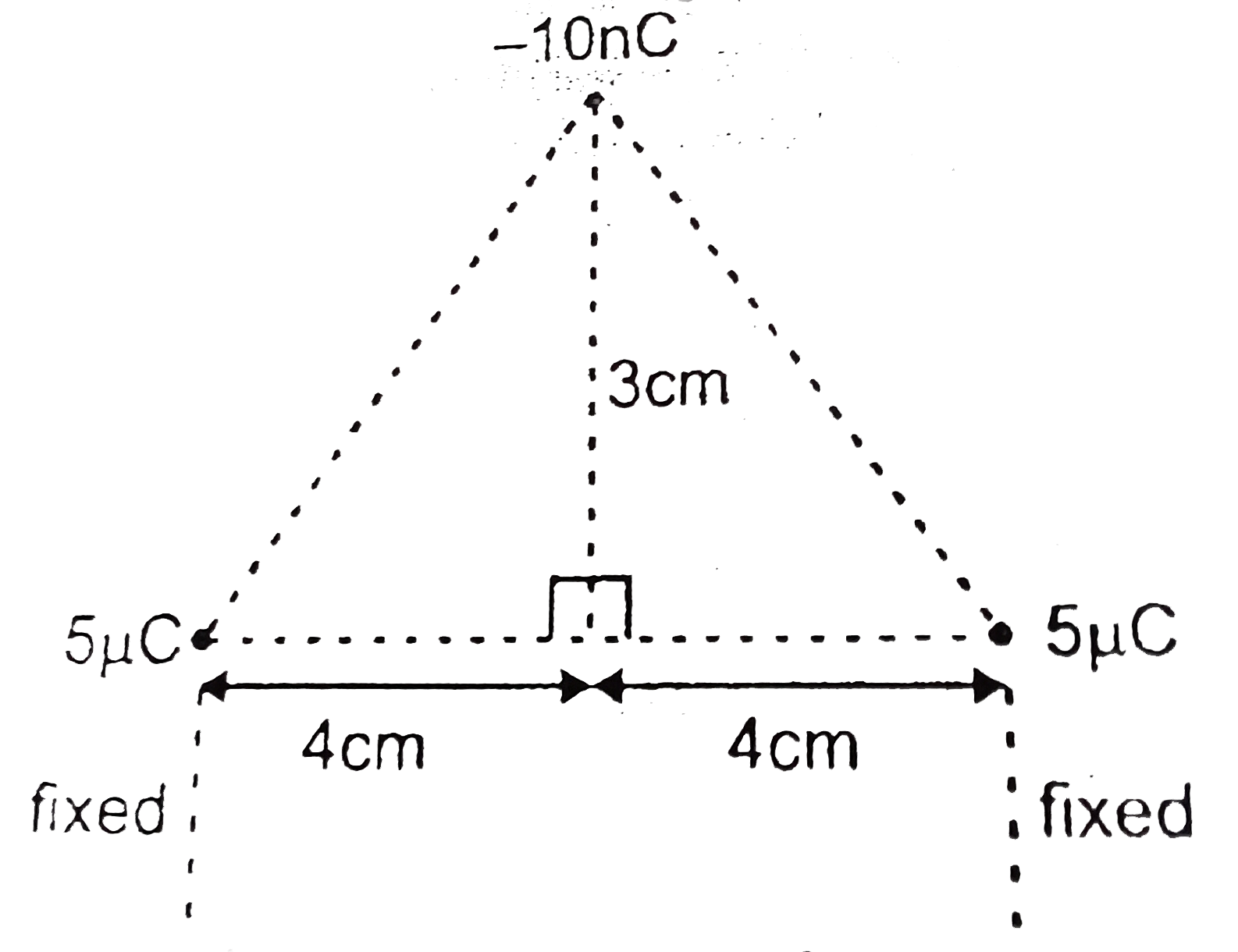
Figure shows two fixed positive point charges of magnitude `5muC` A negative point charge of `-10nC` and mass `1kg` is released as shown in figure (consider only electrostatic foces)

A

Initial acceleration fo `-10nC` charge is `0.216m//s^(2)`

B

initial acceleration of `-10nC` charge is `2.16m//s^(2)`

C

Kinetic energy of `-10nC` charge when it crosses the line joining two fixed charges is 4.5 mJ

D

Kinetic energy of `-10nC` charge when it crosses the line joining two fixed charges is 3 mJ.

Text Solution

Verified by Experts

The correct Answer is:

A, C

`a=(2Kq_(1)q_(2))/(r^(2))(cos53^(2))/(m)`
`=(2xx9xx10^(9)xx10xx10^(-9)xx5xx10^(-6))/((5xx10^(-2))xx1)(3)/(5)`
`=0.216m//s^(2)`
`K.E.=2xx9xx10^(9)xx5xx10^(-6)xx10xx10^(-9)[(1)/(4xx10^(-2))-(1)/(5xx10^(-2))]`
`=2xx9xx5xx10xx10^(9-6-9+2)[(5-4)/(20)]`
`=2xx9xx5xx(10)/(20)xx10^(-4)=4.5mJ`
Initial acceleration of `-10nC` charge is `0.216m//s^(2)`
Promotional Banner

Topper's Solved these Questions

  • TEST PAPERS

    RESONANCE|Exercise PT-01|30 Videos
  • TEST PAPERS

    RESONANCE|Exercise Pt-02|30 Videos
  • TEST PAPERS

    RESONANCE|Exercise PART - II PHYSICS|107 Videos
  • SIMPLE HARMONIC MOTION

    RESONANCE|Exercise Advanced Level Problems|13 Videos
  • TEST SERIES

    RESONANCE|Exercise PHYSICS|127 Videos

Similar Questions

Explore conceptually related problems

In front of an earthed conductor a point charge +q is placed a shown in figure

Two charges are placed s shown in figure below. The potential at point P is

What is the potential energy of two equal negative point charges 2 muC each held 1m apart in air ?

The figure shows two equal, positive charges, each of magnitude 50 muC , fixed at points (3, 0) m and (–3, 0)m respectively. A charge –50muC , moving along negative y–axis has a kinetic energy of 4J at the instant it crosses point (0,4)m. Determine the position of this charge where the direction of its motion reverses for the first time after crossing this point (neglect gravity).

Figure shows lines of force for a system of two point charges. The possible choice for the charge is

A particle of mass 400 mg and charged with 5 xx 10^(-9) C is moving directly towards a fixed positive point charge of magnitude 10^(-8) C . When it is at a distance of 10 cm from the fixed positive point charge it has a velocity of 50 cm/s. At what distance from the fixed point charge will the particle come momentarily to rest ? Is the acceleration constant during the motion ?

Two point charges Q are kept fixed on XY-plane at points A(0, d) and B(0, -d). Another point charge -q with mass m is held at a point, on the positive side of X-axis that is at the distance 2d from both the fixed point charges. What will be the magnitude of acceleration of the negative point charge (i) just after it is released from its location? (ii) at an instant it crosses the origin?

A point charge of 5C is placed at point P (as shown in figure). A unit positive charge is taken from A to B along the circular path shown, then the net work done by electrostatic force is : [O is the centre of the circular path] [Where k=9xx10^9 Nm^2//C^2 ]

Figure shows the electric field lines around three point charges A, B and C . Which of the following charges are positive?

A particle of mass 40 mg and carrying a charge 5 xx 10^(-9) C is moving directly towards a fixed positive point charge on magnitude 10^(-8) C . When it is at a distance of 10 cm from the fixed positive point charge it has a velocity of 50 cm s^(-1) at what distance from the fixed point charge will the particle come momentarily to rest ? Is the acceleration constant during motion?

RESONANCE-TEST PAPERS-Physics
  1. A block of mass m connected to a spring of stiffness k is placed on ho...

    Text Solution

    |

  2. Consider two point charges q(1)=q(2)=q(qgt0) placed in x-y plane at (0...

    Text Solution

    |

  3. Figure shows two fixed positive point charges of magnitude 5muC A nega...

    Text Solution

    |

  4. Figure shows a concave mirror of focal length 20 cm. A point object P ...

    Text Solution

    |

  5. As shown in figure process AB is isobaric, BC is adiabasic CD is isoch...

    Text Solution

    |

  6. Two concentric rings of radii R(1) = sqrt(6) m and R(2) = 4m are place...

    Text Solution

    |

  7. A thin plano-convex lens fits exactly into a thin plano-concave lens. ...

    Text Solution

    |

  8. Two particles A and B oscillates in SHM having same amplitude and freq...

    Text Solution

    |

  9. A uniform tube of volume V contains an ideal monatomic gas at a unifor...

    Text Solution

    |

  10. Consider a transparent homogenous hemisphere of refractive index n=2 i...

    Text Solution

    |

  11. An ideal undergoes a thermodynamic cycle as shown in figure. Which of ...

    Text Solution

    |

  12. A real point object is kept on the pricipal axis of a concave mirror (...

    Text Solution

    |

  13. Monatomic diatomic and triatomic gases whose initial volume and pressu...

    Text Solution

    |

  14. A chinese fire cracker when busted creates 100 dB sound at a distance ...

    Text Solution

    |

  15. A dipole of dipole moment vecp=phati is kep at the centre of a circle ...

    Text Solution

    |

  16. A quarter circular rig (x^(2)+y^(2)=R^(2),xgt0,ygt0,z=0) has Q charge ...

    Text Solution

    |

  17. A cylindrical wire of copper having area of cross section 2.5mm^(2) is...

    Text Solution

    |

  18. two sound sources S(1) and S(2) are kept symmetrically about the centr...

    Text Solution

    |

  19. A steel ball of 50mm radius is kept on a hole of concrete. The diamete...

    Text Solution

    |

  20. Which of the following is incorrect?

    Text Solution

    |
