

Home
Class 12
PHYSICS
Find the mass (in kg) of the hanging blo...


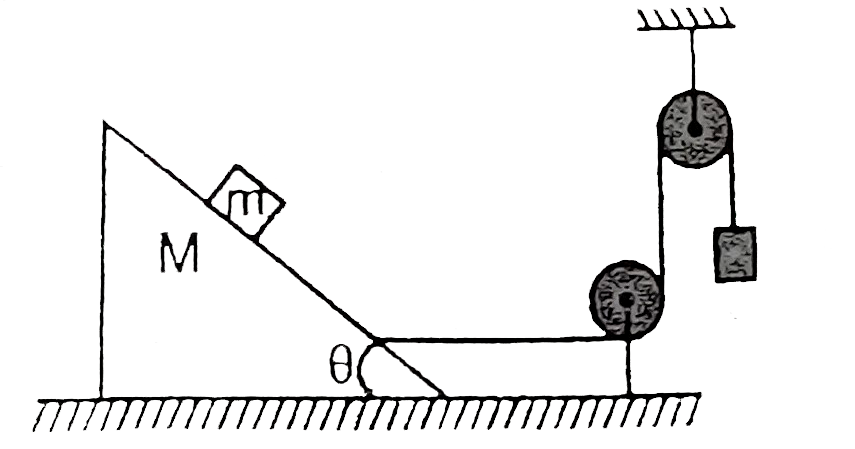
Find the mass (in kg) of the hanging block which will prevent the smaller block from slipping over the triangular block. All the surfaces are frictionless and the strings and the pulleys are light. Given `m=M=1kg,cottheta=2`,

Promotional Banner

Topper's Solved these Questions

  • TEST PAPERS

    RESONANCE|Exercise PT-01|30 Videos
  • TEST PAPERS

    RESONANCE|Exercise Pt-02|30 Videos
  • TEST PAPERS

    RESONANCE|Exercise PART - II PHYSICS|107 Videos
  • SIMPLE HARMONIC MOTION

    RESONANCE|Exercise Advanced Level Problems|13 Videos
  • TEST SERIES

    RESONANCE|Exercise PHYSICS|127 Videos

Similar Questions

Explore conceptually related problems

Find the mass M of the hanging block in figure which will prevent the smaller block from sliping over the triangular blcok. All the surfaces are frictions and the strings and the pulleys are light.

Find the mass of the hanging block in which will prevent the smaller block of mass m from slipping over the triangular block of mass M. All the surfaces are frictionless and the strings and the pulleys are light

In figure m_(1)= 1 kg and m_(2)= 4 kg Find the mass m of the hanging block which will provent the smaller block from slipping over the triangular block .All the surface are frictionless and the string and the pulleys are light

A hanging block of mass m' prevents the smaller block of mass m from slipping over a movable triangular block of mass M. All the surface are frictionless and the strings and the pulleys are light. Value of mass m' in terms of m, M and theta is

find the acceleration of the block of mass M in the situation shown in figure. All the surfaces are frictionless and the pulleys and the string are light.

Three blocks of masses m_1, m_2 and m_3 are connected as shown in the figure. All the surfaces are frictionless and the string and the pulleys are light. Find the acceleration of m_1

Two masses m_(1) kg and m_(2) kg passes over an atwoods machine. Find the ratio of masses m_(1) and m_(2) so that string passing over the pulley will just start slipping over its surface. The friction coefficient between the string and pulley surface is 0.2.

Find the acceleration of the 6 kg block in the figure. All the surfaces and pulleys are smooth. Also the strings are inextensible and light. [Take g = 10 m//s^(2) ] .

In fig. both pulleys and the string are massless and all the surfaces are frictionless. Given m_(1)=1kg, m_(2)= 2kg, m_(3)=3kg . Find the tension in the string

Consider the situation as shown in the figure. All the surface are smooth and the string and pulley are light. Find the mass of the hanging block which will prevent the smaller block form slipping over the triangular block.

RESONANCE-TEST PAPERS-Physics
  1. Consider a cell of emf E and internal resistance r. The current drawn ...

    Text Solution

    |

  2. A string is connected to block of mass m=1.2 kg placed over rough tabl...

    Text Solution

    |

  3. Find the mass (in kg) of the hanging block which will prevent the smal...

    Text Solution

    |

  4. A block is initially at rest on a horizontal frictionless surface when...

    Text Solution

    |

  5. A cart of mass 3 kg is pulled by a 5 kg object as shown in figure. Len...

    Text Solution

    |

  6. Each of the resistors shown in figure has a resistances of 10(Omega)an...

    Text Solution

    |

  7. let there be a non conducting infinite large sheet of charge of surfac...

    Text Solution

    |

  8. A particle experiences a force which is proportional to distance from ...

    Text Solution

    |

  9. P is the centre of mass of four point masses A,B, C and D which are ly...

    Text Solution

    |

  10. In the Young's double slit experiment, the interference pattern is fou...

    Text Solution

    |

  11. A Young's double slit experiment is performed with white light.

    Text Solution

    |

  12. A particle is acted upon by a force of constant magnitude which is alw...

    Text Solution

    |

  13. A heavy particle is tied to the end A of a string of length 1.6 m. its...

    Text Solution

    |

  14. An object follows a curved path. The following quantities may remain c...

    Text Solution

    |

  15. White light is used to illuminate the two slits in a Young's double ...

    Text Solution

    |

  16. A cylinder rests in a supporting carriage as shown. The side AB of car...

    Text Solution

    |

  17. A wedge is moving rightwards on which a block of mass 10 kg is placed ...

    Text Solution

    |

  18. A cylinder of mass M and radius R is resting on two corner edges A and...

    Text Solution

    |

  19. There are two massless springs A and B spring constant K(A) and K(B) r...

    Text Solution

    |

  20. Which fo the following statement is true about friction:

    Text Solution

    |