Home
Class 12
CHEMISTRY
Consider the following complex : [Cr(...

Consider the following complex `:`
`[Cr(NH_(3))_(4)(NO_(2))_(2)]:` inner orbital complex
The oxidation number, number of `d-` electrons, number of unpaired `d-` electrons on the irreleation and number of isomers are respectively.

A

`3,3,3,2`

B

`2,4,0,6`

C

`2,4,2,6`

D

`2,4,4,4`

Text Solution

Verified by Experts

The correct Answer is:
C

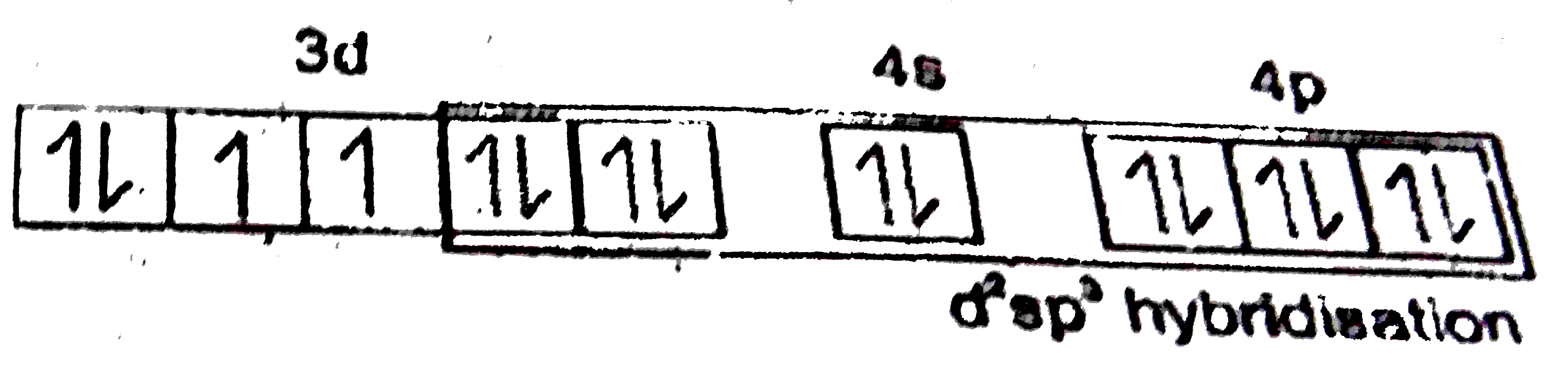
`._(24)Cr` is `+2` oxidation state with `[Ar]^(18)3d^(4)` configuration . It is inner orbital complex , so ,
`[overset(II)(Cr)(NH_(3))_(4)(NO_(2))_(2)]-`
Number of `d-` electrons is four and number of unpaired electrons is two.
It shows geometrical and linkage isomers.
`{:(NO_(2)-NO_(2),,cis-"trans"),(NO_(2)-ONO,,cis-"trans"),(ONO-ONO,,cis-"trans"):}`
`bar("Total number of isomers "=6)`
Promotional Banner

Topper's Solved these Questions

  • COORDINATION COMPOUNDS

    RESONANCE|Exercise Miscellneous Solved Problem (MSPS)|20 Videos
  • COORDINATION COMPOUNDS

    RESONANCE|Exercise Exercise Part-I: Subjective Question Section (A)|5 Videos
  • CHEMISTRY IN EVERYDAY LIFE

    RESONANCE|Exercise ORGANIC CHEMISTRY(Chemistry in every day life)|31 Videos
  • D & F BLOCK ELEMENTS

    RESONANCE|Exercise INORGANIC CHEMISTRY(d & f- Block Elments)|40 Videos

Similar Questions

Explore conceptually related problems

Consider the following complex [Co(NH_(3))_(5)CO_(3)]ClO_(4) The coordination number, oxidation number number of d-electrons and number of unpaired d-electrons on the metal are respectively

Consider the following complex [Co(NH_(3))_(5)CO_(3)]ClO_(4) . The sum of coordination number oxidation number, number of d-electrons and number of unpaired d- electrons on the metal will be

Consider the follwing complex: [Co(NH_(3))_(5)CO_(3)]BrO The coordiantion number, oxidation number, number of d-electrons and number of unpaired d-electrons of the metal are respectively:

Consider the following complex: [Co(NH_(3))_(5)CO_(3)]ClO_(4) the coordination number is X and oxidation number is Y, number of d-electrons is Z, and number of unpaired d-electrons of the metal is A are respectively. (X+Y)-(Z+A).

The number of unpaired electrons in the brown ring complex is

RESONANCE-COORDINATION COMPOUNDS-Additional Problem for Self Practice (APSP) Part-IV Practice Test -2 (Section-5) (Matching Lift type )
  1. Consider the following complex : [Cr(NH(3))(4)(NO(2))(2)]: inner o...

    Text Solution

    |

  2. Column-I and Column-II contains four entries each. Entries of Column-I...

    Text Solution

    |

