Home
Class 12
PHYSICS
A current flows through a rectangular co...

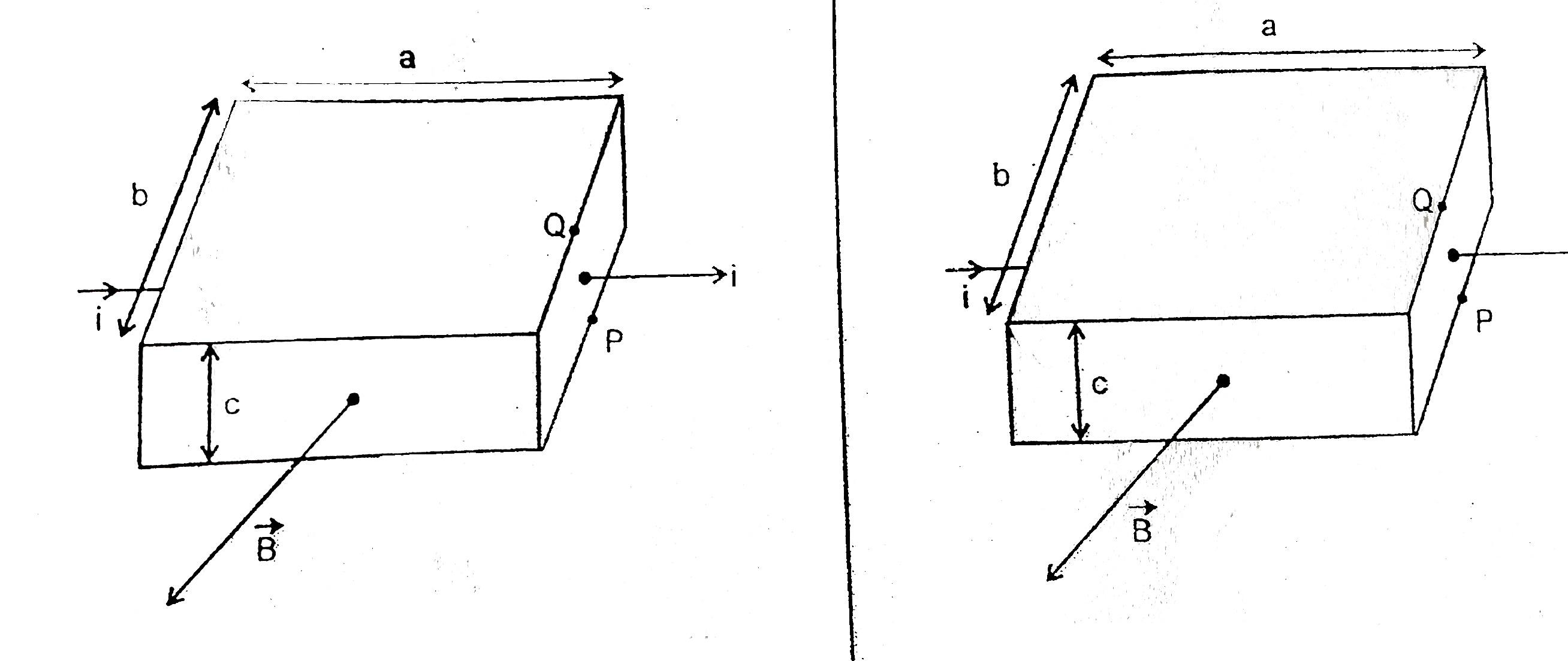
A current flows through a rectangular conductor in the presence of uniform magnetic field B pointing out of the page as shown. Then the potential difference `V_(P)-V_(Q)` is equal to (assume charge carriers in the conductor to be positively charged moving with a drift velocity of v )

A

`Bvb`

B

`-Bvb`

C

`Bve`

D

`-Bve`

Text Solution

Verified by Experts

The correct Answer is:

C

`|epsilon|=B lv` where l is the edge perpendicular to both B and `vecv` i.e.c.
`therefore |epsilon|=B v c`.
Now by right hand thumb rule magnetic force an a positive charge moving towards right is in down wrd direction Hence end P will be positive.
`therefore V_(P)-V_(!)` is positive
`rArr epsilon=+Bvl`.
Promotional Banner

Topper's Solved these Questions

Similar Questions

Explore conceptually related problems

A current of 2 A flows in a system of conductor as shown. The potential difference (V_(A) - V_(B))

A neutral metal bare moves at a constant velocity v to the right through a region of uniform magnetic field directed out the page, as shown. Therefore,

In the figure shown a T-shaped conductor moves with constant angular velocity omega in a plane perpendicular to uniform magnetic field B. The potential difference V_A-V_B is

Find the resistance of a conductor if the electric current flowing through it is 0.35 A when the potential difference across it is 1.4 V.

The loop shown moves with a velocity v in a uniform magnetic field of magnitude B , directed into the paper. The potential differene between point P and Q is e. Then

A proton is accelerated through a potential difference V, subujected to a uniform magnetic field acting normal to the velocity of the proton. If the potential difference is doubled, how will the radius of the circular path described by the proton in the magnetic field charge ?

What would be the resistance of a conductor if the current flow through it is 0.35 A when the potential difference across is 1.4 V?

When a potential difference (V) is applied across a conductor at temperature T, the drift velocity of electrons is proportional to

ALLEN-TEST PAPERS-PAPER 2
  1. An electron moving with a velocity v along the positive x-axis approac...

    Text Solution

    |

  2. If the ratio of time periods of circular motion of two charged particl...

    Text Solution

    |

  3. A current flows through a rectangular conductor in the presence of uni...

    Text Solution

    |

  4. An inducatane L and a resistance R are connected in series with a batt...

    Text Solution

    |

  5. If the readings V(1) and V(3) are 10. volt each, then reading of V(2) ...

    Text Solution

    |

  6. In the series LCR circuit as shown in figure, the heat developed in 80...

    Text Solution

    |

  7. An eye can distinguish between two points of an object if they are sep...

    Text Solution

    |

  8. A Galilean telescope of 10-fold magnification has the length of 45 cm...

    Text Solution

    |

  9. The dispersive powers of two materials are 0.30 & 0.28. They are used ...

    Text Solution

    |

  10. Assume standard notations used for dispersion and deviation is a prise...

    Text Solution

    |

  11. In the figure shown a converging lens and a diverging lens of focal le...

    Text Solution

    |

  12. From the figure shown establish a relation between mu(1),mu(2),mu(3).

    Text Solution

    |

  13. Two point objects are placed on principal axis of a thin converging le...

    Text Solution

    |

  14. A ray R(1) is incident on the plane surface of the glass slab (kept in...

    Text Solution

    |

  15. Assertion: A positively charged rod is held near a neutral conducting ...

    Text Solution

    |

  16. Assertion:A point charge q is placed near an arbitrary shaped solid co...

    Text Solution

    |

  17. Assetrion: If a proton and electron are placed in the same uniform ele...

    Text Solution

    |

  18. Assertion:- In a given situation of arrangement of charges, an extra c...

    Text Solution

    |

  19. STATEMENT 1: The current density vec J at any point in ohmic resistor ...

    Text Solution

    |

  20. Assertion:- To cells of unequal emf E(1) and E(2) having internal resi...

    Text Solution

    |
