Home
Class 12
PHYSICS
Two point objects are placed on principa...

Two point objects are placed on principal axis of a thin converging lens. One is 20cm from the lens and other is on the other side of lens at a distance of 40 cm from the lens. The images of both objects coincide. The magnitude of focal length of lens is :-

A

`(80)/(3)cm`

B

`(40)/(3)cm`

C

40cm

D

`(20)/(3)`

Text Solution

Verified by Experts

The correct Answer is:
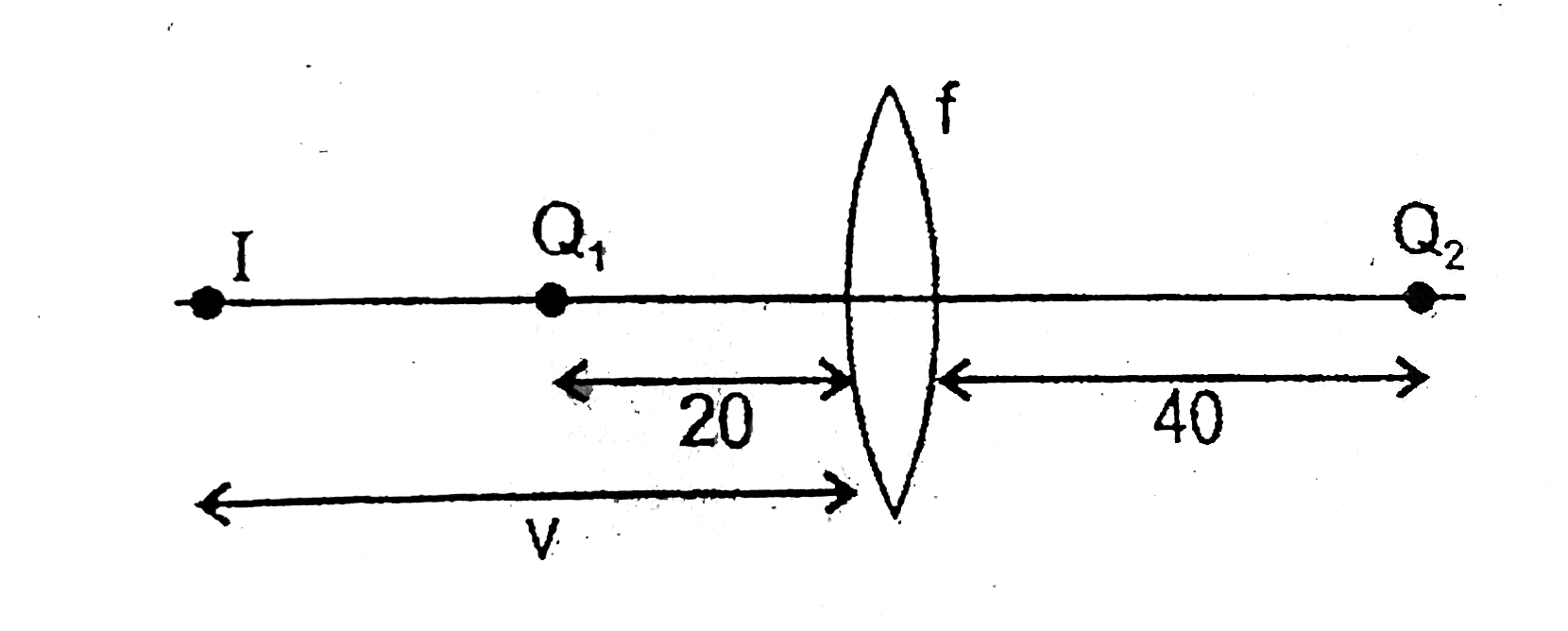
A, C

for object `O_(1)O_(1)`
`(1)/(v)+(1)/(20)=(1)/(f)` ......(1)
for object `O_(2)O_(2)`
`(1)/(v)-(1)/(40)=-(1)/(f)` .....(2)

from equation 1 and 2 we get
`f=80//3`
Promotional Banner

Topper's Solved these Questions

Similar Questions

Explore conceptually related problems

An object 50 cm tall is placed on the principal axis of a convex lens. Its 20 cm tall image is formed on the screen placed at a distance of 10 cm from the lens. Calculate the focal length of the lens.

An object 50 cm tall is placed on the principle axis of a convex lens. Its 20 cm tall image is formed on the screen placed at a distance of 10 cm from the lens. Calculate the focal length of the lens.

An illuminated object is placed on the principal axis of a converging lens so the a real image is formed on the other side of the lens. If the object is shifted a little,

An object is placed at a distance of 20 cm from a convex lens of focal length 10 cm . The image is formed on the other side of the lens at a distance

The focal length of convex lens is 20 cm. If an object of height 4 cm is placed at a distance of 30 cm from the lens, find: The height of the image

Find the distance of an object from a convex lens if image is two times magnified. Focal length of the lens is 10cm

A concave lens produces an image 20 cm from the lens of an object placed 30 cm from the lens. The focal length of the lens is:

An object of length 2.0 cm is placed perpedicular to the principal axis of a conve lens of focal length 12 cm. Find the size of the image of the object is at a distance of 8.0 cm from the lens.

ALLEN-TEST PAPERS-PAPER 2
  1. In the figure shown a converging lens and a diverging lens of focal le...

    Text Solution

    |

  2. From the figure shown establish a relation between mu(1),mu(2),mu(3).

    Text Solution

    |

  3. Two point objects are placed on principal axis of a thin converging le...

    Text Solution

    |

  4. A ray R(1) is incident on the plane surface of the glass slab (kept in...

    Text Solution

    |

  5. Assertion: A positively charged rod is held near a neutral conducting ...

    Text Solution

    |

  6. Assertion:A point charge q is placed near an arbitrary shaped solid co...

    Text Solution

    |

  7. Assetrion: If a proton and electron are placed in the same uniform ele...

    Text Solution

    |

  8. Assertion:- In a given situation of arrangement of charges, an extra c...

    Text Solution

    |

  9. STATEMENT 1: The current density vec J at any point in ohmic resistor ...

    Text Solution

    |

  10. Assertion:- To cells of unequal emf E(1) and E(2) having internal resi...

    Text Solution

    |

  11. Statement I : In the circuit in Fig. 7.46, both cells are ideal and of...

    Text Solution

    |

  12. Assertion:- Time constants of the cirucits shown in the figure are sam...

    Text Solution

    |

  13. Assertion:- If dipole (vecP(1)) is moved along the line normal to the ...

    Text Solution

    |

  14. Assertion:- Average power consumed in an accircuit is equal to average...

    Text Solution

    |

  15. Assertion:- Electric field produced by changing magnetic field is nonc...

    Text Solution

    |

  16. Assertion (A) : When tiny circular obstacle is placed in the path of l...

    Text Solution

    |

  17. Assertion:- In standard YDSE set up with visible light, the position o...

    Text Solution

    |

  18. Assertion:- In glass, red light travels faster than blue light. Reas...

    Text Solution

    |

  19. Assertion:- When a width of one of the slits of Young's double slit ex...

    Text Solution

    |

  20. Assertion:- The formula ((1)/(4)+(1)/(u)=(1)/(f)) connecting u and v f...

    Text Solution

    |

