Home
Class 12
CHEMISTRY
Account for the following : (i) NH(3) ...

Account for the following :
(i) `NH_(3)` is a stronger base than `PH_(3)`
(ii) Sulphur has a greater tendency for catention than oxygen.
(iii) Bond dissociation energy of `F_(2)` is less than that of `Cl_(2)`.
(OR)
Explain the following situations :
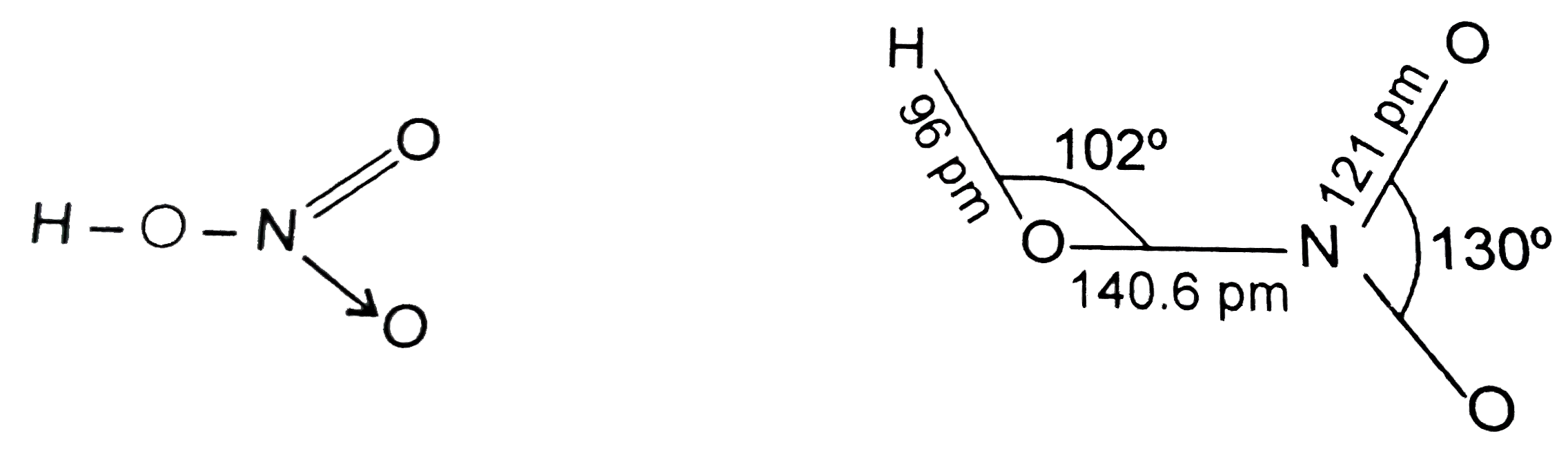
(i) In the structure of `HNO_(3)` moleucle, the `N-O` bond (121 pm) is shorter than the ` N-OH` bond (140 pm).
(ii) `SF_(4)` is easily hydrolysed whereas `SF_(6)` is not easily hydrolysed.
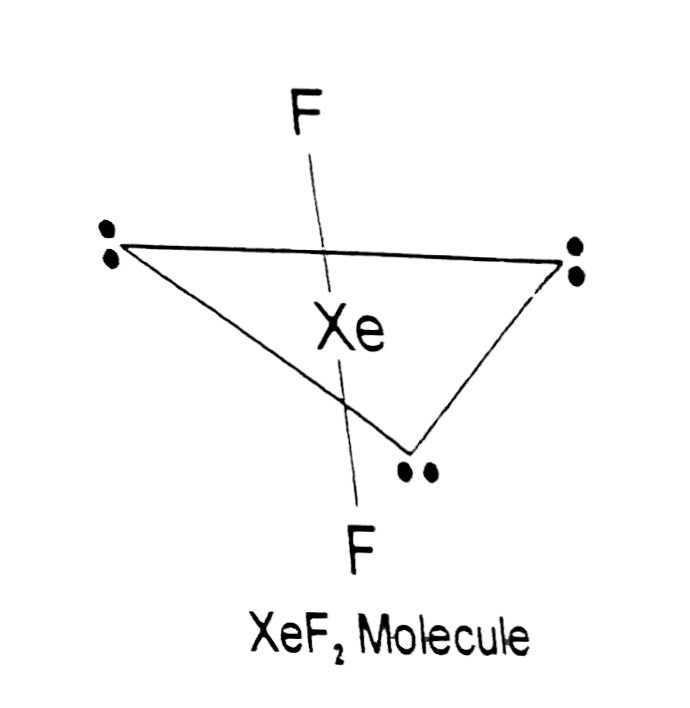
(iii) `XeF_(2)` has a straight linear structure and not a bent angular structure.

Text Solution

Verified by Experts
(i) On moving frm nitrogen to phosphorus, i.e., down the group, the atomic size increases. As the size of the central atom incresases, the lone pair of electrons occupy a larger volume. Consequently, the electron density, and hence, the basic strength decrease. Thus, `NH_(3)` is a stronger base than `PH_(3)`.
(ii) The tendency for actenation depends upon the bond energy. The bond energy of a sulphur molecule is more than that of an molecule. Thus, the sulphur -sulphur bond strength is higher, and as a result the tendency of catenation is also higher. Sulphur shows catenation up to eight atoms.
(iii) Bond dissociation energy of fluorine.Also, the value of enthalpy of hydration of flurione is much higher than that of chlorine.
(i) The structure of nitric acid is
OR

The N-O bond has a double charactor. On the other hand, N-OH bond is a single bond. Since a double bond is shorter than a single bond ,the N-O bond (121 pm) is shorter than the N-OH bond (140 pm).
`SF_(4)` is easily hydrolysed whereas `SF_(6)` is not easily hydroysed. `SF_(6)` is an inery, non-toxic gas. This is a due to the presence of sterically protected six fluorine atoms. As a reusult, reactions like hydrolysis are not allowed to take place.
(iii) According to VSEPR theory, `XeF_(2)` has trigonal biptramidal geometry with `sp^(3)d` hybridisation. It has bond pairs and three lone pairs of electrons. The bond pairs occupy axial positions and the lone pairs occupy the equatorial positions. This is the most favourable arrangment as far as stability is concered. The two flourine atoms if placed at the equatorial positions will face minimum repulsion, and this wolud consequently increase the stability. Hence, the structure is linear.
Promotional Banner

Topper's Solved these Questions

  • P BLOCK ELEMENTS

    RESONANCE|Exercise ALP PART 1 OBJECTIVE Assertion/ Reasonig|6 Videos
  • P BLOCK ELEMENTS

    RESONANCE|Exercise ALP PART 1 Comprehension # 1 OBJECTIVE|8 Videos
  • P BLOCK ELEMENTS

    RESONANCE|Exercise ALP PART CBSC- III SUBJECTIVE|1 Videos
  • NUCLEAR CHEMISTRY

    RESONANCE|Exercise STAGE-II|1 Videos
  • P-BLOCK ELEMENT (BORON AND CARBON FAMILY)

    RESONANCE|Exercise PART - III : OLYMPIAD PROBLEMS (PREVIOUS YEARS) STAGE - V (INTERNATIONAL CHEMISTRY OLYMPIAD (IChO)) Problem 3|8 Videos

Similar Questions

Explore conceptually related problems

Explain the following situations : (i) In the structure of HNO_(3) molecule , the N-O bond (121 pm) is shorter than N-OH bond (140pm). (ii) SF_(4) is easily hydrolysed whereas SF_(6) is not easily hydrolysed. (iii) XeF_(2) has a straight linear structure and not a bent angular structure.

Why is NH_(3) a stronger base than PH_(3) ?

In the structure of HNO_(3) , why is N-O bond (121 pm) shorter than N-OH bond (140 pm) ?

RESONANCE-P BLOCK ELEMENTS-ALP PART 1 OBJECTIVE
  1. Bi(V) and Sb(V) which may be a stronger oxidizing agent and why ?

    Text Solution

    |

  2. Complete the following chemical reaction equations : (i)P (4(s)) +Na...

    Text Solution

    |

  3. Account for the following : (i) NH(3) is a stronger base than PH(3) ...

    Text Solution

    |

  4. Though nitrogen exhibits +5oxidation state,it does not form pentahalid...

    Text Solution

    |

  5. (a) Why does NO2 dimerise ? (b) In what way can it be proved that PH...

    Text Solution

    |

  6. Draw the structures of white phosphours and red phosphours. Which one ...

    Text Solution

    |

  7. Complete the following chemical reaction equations : (i) l(2)+HNO(3...

    Text Solution

    |

  8. State reasons for each of the following : (i) "The" N-O "bond in" NO...

    Text Solution

    |

  9. (a) Explain the following : (i) NF(3) is an exothermic compound wher...

    Text Solution

    |

  10. How would you account for the following : (i) H(2)S is acidic thanH(...

    Text Solution

    |

  11. Why BiH3 is strongest reducing agent amongst group 15 hydrides ?

    Text Solution

    |

  12. Explain the following facts giving approciate reason in each case : ...

    Text Solution

    |

  13. (A) complete the following chemical equations : (i) Cu+HNO(3) (dilut...

    Text Solution

    |

  14. What happens when (i) PCl(5) is heated ? (ii) H(3)PO(3) is heated ...

    Text Solution

    |

  15. Nitrogen shows different oxidation states in the range:

    Text Solution

    |

  16. Dinitrogen gas is evolved when sodium nitrite is heated :

    Text Solution

    |

  17. Dinitrogen cannot be librated by :

    Text Solution

    |

  18. Dinitrogen can be purified from the impurities of NO and NH(3) by pass...

    Text Solution

    |

  19. Ammonia and red hot CuO react to produce :

    Text Solution

    |

  20. Which compounds are produced when ammonia reacts with excess of bromin...

    Text Solution

    |