

Home
Class 12
MATHS
If alpha is the root of the equation x-t...

If `alpha` is the root of the equation `x-tanx=3` where `alpha epsilon((pi)/2,(3pi)/2)`, then which of the following is/are correct? (where [.] denotes the greatest integer function and {.} fractional part function)

A

`lim_(xtoalpha^(+))[("max"(tanx, {x}))/(x-3)]=1`

B

`lim_(xtoalpha^(+))[("mi"(tanx, {x}))/(x-3)]=1`

C

`lim_(xtoalpha^(-))[("min"(tanx, {x}))/(x-3)]=0`

D

`lim_(xtoalpha^(-))[("max"(tanx,{x}))/(tannx)]=1`

Text Solution

Verified by Experts

The correct Answer is:
A, B, C, D

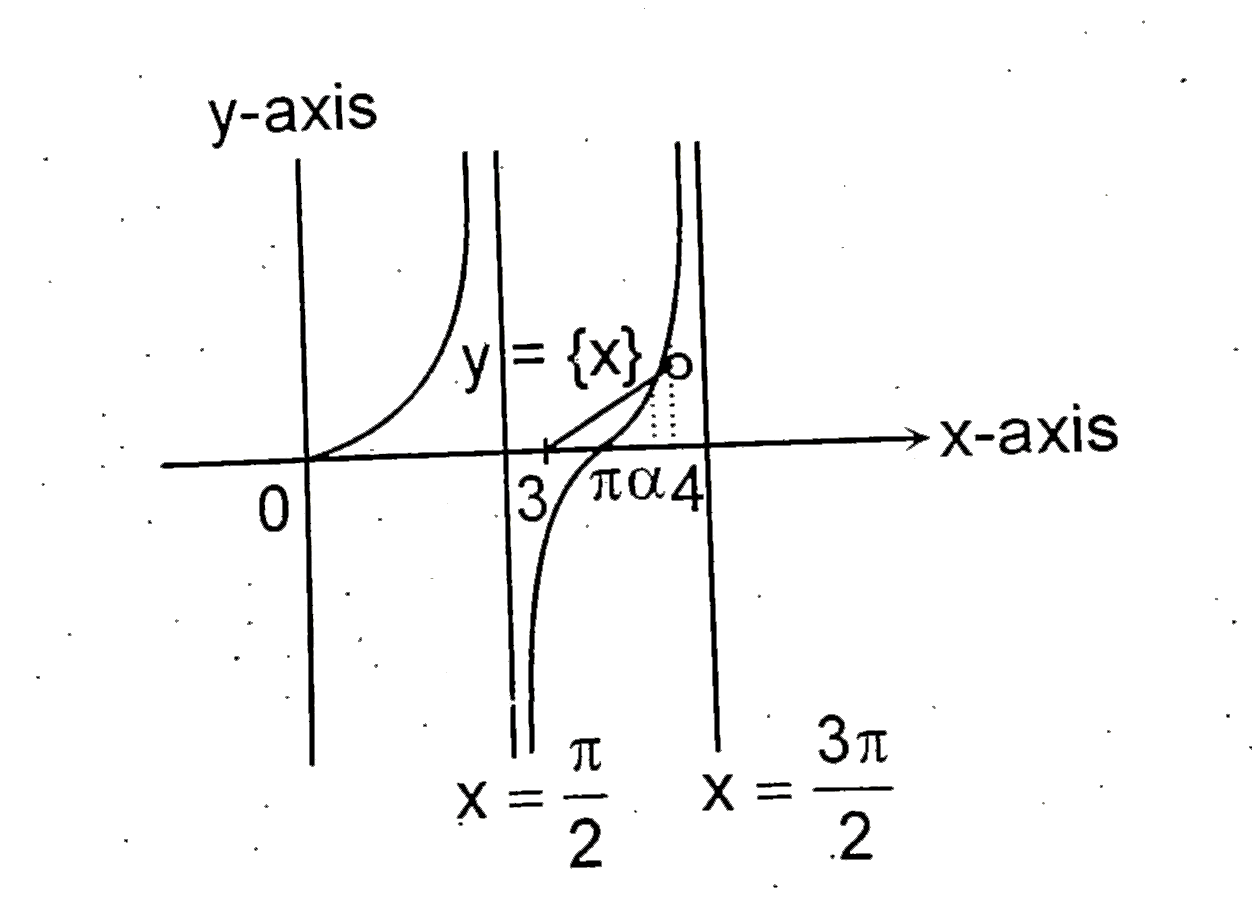
Shown in the figure
Promotional Banner

Topper's Solved these Questions

  • STRAIGHT LINE

    FIITJEE|Exercise NUMERICAL BASED|4 Videos
  • TIPS

    FIITJEE|Exercise NUERICAL DECIMAL BASED QUATIONS|20 Videos

Similar Questions

Explore conceptually related problems

If alpha is the root of the equation x-tan x=3 where alpha in((pi)/(2),(3 pi)/(2)): then which of the following is/are ecorrect? (where I.] denotes the greatest integer function and ( fractional part function)

Which of the following is/are unity? (where [.] and {.} denote the greatest integer and fractional part functions, respectively)

Solve the following inequalities (where [*] denotes greatest integer function and {*} represent fractional part function) [2x^(2)-x]<1

Solve : 4{x}= x+ [x] (where [*] denotes the greatest integer function and {*} denotes the fractional part function.

Solve the following equations x^(2)-3-{x}=0 where [x] denotes the greatest integer and {x} fractional part.

The sum of solutions of the equation 2[x] + x =6{x} is (where [.] denotes the greatest integer function and {.} denotes fractional part function)

Consider the function f(x) = {x+2} [cos 2x] (where [.] denotes greatest integer function & {.} denotes fractional part function.)

The function f(x)={x} sin (pi[x]) , where [.] denotes the greatest integer function and {.} is the fractional part function, is discontinuous at

Find x if 4x,5[x],6{x} are sides of a triangle ( triangle where [..] denotes the greatest integers function and {.} denotes fractional part function)

FIITJEE-TEST PAPERS-MATHEMATICS
  1. If x=int(0)^(oo)(dt)/((1+t^(2))(1+t^(2017))), then (3x)/(pi) is equal ...

    Text Solution

    |

  2. If log((3x+4))(4x^(2)+4x+1)+log((2x+1))(6x^(2)+11x+4)=4 then x is .

    Text Solution

    |

  3. If alpha is the root of the equation x-tanx=3 where alpha epsilon((pi)...

    Text Solution

    |

  4. Which of the following is/are incorrect?

    Text Solution

    |

  5. Let S(n)=sum(r=1)^(n)((r^(4)r^(3)n+r^(2)n^(2)+2n^(4))/(n^(5))) and T(n...

    Text Solution

    |

  6. Which of the following option(s) is/are incorrect?

    Text Solution

    |

  7. The most general solution of the differential equation (x+y(dy)/(dx))/...

    Text Solution

    |

  8. f(x)=2x^3-3x^2-x+3/2 then which of the following is/are incorrect? in...

    Text Solution

    |

  9. If inte^(xsec^(2)x-tanx)(x tanx -(sin2x)/2)dx=e^(f(x)).g(x)+c then whi...

    Text Solution

    |

  10. Column -1 : real valued function, Column -2: continuity of the functio...

    Text Solution

    |

  11. Column -1 : real valued function, Column -2: continuity of the functio...

    Text Solution

    |

  12. Column -1 : real valued function, Column -2: continuity of the functio...

    Text Solution

    |

  13. Column 1: real valued function, Column-2: domain of the function, Colu...

    Text Solution

    |

  14. Column 1: real valued function, Column-2: domain of the function, Colu...

    Text Solution

    |

  15. Column 1: real valued function, Column-2: domain of the function, Colu...

    Text Solution

    |

  16. If the value of A for which the equation cot^(3)A+cot^(2)A|cotA+x|+|c...

    Text Solution

    |

  17. Let f(x) be a differentiable and g(x) be a twice differentiable functi...

    Text Solution

    |

  18. Let f(x) be a non-constant thrice differential function defined on (-o...

    Text Solution

    |

  19. If AA h in R - {0}, two distinct tangents can be drawn from the points...

    Text Solution

    |

  20. Let lim(n->oo)sum(k=1)^n(lambdak^4+2k^3+k^2+k+1)/(3n^5+n^2+n+5k)=1/3 ...

    Text Solution

    |