Home
Class 12
PHYSICS
The potential difference across a 10H in...

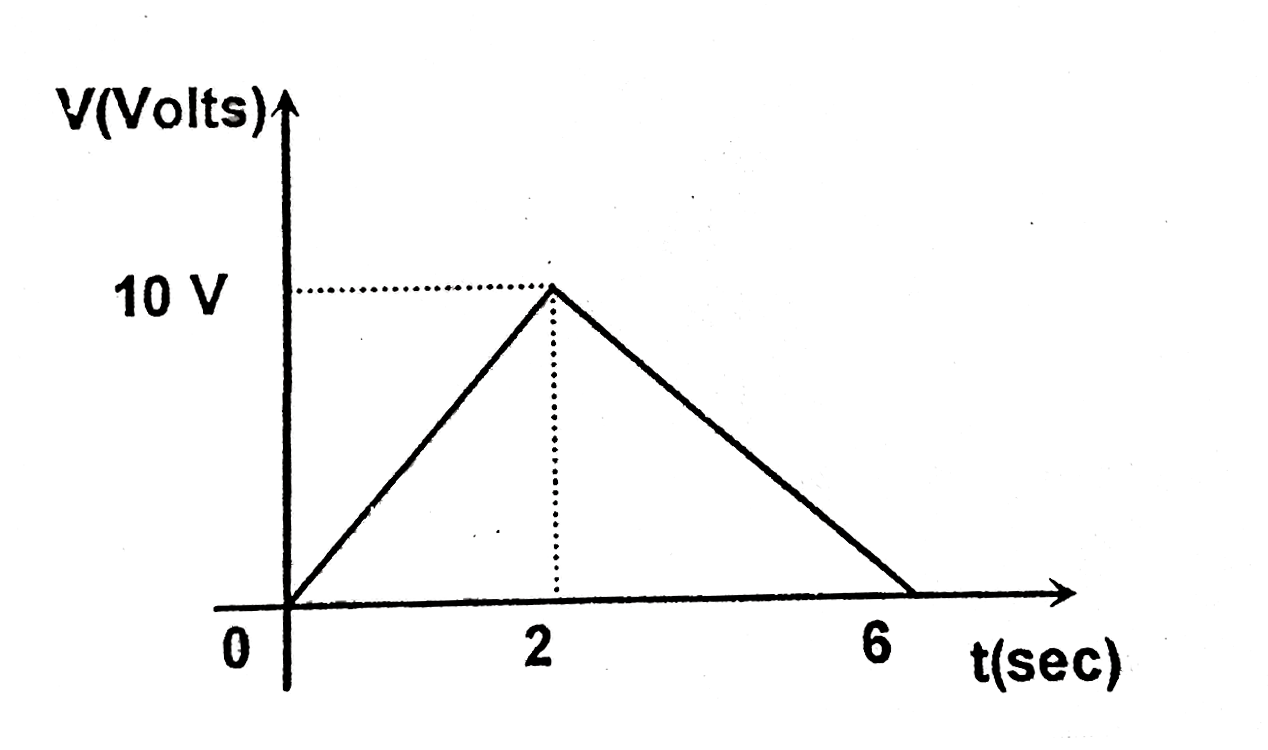
The potential difference across a `10H` inductor as a function of time is shown in the figure. At `t=0` current is zero. Then

A

The current in the inductor at `t=6` is 3 amp

B

The current in the inductor at `t=1` sec is `1//4` amp

C

The current in the inductor at `t=4` is `5//2` amp.

D

The variation of current versus time parabola.

Text Solution

Verified by Experts

The correct Answer is:

A, B, C, D

`V_(L)=L (di)/(dt)impliesLdi=V_(L)dt`
`L int di=int V_(L)d=1/2 . 6 . 10=30`
`L(i_(f)-i_(i))=30` Amp
`i_(f)=30/10=3` amp
for `tlt2`
`V_(L)=10/2t=5t`
`int_(0)^(i) Ldi=intV_(L) dt =5 int_(0)^(1) tdt`
`L(i-0)=5/2`
`impliesi=1//4`
For `tge2`
`V_(L)=(15-5/2t)`
`int_(1)^(i)Ldi=int_(2)^(4)(15-5/2t)dt`
`impliesi=5//2` amp
Promotional Banner

Topper's Solved these Questions

  • TEST PAPERS

    FIITJEE|Exercise PHYSICS|747 Videos
  • SIMPLE HARMONIC MOTION

    FIITJEE|Exercise Assignment Problems (Objective) (Level-II)|20 Videos
  • WORK, ENERGY AND POWER

    FIITJEE|Exercise COMPREHENSIONS ( Comprehension-II)|5 Videos

Similar Questions

Explore conceptually related problems

The potentiak difference across a 2H inductor as a function of time is shown in the figure. At time t=0, current is zero. Current versus time graph across the inductor will be

The potential difference across a 2 H inductor as a function of time is shown in figure. At time t=0 , current is zero Current t = 2 second is

The potential difference across a 2-H inductor as a function of time is shown in Fig. At time t = 0, current is zero. Current at t = 1 s is

The potential difference across a 2-H inductor as a function of time is shown in Fig. At time t = 0, current is zero. The variation of current versus time is

The potential difference across a 2-H inductor as a function of time is shown in Fig. At time t = 0 , current is zero. Area under V_(L) - t graph gives

The potential difference a 2 H inductor as a function of time is shown in figure. At time t = 0 , current is zero Current versus time graph across the inductor will be

The potential difference across a 150 mH inductor as a function of time is shown in figure. Assume that the initial value of the current in the inductor is zero. What is the current when t=2.0 ms ? and t = 4.0 ms ?

The potential difference across a 4 H inductor vary with time is as shown. The current is Zero at t = 0, Then the current at time t =2s

FIITJEE-TEST PAPERS-PHYSICS
  1. In the cylindrical region of radius R=2m, there exists a time varying ...

    Text Solution

    |

  2. A uniform conducting ring of mass m=2kg, radius r=2m and resistance 8O...

    Text Solution

    |

  3. The potential difference across a 10H inductor as a function of time i...

    Text Solution

    |

  4. Initially the switch 'S' is open for a ling time. Now the switch 'S' i...

    Text Solution

    |

  5. An electric kettle has two coils of different power. When one coil is ...

    Text Solution

    |

  6. A ideal gas whose adiabatic exponent equals gamma is expanded so that ...

    Text Solution

    |

  7. When steady state is reached, switch S is opened. Then the amount of h...

    Text Solution

    |

  8. A coil of inductance L=5H and resistance R=55Omega is connected in ser...

    Text Solution

    |

  9. A particle having charge 'q' and mass 'm' is projected with velocity (...

    Text Solution

    |

  10. In th circuit the key (K) is closed at t=0. Find the current in ampere...

    Text Solution

    |

  11. A non-uniform magnetic field vecB=B(0)(1+ y/d)(-hatk) is present in th...

    Text Solution

    |

  12. A thin non-conducting hemispherical shell contains a positive charge q...

    Text Solution

    |

  13. A point charge 'q' is placed on the line AH and just outside the cube ...

    Text Solution

    |

  14. Two identical pates P(1) and P(2) of cross sectional area A are separa...

    Text Solution

    |

  15. In the circuit shown epsilon(1) and epsilon(2) are two ideal sources o...

    Text Solution

    |

  16. A circuit contains an ideal battery, three resistors and two ideal amm...

    Text Solution

    |

  17. In an LCR series circuit, the reading of ideal voltmeters V(1) and V(2...

    Text Solution

    |

  18. Three capacitor C(1)=6F, C(2)=3F and C(3)=4F are separately charged wi...

    Text Solution

    |

  19. Two moles of an ideal mono-atomic gas undergoes a thermodynamic proces...

    Text Solution

    |

  20. Two moles of an ideal mono-atomic gas undergoes a thermodynamic proces...

    Text Solution

    |
