Home
Class 12
PHYSICS
A non-uniform magnetic field vecB=B(0)(1...

A non-uniform magnetic field `vecB=B_(0)(1+ y/d)(-hatk)` is present in the region of space between `y=0` and `y=d`. A particle of mass `m` and positive charge `q` has velocity `vecv=(3qB_(0)d)/mhati` at origin `O`. Find the angle made by velocity of the particle withe the positive `x`-axis when it leaves the field. (Ignore any interaction other than magnetic field)

A

`90^(@)`

B

`30^(@)`

C

`60^(@)`

D

`45^(@)`

Text Solution

Verified by Experts

The correct Answer is:
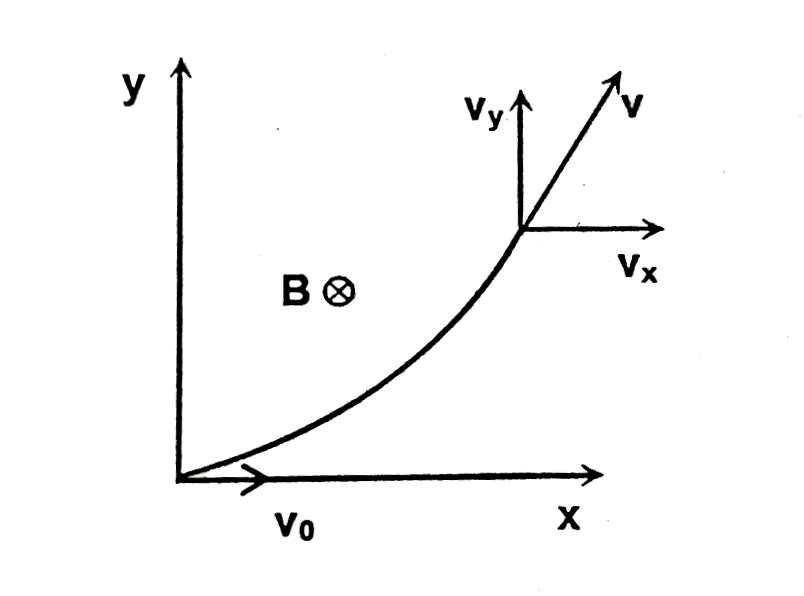
C

`vecF=q(v_(x)hati+v_(y)hatj)xxB_(0)(1+y/d)(-hatk)=F_(x)hati+F_(y)hatj`
`|F_(x)|=qB_(0)(1+y/d)v_(y)`

`-int_(v_(0))^(v_(x))mdv_(x)=qint_(0)^(d)B_(0)(1+y/d) dy ((dv_(x))/(dy) "is negative")`
`v_(x)=v_(0)-(qB_(0))/m(3/2d)`
`v_(x)=(3qB_(0)d)/m-3/2 (qB_(o)d)/m=3/2(qB_(0)d)/m=(v_(0))/2`
`v_(x)^(2)+v_(y)^(2)=v_(0)^(2)`
`(v_(0)^(2))/4+v_(y)^(2)=v_(0)^(2)`
`impliesv_(y)=(sqrt(3v_(0)))/2`
`tantheta=(v_(y))/(v_(x))=sqrt(3)`
`theta=60^(@)`
Promotional Banner

Topper's Solved these Questions

  • TEST PAPERS

    FIITJEE|Exercise PHYSICS|747 Videos
  • SIMPLE HARMONIC MOTION

    FIITJEE|Exercise Assignment Problems (Objective) (Level-II)|20 Videos
  • WORK, ENERGY AND POWER

    FIITJEE|Exercise COMPREHENSIONS ( Comprehension-II)|5 Videos

Similar Questions

Explore conceptually related problems

Magnetic field exist in the space and given as vecB=-(B_(0))/(l^(2))x^(2)hatk , where B_(0) and l positive constants. A particle having positive charge 'q' and mass 'm' is pojected wit speed 'v_(0)' along positive x axis from the origin. What is the maimum distance of the charged particle from the y -axis before it turns back due to the magnetic field. (Ignore any interaction other than magnetic field)

There exist uniform magnetic field vec(B)=-B_(0)hatk in region of space with 0ltxltd and 2dltxlt3d as shown in the figure. A positive charged particle of mass m and charge q is projected with velocity vec(v)=vhat(i) as shown in the figure. If radius of curvature of path of the charged particle in magnetic field is R(2dltRlt3d) then time elapse by charged particle in magnetic field regions is

There exist uniform magnetic field vec(B)=-B_(0)hatk in region of space with 0ltxltd and 2dltxlt3d as shown in the figure. A positive charged particle of mass m and charge q is projected with velocity vec(v)=vhat(i) as shown in the figure. If radius of curvature of path of the charged particle in magnetic field is R(2dltRlt3d) then time elapse by charged particle in magnetic field regions is

In a certain region, uniform electric field E=-E_0hatk and magnetic field B = B_0hatk are present. At time t = 0 , a particle of mass in and charge q is given a velocity v = v-0hatj + v-0hatk . Find the minimum speed of the particle and the time when it happens so.

The region between y =0 and y=d constains a magnetic field vecB = Bvecz . A particle of mass m and charge q enters of the region with a velocity vecv = v veci . If d =(mv)/(2qB) the acceleration of the charged particle at the point of its emergence at the other side is :

A uniform electric field, underset(E)to=E_(0)hati and a uniform magnetic field, underset(B)to=B_(0)hati exist in region y gt 0. A particle hav- ing positive charge q and mass m is projected from the origin with a velocity underset(V)to=V_(0)hati+V_(0)hatJ. The velocity of the particle when it leaves the region of fields was found to be -underset(V)to. (i) Find the ratio (E_(0))/(B_(0)) in terms of v0. (ii) Find the co-ordinates of the point where the particle leaves the fields. (iii) Find the minimum speed of the particle during the course of the motion.

A particle of specific charge alpha enters a uniform magnetic field B=-B_0hatk with velocity v=v_0hati from the origin. Find the time dependence of velocity and position of the particle.

A positive charge particle of mass m and charge q is projected with velocity v as shown in Fig. If radius of curvature of charge particle in magnetic field region is greater than d, then find the time spent by the charge particle in magnetic field.

FIITJEE-TEST PAPERS-PHYSICS
  1. A particle having charge 'q' and mass 'm' is projected with velocity (...

    Text Solution

    |

  2. In th circuit the key (K) is closed at t=0. Find the current in ampere...

    Text Solution

    |

  3. A non-uniform magnetic field vecB=B(0)(1+ y/d)(-hatk) is present in th...

    Text Solution

    |

  4. A thin non-conducting hemispherical shell contains a positive charge q...

    Text Solution

    |

  5. A point charge 'q' is placed on the line AH and just outside the cube ...

    Text Solution

    |

  6. Two identical pates P(1) and P(2) of cross sectional area A are separa...

    Text Solution

    |

  7. In the circuit shown epsilon(1) and epsilon(2) are two ideal sources o...

    Text Solution

    |

  8. A circuit contains an ideal battery, three resistors and two ideal amm...

    Text Solution

    |

  9. In an LCR series circuit, the reading of ideal voltmeters V(1) and V(2...

    Text Solution

    |

  10. Three capacitor C(1)=6F, C(2)=3F and C(3)=4F are separately charged wi...

    Text Solution

    |

  11. Two moles of an ideal mono-atomic gas undergoes a thermodynamic proces...

    Text Solution

    |

  12. Two moles of an ideal mono-atomic gas undergoes a thermodynamic proces...

    Text Solution

    |

  13. The electrostatic potential existing in the space is given as V=-((x^(...

    Text Solution

    |

  14. A hollow cube A of very small thickness at temperature T emits radiati...

    Text Solution

    |

  15. A small block of mass 'm' is kept on the smooth inclined plane of angl...

    Text Solution

    |

  16. A capacitance balance is shown in the figure. The balance has a block ...

    Text Solution

    |

  17. In the circuit shown, charge q varies with time 't' as q=t^(3)-t^(2)+4...

    Text Solution

    |

  18. A charge particle of mass m=5gm and charge q=12 muCenters along AB at ...

    Text Solution

    |

  19. A conducting rod of length 'l'=2sqrt(5) meter and mass 'm'=4kg lies on...

    Text Solution

    |

  20. A resitance R=1kOmega connected to a conducting rod PQ that can slide ...

    Text Solution

    |