Home
Class 12
CHEMISTRY
{:(,"Column I",,"Column 2",,"Column 3",)...

`{:(,"Column I",,"Column 2",,"Column 3",),(,"Enthalpy and",,"Entropy change",,"Entropy change of",),(,"internal energy change",,"of the system",,"the surroundings",),((I),DeltaH=0,(i),(DeltaH)/(T),(P),-(DeltaH)/(T),),((II),DeltaU=0,(ii),0,(Q),0,),((III),DeltaH=+ve,(iii),+ve,(R),+ve,),((IV),DeltaH=-ve,(iv),-ve,(S),-ve,):}`

A

`(III)-(ii)-(R )`

B

`(I)-(iii)-(Q)`

C

`(I)-(i)-(R )`

D

`(II)-(i)-(R )`

Text Solution

Verified by Experts

The correct Answer is:

B

`{:(,DeltaH=-ve,),(P_(4)("red")rarrP_(4)("black"),DeltaS=-ve,),(,DeltaS_("surr")=+ve,):}`
For an irreversible adibatic compression,
`DeltaH=+ve`
`DeltaS=+ve`
`DeltaS_("surr")=0`
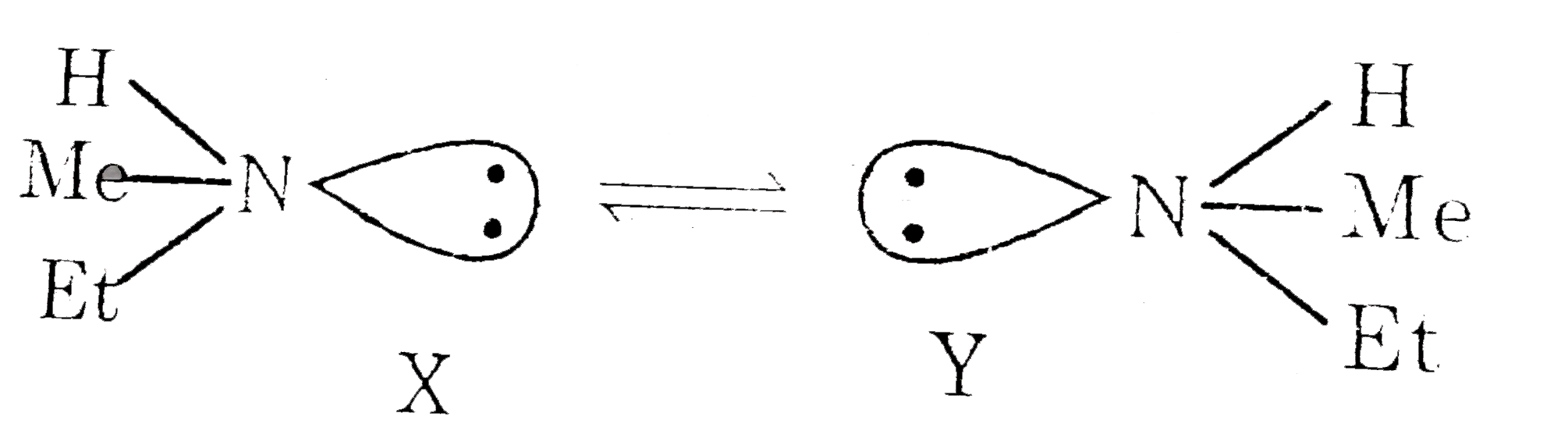
For interconversion of enantiomers,
`DeltaH=0`
`DeltaS=+ve`
`DeltaS_("surr")=0`
Promotional Banner

Topper's Solved these Questions

Similar Questions

Explore conceptually related problems

Match the column :- {:(,"Column - I",,"Column - II",),(A,"Adiabatic process",P,q=0,),(B,"Isothermal process",Q,DeltaH=0,),(C,"Isoenthalpic process",R,DeltaT=0,),(D,"Isoentropic process",S,DeltaS=0,):}

Match the follwoing: {: ( "Column I", " Column II"),( "(a)Entropy of vapoursation", " (p)decreases") , ("(b) K for spontaneous process " , "(q)is always positive"),(" (c)Crystalline solid state" , "(r)lowest entropy") , ( "(d)"DeltaU "in adiabatic" , " (s)"(DeltaH_(vap))/(T_(b))):}

{:(,"Column-I",,"Column-II"),((a),C ("s,graphite")+0_(2)(g)rarrCO_(2)(g),(p),DeltaH^(@)_("Combustion")),((b),C("s,graphite")rarrC(g),(q),DeltaH^(@)_("combustion")),((c),CO(g)+(1)/(2)O_(2)(g)rarrCO_(2)(g),(r),DeltaH^(@)_("atomization")),((d),CH_(4)(g)rarrC(g)+4H(g),(s),DeltaH^(@)("sublimation")):}

ALLEN-TEST PAPERS-part-2 Chemisty
  1. One of the important compound containing P-N bonds is phosphazens. One...

    Text Solution

    |

  2. A(C(9)H(8)O(2)Br(2))undersetDeltaoverset(NaHCO(3))rarr Ph-CH =CHBr+CO(...

    Text Solution

    |

  3. Both compartments in the above diagram are larege and contain ideal ga...

    Text Solution

    |

  4. Which molecular orbital of O(2) have a nodal plane which is perpendicu...

    Text Solution

    |

  5. Select INCORRECT about inert pair effect.

    Text Solution

    |

  6. An optically active compound I H(C(5)H(6)O) on treatment with H(2) in ...

    Text Solution

    |

  7. Which of the following is/are independent of path?

    Text Solution

    |

  8. underset((ii)H^(+))overset("Heated with aq. NaOH for prolonged time")r...

    Text Solution

    |

  9. underset((ii)H^(+))overset("Heated with aq. NaOH for prolonged time")r...

    Text Solution

    |

  10. underset((ii)H^(+))overset("Heated with aq. NaOH for prolonged time")r...

    Text Solution

    |

  11. {:(,"Column I",,"Column 2",,"Column 3",),(,"Enthalpy and",,"Entropy ch...

    Text Solution

    |

  12. {:(,"Column I",,"Column 2",,"Column 3",),(,"Enthalpy and",,"Entropy ch...

    Text Solution

    |

  13. {:(,"Column I",,"Column 2",,"Column 3",),(,"Enthalpy and",,"Entropy ch...

    Text Solution

    |

  14. In one litre of 3M solution of NaOH, H(2)SO(4) is added until 27.4 Kca...

    Text Solution

    |

  15. DeltaH(f)^(o) ("cyclohexane")=-300u DeltaH(f)^(o) ("cyclohecene")=-...

    Text Solution

    |

  16. Select number of species in which bond angle at nitrogen is greater th...

    Text Solution

    |

  17. X is the number of hydrogen bonds that surround each H(2)O molecule in...

    Text Solution

    |

  18. X is the maximum number of atoms that are in one plane in isobutylene....

    Text Solution

    |
