Home
Class 11
PHYSICS
The molar specific heat capacity at cons...

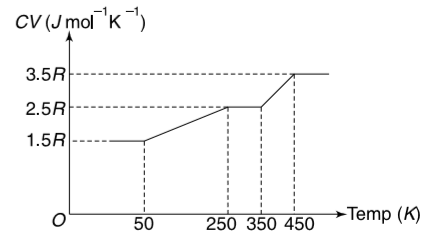
The molar specific heat capacity at constant volume `(C_(V))` for an ideal gas changes with temperature as shown in the graph. Find the amount of heat supplied at constant pressure in raising the temperature of one mole of the gas from 200 K to 400 K.

Text Solution

Verified by Experts

The correct Answer is:

`706.25 R`
Promotional Banner

Topper's Solved these Questions

  • FIRST LAW OF THERMODYNAMICS

    ARIHANT|Exercise Level 3|6 Videos
  • FIRST LAW OF THERMODYNAMICS

    ARIHANT|Exercise Level 3|6 Videos
  • ELASTICITY

    ARIHANT|Exercise Level 3|1 Videos
  • FLUIDS

    ARIHANT|Exercise All Questions|70 Videos

Similar Questions

Explore conceptually related problems

For an ideal monoatomic gas, molar heat capacity at constant volume (C_(v)) is

The heat required to increase the temperature of 4 moles of a monoatomic ideal gas from 273 K to 473 K at constant volume is

Internal energy of two moles of an ideal gas at temperature of 27^(@)C is 1200 R . Then find the molar specific heat of the has at constant pressure ?

When a certain amount of heat is supplied to a diatomic gas at constant volume, rise in temperature is T_(0) . When same heat is supplied to the gas at constant pressure, find the rise in temperature

Internal energy of two moles of an ideal gas at a temperature of 127^(@)C is 1200R . Then find the molar specific heat of the gas at constant pressure?

The molar specific heat of a gas at constant volume is 24 J/mol K. then change in its internal energy if one mole of such gas is heated at constant from 10^(@)C to 30^(@)C is

If Q amount of heat is given to a diatomic gas at constant volume to raise its temperature by DeltaT . Then for change of temperature how much amount of heat should be supplied at constant pressure ?

The heat capacity at constant volume of a monoatomic gas is 35 j//K . Find (a) the number of moles (b) the internal energy at 0^@ C . (c ) the molar heat capacity at constant pressure.

If R = universal gas constant, the amount of heat needed to raise the temperature of 2 mole of an ideal monoatomic gas from 273 K to 373 K when no work is done

ARIHANT-FIRST LAW OF THERMODYNAMICS-Level 2
  1. One end of an insulating U tube is sealed using insulating material. A...

    Text Solution

    |

  2. Air is filled inside a jar which has a pressure gauge connected to it....

    Text Solution

    |

  3. The molar specific heat capacity at constant volume (C(V)) for an idea...

    Text Solution

    |

  4. A sample of oxygen is heated in a process for which the molar specific...

    Text Solution

    |

  5. A gas-gun has a cylindrical bore made in an insulating material. Lengt...

    Text Solution

    |

  6. During a process carried on an ideal gas it was found that eta (lt 1) ...

    Text Solution

    |

  7. An ideal gas is taken through a thermodynamic cycle ABCDA. In state A ...

    Text Solution

    |

  8. (i) A conducting piston divides a closed thermally insulated cylinder ...

    Text Solution

    |

  9. A spherical container made of non conducting wall has a small orifice ...

    Text Solution

    |

  10. A glass tube is inverted and dipped in mercury as shown. One mole of a...

    Text Solution

    |

  11. Figure shows P versus V graph for various processes performed by an id...

    Text Solution

    |

  12. n' moles of an ideal gas having molar mass M is made to undergo a cycl...

    Text Solution

    |

  13. In the arrangement shown in figure, the piston can smoothly move insid...

    Text Solution

    |

  14. There is a long vertical tube of radius r containing air at atmospheri...

    Text Solution

    |

  15. A ball of radius r fits tightly inside a tube attached to a container....

    Text Solution

    |

  16. An ideal mono atomic gas is at temperature T(0). The pressure and volu...

    Text Solution

    |

  17. A cylinder contains equal volumes of Ar and H(2), separated by a freel...

    Text Solution

    |

  18. An ideal gas is taken through cycle 1231 (see figure) and the efficien...

    Text Solution

    |

  19. A heat engine is based on a gaseous cycle comprising of four processes...

    Text Solution

    |

  20. An ideal gas with a known gamma, completes a cycle consisting of two i...

    Text Solution

    |
