Home
Class 11
PHYSICS
A Carnot cycle based ideal heat engine o...

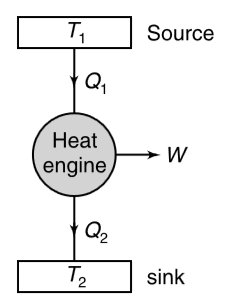
A Carnot cycle based ideal heat engine operates between two tanks each having same mass m of water. The source tank has an initial temperature of `T_(1) = 361 K` and the sink tank has an initial temperature of `T_(2) = 289 K`. Assume that the two tanks are isolated from the surrounding and exchange heat with the engine only. Specific heat of water is s.
(a) Find the final common temperature of the two tanks.
(b) Find the total work that the engine will be able to deliver by the time the two tanks reach common temperature.

Text Solution

Verified by Experts

The correct Answer is:

(a) `T_(0)=sqrt(T_(1)T_(2))=323 K`
(b) W=ms `(T_(1)+T_(2)-2sqrt(T_(1)T_(2)) =4ms `
Promotional Banner

Topper's Solved these Questions

  • FIRST LAW OF THERMODYNAMICS

    ARIHANT|Exercise Level 3|6 Videos
  • FIRST LAW OF THERMODYNAMICS

    ARIHANT|Exercise Level 3|6 Videos
  • ELASTICITY

    ARIHANT|Exercise Level 3|1 Videos
  • FLUIDS

    ARIHANT|Exercise All Questions|70 Videos

Similar Questions

Explore conceptually related problems

A carnot engine operates between temperatures T and 400K(Tgt400K) . If efficiency of engine is 25% , the temperature T is :

Efficiency of carnot heat engine,if source temperature is T1K and sink temperature is T2K

A Carnot enginer abosrbs an amount Q of heat from a reservoir at an absolute temperature T and rejects heat to a sink at a temperature of T//3 . The amount of heat rejects is

An ideal heat engine working between temperature T_(1) and T_(2) has an efficiency eta , the new efficiency if both the source and sink temperature are doubled, will be

An ideal heat engine working between temperature T_(H) and T_(L) has efficiency eta . If both the temperature are raised by 100 K each the new efficiency of heat engine will be

A heat engine works between a source and a sink maintaned at constant temperatures T_(1) and T_(2) . For the efficiency to be greatest

ARIHANT-FIRST LAW OF THERMODYNAMICS-Level 2
  1. Figure shows P versus V graph for various processes performed by an id...

    Text Solution

    |

  2. n' moles of an ideal gas having molar mass M is made to undergo a cycl...

    Text Solution

    |

  3. In the arrangement shown in figure, the piston can smoothly move insid...

    Text Solution

    |

  4. There is a long vertical tube of radius r containing air at atmospheri...

    Text Solution

    |

  5. A ball of radius r fits tightly inside a tube attached to a container....

    Text Solution

    |

  6. An ideal mono atomic gas is at temperature T(0). The pressure and volu...

    Text Solution

    |

  7. A cylinder contains equal volumes of Ar and H(2), separated by a freel...

    Text Solution

    |

  8. An ideal gas is taken through cycle 1231 (see figure) and the efficien...

    Text Solution

    |

  9. A heat engine is based on a gaseous cycle comprising of four processes...

    Text Solution

    |

  10. An ideal gas with a known gamma, completes a cycle consisting of two i...

    Text Solution

    |

  11. One mole of a mono atomic gas of molar mass M undergoes a cyclic proce...

    Text Solution

    |

  12. Helum gas is used as working substance in an engine working on a therm...

    Text Solution

    |

  13. A ring shaped tube has uniform cross sectional area and its entire vol...

    Text Solution

    |

  14. A cylindrical container has insulating wall and an insulating piston w...

    Text Solution

    |

  15. On a hot summer day the temperature inside is house is T(0) and the ou...

    Text Solution

    |

  16. A room air conditioner is a Carnot cycle based heat engine run is reve...

    Text Solution

    |

  17. A Carnot cycle based ideal heat engine operates between two tanks each...

    Text Solution

    |

  18. A cylindrical container of height 3L and cross sectional area A is fit...

    Text Solution

    |

  19. An adiabatic cylindrical chamber with a frictionless movable piston ha...

    Text Solution

    |

  20. (a) A polytropic process for an ideal gas is represented by PV^(x) = c...

    Text Solution

    |
