Home
Class 12
PHYSICS
Two charges, Q each, are fixed on a hori...

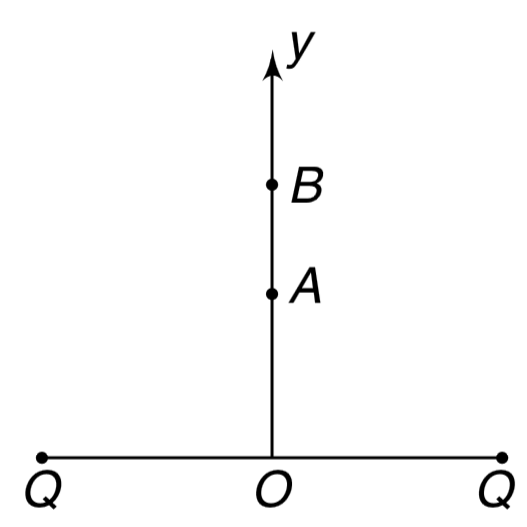
Two charges, Q each, are fixed on a horizontal surface at separation 2a. Line OY is vertical and is perpendicular bisector of the line joining the two charges. Another particle of mass m and charge q has two equilibrium positions on the line OY, at A and B. The distances OA and OB are in the ratio `1:3sqrt(3)` (a) Find the distance of the point on the line OY where the particle will be in stable equilibrium. (b) Where will the particle experience maximum electric force – at a point above B or at a point between A and B or somewhere between O and A? Where is the acceleration of particle maximum on y axis from O to B?

Text Solution

Verified by Experts

The correct Answer is:

(a). `(3)/(2)a`
(b). Maximum electric force is between A and B. Maximum acceleration is at O.
Promotional Banner

Topper's Solved these Questions

Similar Questions

Explore conceptually related problems

Two point charges+ q and-q are placed at distanced apart. What are the points at which the resultant field is parallel to the line joining the two charges ?

A charge q is placed at the centre of the line joining two equal charges Q. The system of the three charges will be in equilibrium if q is equal to:

Two equal charges q of opposite sign are separated by a small distance 2a ,The electric intensity E at a point on the perpendicular bisector of theline joining the two charges at a very large distance r form the line is

At any point on the right bisector of line joining two equal and opposite charges

Two point charges of 1muC and -1muC are separated by a distance of 100 Å. A point P is at a distance of 10 cm from the midpoint and on the perpendicular bisector of the line joining the two charges. The electric field at P will be

If a charge q is placed at the centre of the line joining two equal charges Q such that the system is in equilibrium then the value of q is

Draw E-r and V-r graphs due to two point charges + q and -2q kept at some along the line joining these two charges.

ARIHANT-ELECTROSTATICS-Level 2
  1. A fixed non conducting smooth track is in the shape of a quarter circl...

    Text Solution

    |

  2. A smooth fixed rod is inclined at an angle theta to the horizontal. At...

    Text Solution

    |

  3. Two charges, Q each, are fixed on a horizontal surface at separation 2...

    Text Solution

    |

  4. A neutral spherical conductor has a cavity. A point charge q is locate...

    Text Solution

    |

  5. Draw electric field lines in following situations: (a) A small neutral...

    Text Solution

    |

  6. Three configurations of electrostatic field lines have been shown in t...

    Text Solution

    |

  7. A uniformly charged semicircular ring (ABCD) produces an electric fiel...

    Text Solution

    |

  8. Consider a uniformly charged hemispherical shell. What can you say abo...

    Text Solution

    |

  9. Consider a uniformly charged thin spherical shell as shown in figure. ...

    Text Solution

    |

  10. There is an infinite non conducting sheet of charge having uniform cha...

    Text Solution

    |

  11. A thread having linear charge density lamda is in the shape of a circu...

    Text Solution

    |

  12. (a) There is an infinitely long thread uniformly charged with linear c...

    Text Solution

    |

  13. An infinitely long line charge is bent in U shape as shown in figure. ...

    Text Solution

    |

  14. Repeat the above problem if the semicircular part is replaced with a q...

    Text Solution

    |

  15. (a) There is a long uniformly charged cylinder having a volume charge ...

    Text Solution

    |

  16. A pendulum has a bob of mass m carrying a positive charge q. Length of...

    Text Solution

    |

  17. A uniform non conducting ring has mass m and radius R. tow point charg...

    Text Solution

    |

  18. An infinitely long time charge has linear charge density lamdaC//m the...

    Text Solution

    |

  19. A charged particle is placed at the centre of two thin concentric sphe...

    Text Solution

    |

  20. There are two infinite slabs of charge, both of thickness d with the j...

    Text Solution

    |
