Home
Class 12
PHYSICS
Consider a uniformly charged hemispheric...

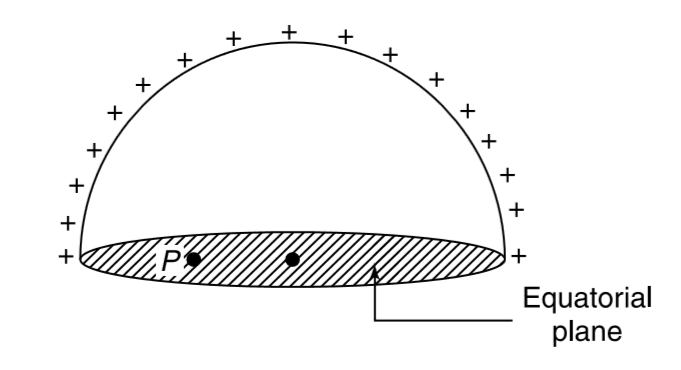
Consider a uniformly charged hemispherical shell. What can you say about the direction of electric field at points on the equatorial plane. (e.g. point P)

Text Solution

Verified by Experts

The correct Answer is:

Perpendicular to the equatorial plane.
Promotional Banner

Topper's Solved these Questions

Similar Questions

Explore conceptually related problems

The angle between the dipole moment and electric field at any point on the equatorial plane is

Figure shows a uniformly charges hemispherical shell. The direction of electric field at point p that is off centre (but in the plane of the largest circle of the hemisphere), will be along

Consider a uniformly charged thin spherical shell as shown in figure. Radius of the shell is R. The electric field at point P(x,0,0) is vecE what is the electric field at a point Q(-x,0,0) given x lt R .

What is the electric potential at a point on the equatorial plane of a short electric dipole?

The magnitude and direction of the electric field at point P can be best represented by

(a) Use Gauss's law to show that due to a uniformly charged spherical shell of radius R, the electric field at any point situated outside the shell at a distance r from its centre is equal to the electric field at the same point, when the entire charge on the shell were concentrated at its centre. Also plot the graph showing the variation of electric field with r, for r le R and r ge R . (b) Two point charges of +1 muC and +4 muC are kept 30 cm apart. How far from the +1muC charge on the line joining the two charges, will the net electric field be zero ?

Figure show a hemispherical shell having uniform mass density The direction of gravitational field at point P will be along .

Figure shows a uniformly charged hemisphere of radius R. It has a volume charge density rho . If the electric field at a point 2R, above the its center is E, then what is the electric field at the point 2R below its center?

ARIHANT-ELECTROSTATICS-Level 2
  1. Three configurations of electrostatic field lines have been shown in t...

    Text Solution

    |

  2. A uniformly charged semicircular ring (ABCD) produces an electric fiel...

    Text Solution

    |

  3. Consider a uniformly charged hemispherical shell. What can you say abo...

    Text Solution

    |

  4. Consider a uniformly charged thin spherical shell as shown in figure. ...

    Text Solution

    |

  5. There is an infinite non conducting sheet of charge having uniform cha...

    Text Solution

    |

  6. A thread having linear charge density lamda is in the shape of a circu...

    Text Solution

    |

  7. (a) There is an infinitely long thread uniformly charged with linear c...

    Text Solution

    |

  8. An infinitely long line charge is bent in U shape as shown in figure. ...

    Text Solution

    |

  9. Repeat the above problem if the semicircular part is replaced with a q...

    Text Solution

    |

  10. (a) There is a long uniformly charged cylinder having a volume charge ...

    Text Solution

    |

  11. A pendulum has a bob of mass m carrying a positive charge q. Length of...

    Text Solution

    |

  12. A uniform non conducting ring has mass m and radius R. tow point charg...

    Text Solution

    |

  13. An infinitely long time charge has linear charge density lamdaC//m the...

    Text Solution

    |

  14. A charged particle is placed at the centre of two thin concentric sphe...

    Text Solution

    |

  15. There are two infinite slabs of charge, both of thickness d with the j...

    Text Solution

    |

  16. In an insulating medium (dielectric constant =1) the charge density va...

    Text Solution

    |

  17. A nonconducting sheet of large surface area and thickness d contains u...

    Text Solution

    |

  18. A charge distribution generates a radial electrif field vecE=(a)/(r^(2...

    Text Solution

    |

  19. A pyramid has four faces, all of them being equilateral triangle of si...

    Text Solution

    |

  20. A point charge is placed very close to an infinite plane. What is flux...

    Text Solution

    |
