Home
Class 12
PHYSICS
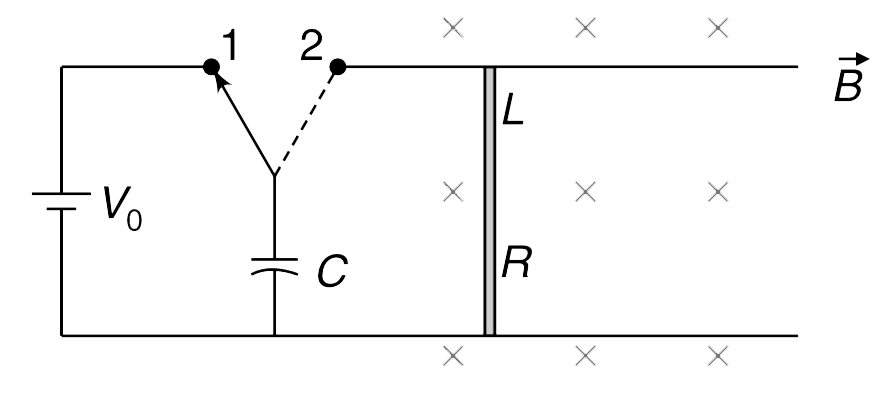
The Figure shows an electromagnetic gun....

The Figure shows an electromagnetic gun. A bar of mass m, resistance R and length L is free to slide on two smooth rails separated by a distance L. A uniform magnetic field B is present perpendicular to the plane of the figure. A capacitor of capacitance C is charged using a battery of emf `V_(0)` by placing switch (S) at 1. To fire the gun (i.e., to impart a kinetic energy to the rod) the switch is shifted to position 2 after the capacitor is fully charged. The rails end abruptly at the point where the speed of the rod becomes maximum. The efficiency of the gun can be defined as the kinetic energy imparted to the bar divided by the energy spent by the battery while charging the capacitor. Calculate the efficiency of the gun. Neglect self inductance of the circuit.

Text Solution

Verified by Experts

The correct Answer is:

`(mB^(2)L^(2)C)/(2(m+B^(2)L^(2)C)^(2))`
Promotional Banner

Topper's Solved these Questions

  • ELECTROMAGNETIC INDUCTION

    ARIHANT|Exercise Level 2|39 Videos
  • CURRENT ELECTRICITY

    ARIHANT|Exercise Current Electricity|105 Videos
  • ELECTROSTATICS

    ARIHANT|Exercise Level 3|59 Videos

Similar Questions

Explore conceptually related problems

Shows a rod of length l and resistance r moving on two rails shorted by a resistance R . A uniform magnetic field B is present normal to the plane of rod and rails. Show the electrical equivalence of each branch.

A conducting wire xy of lentgh l and mass m is sliding without friction on vertical conduction rails ab and cd as shown in figure. A uniform magnetic field B exists perpendicular to the plane of the rails, x moves with a constant velocity of

A rod of mass m , length l and resistance R is sliding down on a smooth inclined parallel rails with a cinstant velocity v . If a uniform horizontal magnetic field B exists, then find thevalue of B .

Figure shows a wire of resistance R sliding on two parallel, conducting fixed thick rails placed at a separation l. A magnetic fild B exist in a direction perpendicular to the plane of the rails. The wire is moving with a constant velocity v. Find current through the wire

Figure shows a wire sliding on two parallel, conducting rails placed at a separation L . A magnetic field B exists in a direction perpendicular to the plane of the rails. What force is necessary to keep the wire moving at a constant velocity V ?

A copper rod of mass m slides under gravity on two smooth parallel rails l distance apart set at an angle theta to the horizontal. At the bottom, the rails are joined by a resistance R . There is a uniform magnetic field perpendicular to the plane of the rails. the terminal valocity of the rod is

A conducting bar of mass m and length l moves on two frictionless parallel rails in the presence of a constant uniform magnetic field of magnitude B directed into the page as shown in the figure . The bar is given an initial velocity v_(0) towards the right at t = 0. Then the
