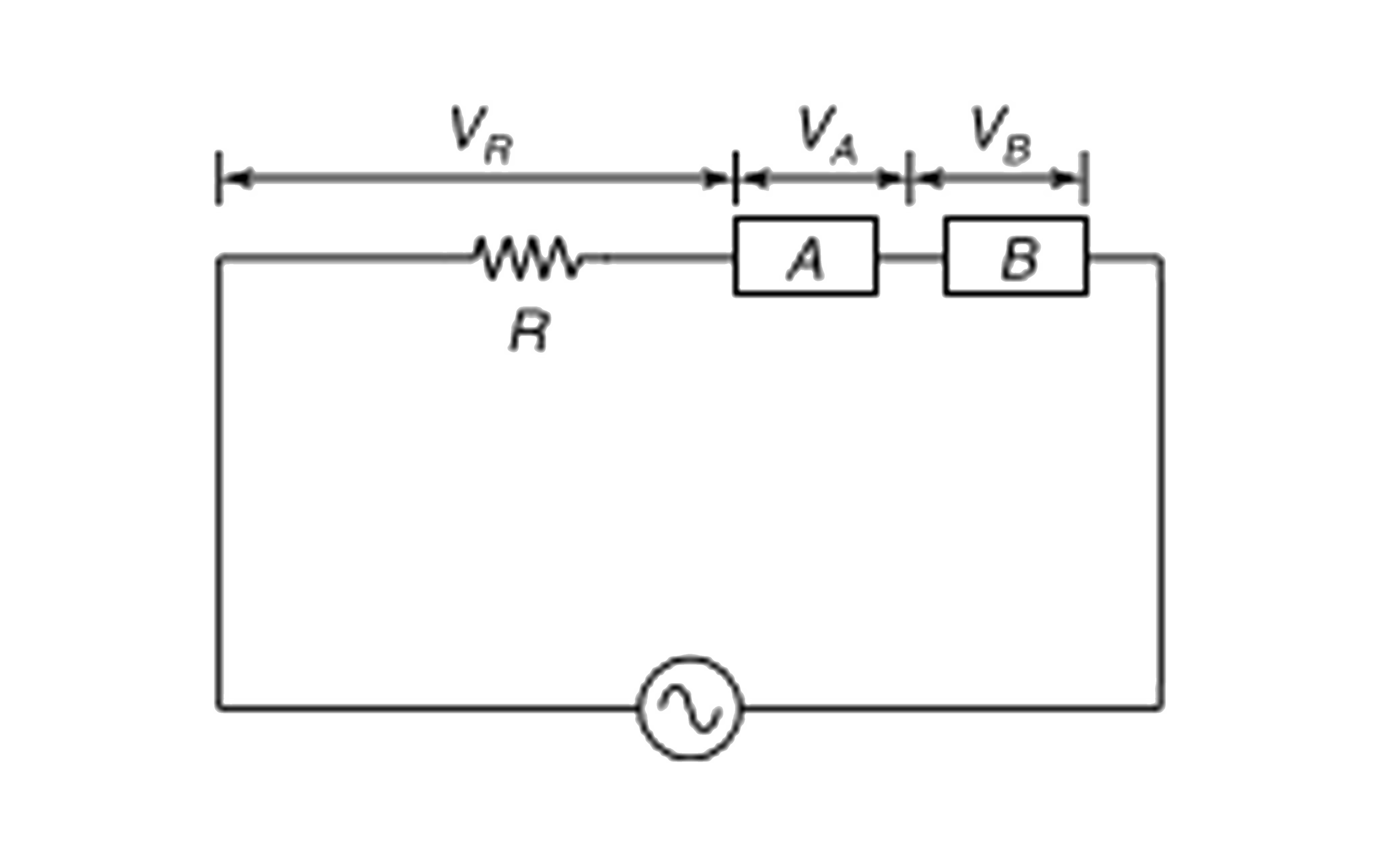
In the circuit shown in the Figure, the voltage across resistance R, box A and box B are represented as `v_(R)=vsin(omegat),v_(A)=sqrt(2)Vsin(omegat+(pi)/(4))and` `v_(B)=vsin(omegat+(pi)/(2))`Find the phase difference between current and the applied voltage.
Text Solution
Verified by Experts
The correct Answer is:
`45^(@)`
Topper's Solved these Questions
ALTERNATING CURRENT
ARIHANT|Exercise level-2|15 Videos
ALTERNATING CURRENT
ARIHANT|Exercise level-3|1 Videos
CAPACITOR
ARIHANT|Exercise Capacitor|50 Videos
Similar Questions
Explore conceptually related problems
In the circuit shown in figure, if the A diode forward voltage drop is 0.3 V, the voltage difference between A and B is
In the circuit shown in figure, if the diode forward voltage drop is 0.3 V, then the voltage difference between A to B is,
The two waves represented by y_1=a sin (omegat) and y_2=b cos (omegat) have a phase difference of
The instantaneous voltages at three terminals marked X, Y and Z are given by V_(X)=V_(0)sin omegat, V_(Y)=V_(0)sin (omegat=(2pi)/(3))and V_(z)=V_(0)sin (omegat=(4pi)/(3)) An ideal voltmeter is configured to read runs value of the potential difference between its terminals. is connected between points X and Y and then between Y and Z. The reading the voltmeter will be
In a series CR circuit shown in figure,the applied voltage is 10V and the voltage across capacitor is found to be 8V
Two SHMs are respectively represented by y_(1)=a sin (omegat-kx) and y_(2)=b cos(omegat-kx) . The phase difference between the two is
The instantaneous voltages at three terminals marked X, Y and Z are given by [ " "V_(x)=V_(0)sinomegat , " "V_(Y)=V_(0)sin(omegat+(2pi)/3) and " "V_(Z)=V_(0)sin(omegat+(4pi)/3) An ideal voltmeter is configured to read rms value of the potential difference between its terminals. It is connected between points X and Y and then between Y and Z. The reading(s) of the voltmeter will be
In the circuit given below, V(t) is the sinusoidal voltage source, voltage drop V_(AB)(t) across the resistance R is
In the circuit given below, V(t) is the sinusiodal voltage source, voltage drop V_(AB)(t) across the resistance R is

