Home
Class 12
PHYSICS
An electric field line emerges from a po...

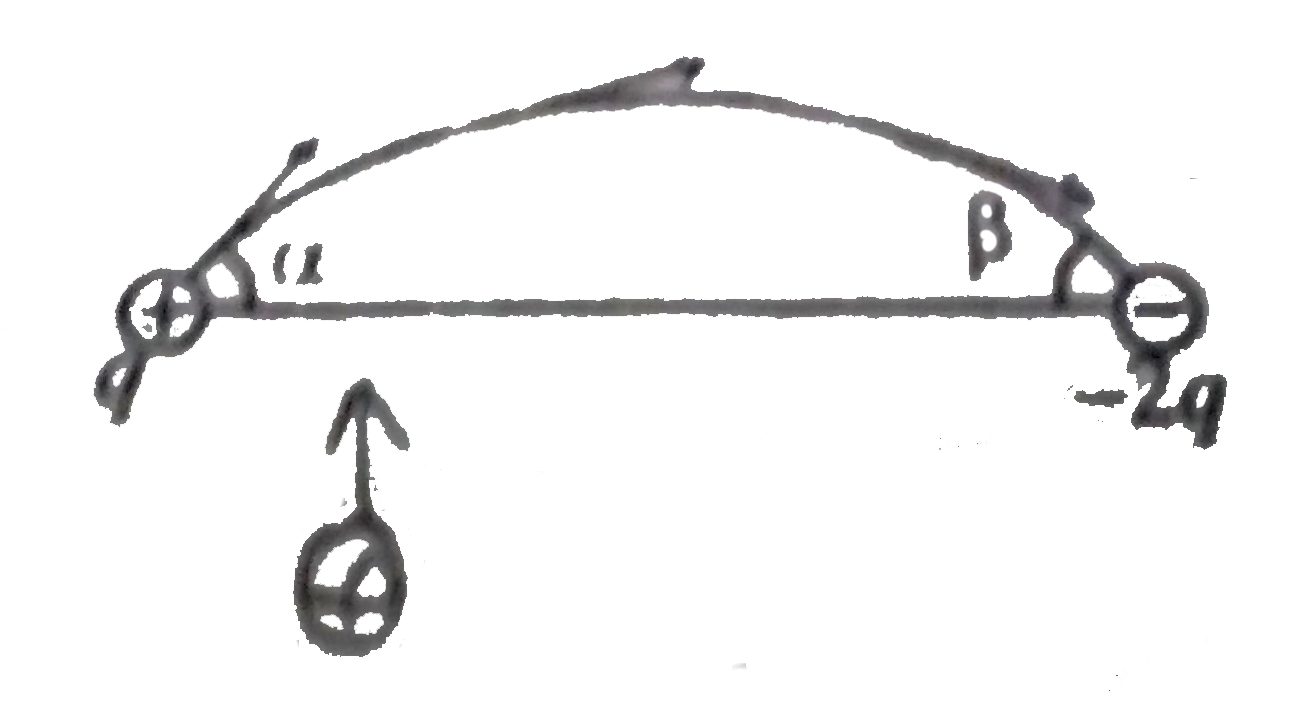
An electric field line emerges from a positive point charge `+q` at angle `alpha` to the straight line connecting it to a negative point charge `-2q` as shown in figure. At what angle `beta` with the field line enter the charge`-2q` ?

A

`alpha`

B

`2 sin^(-1)((1)/(sqrt(2))sin.(alpha)/(2))`

C

` sin^(-1)((1)/(sqrt(2))sin.(alpha)/(2))`

D

` sin^(-1)((1)/(2sqrt(2))sin.(alpha)/(2))`

Text Solution

Verified by Experts

The correct Answer is:

D

Torque due to `vec(B)` = Torque of weight of (QRST) (about QT)
`L(B_(0)IL)=3(lambdaL)g((L)/(2)+(L)/(6))=3lambdaLg((2L)/(3))`
`B_(0)=(2lambdag)/(I)`
No external force, so COM cannot displace initial coordinate of `COM=(3(lambdaL)("zero")+2lambdaL((L)/2)+lambdaL(L))/(6lambdag)=(L)/(3)`
Final coordinate of `COM=(L)/(3)("same")`
But COM displaces with respect to QT by `(2L)/(3)`. So displacement of `QPUT=(2L)/(3)`.
Initial magnetic dipole moment M makes an angle of `(pi)/(4)` ACW from +ive x-axis and finally it makes angle `(3pi)/(4)` ACW from `+"ive x-axis" (M=sqrt(2)IL^(2))`
So change in `PE=-MB(cos theta_(2)-costheta_(1))=MB_(0)[cos135^(@)-cos45^(@)]=2B_(0)IL^(2)="Gain in KE"=(1)/(2)I omega ^(2)`
`I("about QT")=2[(2lambdaL^(3))/(3)+lambdaL^(3)]=(10lambdaL^(3))/(3),2B_(0)IL^(2)=(1)/(2)(Iomega^(2))=(1)/(2)((10lambdaL^(3))/(3))omega^(2),omega^(2)=(6B_(0)I)/(5lambdaL)`
Promotional Banner

Topper's Solved these Questions

  • TEST PAPERS

    VIBRANT|Exercise PART - II : PHYSICS|56 Videos
  • REVIEW TEST

    VIBRANT|Exercise PART - II : PHYSICS|262 Videos

Similar Questions

Explore conceptually related problems

A charge Q is placed at the centre of the line joining two point charges +q and +q as shown in figure. The ratio of charges Q and q is

" Electric field intensity due to a point charge " "q" ' at a distance 'r' from it is "

Three charges +q, +q, +2q are arranged as shown in figure. What is the field at point P (center of side AC)

An electrostatic field line leaves at angle alpha from charge q_(1) and connects with point charge -q_(2) at angle beta (see figure). then find the relationship between alpha and beta :

Charge +2Q and -Q are placed as shown in figure. The point at which electric field intensit is zero will be

VIBRANT-TEST PAPERS-PART - II : PHYSICS
  1. An electric field line emerges from a positive point charge +q at angl...

    Text Solution

    |

  2. A particle has an initial velocity of 9m//s due east and a constant ac...

    Text Solution

    |

  3. Two bodies begin to fall freely from the same height but the second fa...

    Text Solution

    |

  4. A stone is dropped from the top of a 400 m high tower. At the same tim...

    Text Solution

    |

  5. One end of a uniform rod of length l and mass m is hinged at A. It is ...

    Text Solution

    |

  6. A car A going north-east at 80km//h and another car B is going south-e...

    Text Solution

    |

  7. The acceleration of a train between two stations 2 kilometre apart is ...

    Text Solution

    |

  8. Two particles P and Q are moving as shown in the figure. At this momen...

    Text Solution

    |

  9. A boy throws a ball upward with velocity v(0)=20m//s. The wind imparts...

    Text Solution

    |

  10. For two projectiles launched with same initial velocity, the maximum h...

    Text Solution

    |

  11. In the time taken by the projectile to reach from A to B is t. Then th...

    Text Solution

    |

  12. The greatest height h of the sand pile that can be erected without spi...

    Text Solution

    |

  13. The pulleys and strings shown in the figure are smooth and of negligib...

    Text Solution

    |

  14. Two uniform rods of equal length but different masses are rigidly join...

    Text Solution

    |

  15. Two masses m and M are attached with strings as shown. For the system ...

    Text Solution

    |

  16. In the figure, the ball B is released from rest when the spring is in ...

    Text Solution

    |

  17. Two equal masses are attached to the two end of a spring of force cons...

    Text Solution

    |

  18. The work done by a force vec(F)=(-6x^(3)hat(i)) N in displacing a part...

    Text Solution

    |

  19. A particle moves with a velocity vec(v)=5hat(i)-3hat(j)+6hat(k) " "ms^...

    Text Solution

    |

  20. A uniform sphere is place on a smooth horizontal surface and as horizo...

    Text Solution

    |

  21. A force vec(F)=(2hat(i)+hat(j)+3hat(k)) N acts on a particle of mass 1...

    Text Solution

    |
