

Home
Class 12
PHYSICS
A cavity of radius r is made inside a ...

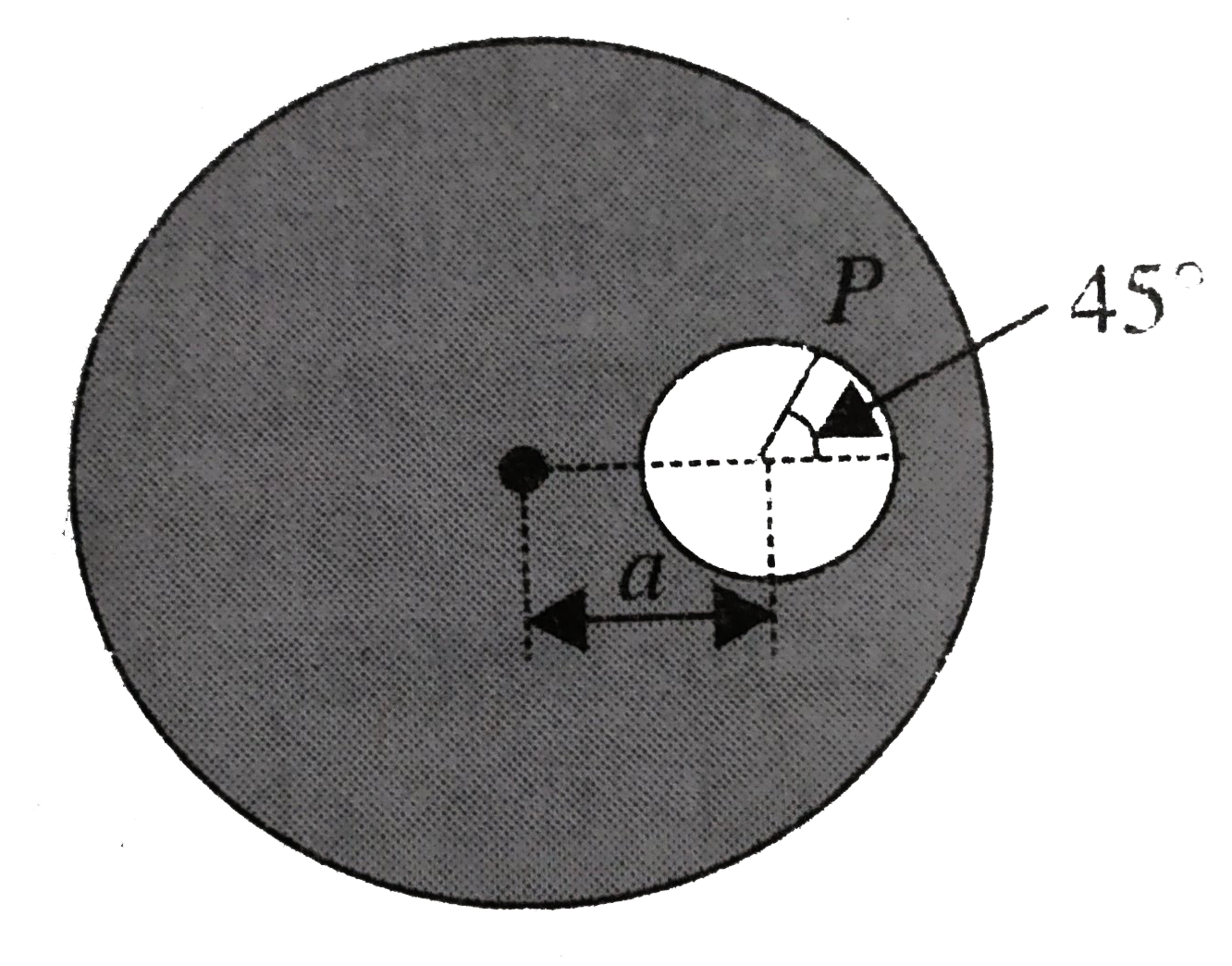
A cavity of radius r is made inside a solid sphere. The volume charge density of the remaining sphere is `rho`. An electron (charge e, mass m) is released inside the cavity from point P as shown in figure. The centre of sphere and center of cavity are separated by a distance a. The time after which the electron again touches the sphere is

A

`sqrt((6sqrt(2)repsilon_(0)m)/(epa))`

B

`sqrt((sqrt(2)repsilon_(0)m)/(epa))`

C

`sqrt((6repsilon_(0)m)/(epa))`

D

`sqrt((repsilon_(0)m)/(epa))`

Text Solution

Verified by Experts

The correct Answer is:
B

Torque due to `vec(B)` = Torque of weight of (QRST) (about QT)
`L(B_(0)IL)=3(lambdaL)g((L)/(2)+(L)/(6))=3lambdaLg((2L)/(3))`
`B_(0)=(2lambdag)/(I)`
No external force, so COM cannot displace initial coordinate of `COM=(3(lambdaL)("zero")+2lambdaL((L)/2)+lambdaL(L))/(6lambdag)=(L)/(3)`
Final coordinate of `COM=(L)/(3)("same")`
But COM displaces with respect to QT by `(2L)/(3)`. So displacement of `QPUT=(2L)/(3)`.
Initial magnetic dipole moment M makes an angle of `(pi)/(4)` ACW from +ive x-axis and finally it makes angle `(3pi)/(4)` ACW from `+"ive x-axis" (M=sqrt(2)IL^(2))`
So change in `PE=-MB(cos theta_(2)-costheta_(1))=MB_(0)[cos135^(@)-cos45^(@)]=2B_(0)IL^(2)="Gain in KE"=(1)/(2)I omega ^(2)`
`I("about QT")=2[(2lambdaL^(3))/(3)+lambdaL^(3)]=(10lambdaL^(3))/(3),2B_(0)IL^(2)=(1)/(2)(Iomega^(2))=(1)/(2)((10lambdaL^(3))/(3))omega^(2),omega^(2)=(6B_(0)I)/(5lambdaL)`
Promotional Banner

Topper's Solved these Questions

  • TEST PAPERS

    VIBRANT|Exercise PART - II : PHYSICS|56 Videos
  • REVIEW TEST

    VIBRANT|Exercise PART - II : PHYSICS|262 Videos

Similar Questions

Explore conceptually related problems

A solid non-conducting sphere of radius R is charged with a uniform volume charge density rho . Inside the sphere a cavity of radius r is made as shown in the figure. The distance between the centres of the sphere and the cavity is a. An electron of charge 'e' and mass 'm' is kept at point P inside the cavity at angle theta = 45^(@) as shown. If at t = 0 this electron is released from point P, calculate the time it will take to touch the sphere on inner wall of cavity again.

A positive charge q is placed in a spherical cavity made in a positively charged sphere. The centres of sphere and cavity are displaced by a small distance vec(l) . Force on charge q is :

A cavity of radius r is present inside a solid dielectric sphere of radius R, having a volume charge density of rho . The distance between the centres of the sphere and the cavity is a. An electron e is kept inside the cavity at an angle theta=45^(@) as shown. the electron (mass m and -e) touches the sphere again after time ((P sqrt(2) mr epsi_(0))/(e a rho))^(1//2) ? Find the value of P. Neglect gravity.

A mass m is placed in the cavity inside hollow sphere of mass M as shown in the figure. The gravitational force on m is

A hemi-spherical cavity is created in solid sphere (of radius 2R ) as shown in the figure. Then

A hemispherical cavity of radius R is created in a solid sphere of radius 2R as shown in the figure . Then y -coordinate of the centre of mass of the remaining sphere is

A cavity of radius r is present inside a fixed solid dielectric sphere of radius R, having a volume charge density of rho . The distance between the centres of the sphere and the cavity is a. An electron is released inside the cavity at an angle theta = 450 as shown. The electron (of mass m and charge –e) will take ((Psqrt(2)mrepsilon_(0))/(earho))^(1//2) time to touc the sphere again. Neglect gravity. find the value of P:

A spherical cavity of radius r is made in a conducting sphere of radius 2 r.A charge q is kept at the centre of cavity as shown in the figure.Find the magnitude of the total electric field at (4r 0) .

VIBRANT-TEST PAPERS-PART - II : PHYSICS
  1. A cavity of radius r is made inside a solid sphere. The volume charg...

    Text Solution

    |

  2. A particle has an initial velocity of 9m//s due east and a constant ac...

    Text Solution

    |

  3. Two bodies begin to fall freely from the same height but the second fa...

    Text Solution

    |

  4. A stone is dropped from the top of a 400 m high tower. At the same tim...

    Text Solution

    |

  5. One end of a uniform rod of length l and mass m is hinged at A. It is ...

    Text Solution

    |

  6. A car A going north-east at 80km//h and another car B is going south-e...

    Text Solution

    |

  7. The acceleration of a train between two stations 2 kilometre apart is ...

    Text Solution

    |

  8. Two particles P and Q are moving as shown in the figure. At this momen...

    Text Solution

    |

  9. A boy throws a ball upward with velocity v(0)=20m//s. The wind imparts...

    Text Solution

    |

  10. For two projectiles launched with same initial velocity, the maximum h...

    Text Solution

    |

  11. In the time taken by the projectile to reach from A to B is t. Then th...

    Text Solution

    |

  12. The greatest height h of the sand pile that can be erected without spi...

    Text Solution

    |

  13. The pulleys and strings shown in the figure are smooth and of negligib...

    Text Solution

    |

  14. Two uniform rods of equal length but different masses are rigidly join...

    Text Solution

    |

  15. Two masses m and M are attached with strings as shown. For the system ...

    Text Solution

    |

  16. In the figure, the ball B is released from rest when the spring is in ...

    Text Solution

    |

  17. Two equal masses are attached to the two end of a spring of force cons...

    Text Solution

    |

  18. The work done by a force vec(F)=(-6x^(3)hat(i)) N in displacing a part...

    Text Solution

    |

  19. A particle moves with a velocity vec(v)=5hat(i)-3hat(j)+6hat(k) " "ms^...

    Text Solution

    |

  20. A uniform sphere is place on a smooth horizontal surface and as horizo...

    Text Solution

    |

  21. A force vec(F)=(2hat(i)+hat(j)+3hat(k)) N acts on a particle of mass 1...

    Text Solution

    |