A
B
C
D
Text Solution
Verified by Experts
The correct Answer is:



Topper's Solved these Questions
Similar Questions
Explore conceptually related problems
VIBRANT-TEST PAPERS-PART-II : MATHEMATICS
- bar(OA)=bar(i)+2bar(j)+2bar(k) .In the plane bar(OA) and bar(i) rotate...
Text Solution
|
- The solution of the differential equation x^(3)(dy)/(dx)+4x^(2) tany=e...
Text Solution
|
- The values of parameter a for which the point of minimum of the functi...
Text Solution
|
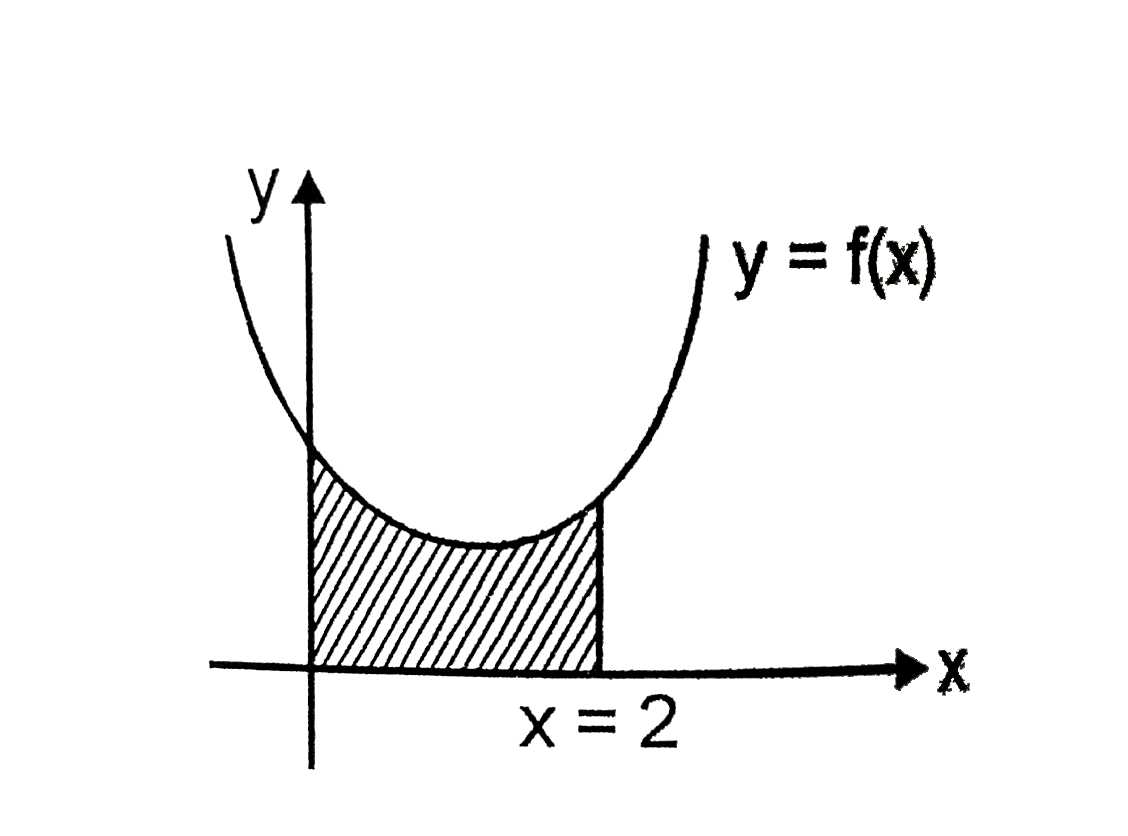
- If f(x) = a + bx + cx^(2) where c > 0 and b^(2) - 4ac < 0. Then the ar...
Text Solution
|
- If z(1),z(2),z(3) are three points lying on the circle |z|=2, then mi...
Text Solution
|
- If a in [-20,0], then the probability that the graph of the function ...
Text Solution
|
- Let f be a positive differentiable function defined on (0,oo) and phi(...
Text Solution
|
- Let f(x) = sgn (x) and g (x) = x(x^(2)-5x+6). The function f(g(x)) is ...
Text Solution
|
- Let A and B be two matrices different from identify matrix such that A...
Text Solution
|
- Let alpha(n)=1-(1)/(2)+(1)/(3)-(1)/(4)+.........+(-1)^(n-1)(1)/(n),ni...
Text Solution
|
- If veca,vecb,vecc are three non-coplanar vectors such that veca+vecb+...
Text Solution
|
- If m is a positive integer, then [(sqrt(3)+1)^(2m)]+1, where [x] denot...
Text Solution
|
- Let A,B and I (identity matrix) be the matrices of order 4 such that A...
Text Solution
|
- Five balls b(1),b(2),b(3),b(4),b(5) are kept at random in five foxes B...
Text Solution
|
- Let A(1),A(2),A(3),.........,A(14) be a regular polygon with 14 sides ...
Text Solution
|
- If (sum(n=1)^(n=n) (n^(2)+3n+3)(n+1)!)/((n+2)!)=8, then n is equal to ...
Text Solution
|
- The number of ordered pairs (x,y) satisfying x(sin^(2)x+(1)/x^(2))=2si...
Text Solution
|
- If (.^(20)C(1))/(1)+(.^(20)C(3))/(2)+(.^(20)C(5))/(3)+.......+("^(20)C...
Text Solution
|
- If f(x) is a polynomial function satisfying f(x)f(y)=f(x)+f(y)+f(xy)-2...
Text Solution
|
- The number of points P(x,y) satisfying y^(2)(log(2)(x^(2)+1)+log((x^(2...
Text Solution
|