Home
Class 12
PHYSICS
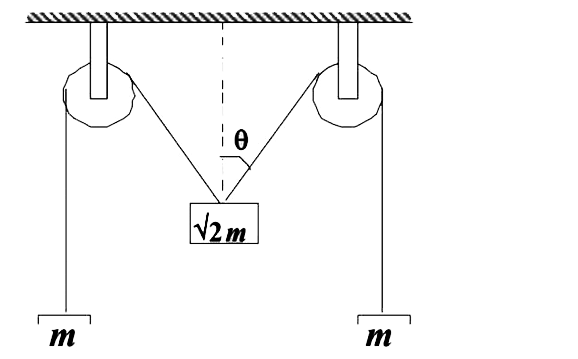
The pulleys and strings shown in the fig...

The pulleys and strings shown in the figure are smooth and of negligible mass. For the system to remain in equilibrium, the angle `theta` should be

A

`0^(@)`

B

`30^(@)`

C

`45^(@)`

D

`60^(@)`

Text Solution

Verified by Experts

The correct Answer is:

B

`-(df)/(Kf^(3))=dt" "," "-underset(f_(0))overset(f)(int)(df)/(Kf^(3))=underset(0)overset(t)(int)dt" ", " "-(1)/(K)underset(f_(0))overset(f)(int)f^(-3)df=timplies (1)/(2K)[(1)/(f^(2))-(1)/(f_(0)^(2))]=t`
`(1)/(f^(2))=(1+2f_(0)^(2)Kt)/(f_(0)^(2))" "," "f=(f_(0))/(sqrt(2f_(0)^(2)Kt+1))`
Promotional Banner

Topper's Solved these Questions

  • TEST PAPERS

    VIBRANT|Exercise PART - II : PHYSICS|56 Videos
  • REVIEW TEST

    VIBRANT|Exercise PART - II : PHYSICS|262 Videos

Similar Questions

Explore conceptually related problems

A step pulley system is shown in figure-2.50. Find the relation in masses m and M for which the system remain in equilibrium. Assume string will not slide over the pulleys. ((r_(1))/(r_(2))=(1)/(2),(r_(3))/(r_(4))=(3)/(4)) [(M)/(m)=(3)/(8)sintheta]

A smooth rod length l is kept inside a trolley at an angle theta as shown in the figure. What should be the acceleration a of the trolley so that the rod remain in equilibrium with respect to it?

In the arrangements shown, the pulley is smooth and the rope is inextensible. If the system is in equilibrium, the contact force between ground and block is

For the given situation as shown in the figure, the value of q theta keep the system in equilibrium will be

Two masses m and M are attached to the strings as shown in the figure. If the system is in equilibrium, then

For the equilibrium of the system shown, the value of mass m should be

Two masses m_(1) and m_(2) are attached with light strings as shown. If the system is in equilibrium, find the value of theta

Two masses m and M are attached to the strings as shown in the figure. If the system is in equilibruim, then

VIBRANT-TEST PAPERS-PART - II : PHYSICS
  1. In the time taken by the projectile to reach from A to B is t. Then th...

    Text Solution

    |

  2. The greatest height h of the sand pile that can be erected without spi...

    Text Solution

    |

  3. The pulleys and strings shown in the figure are smooth and of negligib...

    Text Solution

    |

  4. Two uniform rods of equal length but different masses are rigidly join...

    Text Solution

    |

  5. Two masses m and M are attached with strings as shown. For the system ...

    Text Solution

    |

  6. In the figure, the ball B is released from rest when the spring is in ...

    Text Solution

    |

  7. Two equal masses are attached to the two end of a spring of force cons...

    Text Solution

    |

  8. The work done by a force vec(F)=(-6x^(3)hat(i)) N in displacing a part...

    Text Solution

    |

  9. A particle moves with a velocity vec(v)=5hat(i)-3hat(j)+6hat(k) " "ms^...

    Text Solution

    |

  10. A uniform sphere is place on a smooth horizontal surface and as horizo...

    Text Solution

    |

  11. A force vec(F)=(2hat(i)+hat(j)+3hat(k)) N acts on a particle of mass 1...

    Text Solution

    |

  12. A solid hemisphere and a solid cone have a common base and are made of...

    Text Solution

    |

  13. If the centre of mass of three particles of masses of 1kg, 2kg, 3kg is...

    Text Solution

    |

  14. The displacement of a particle of mass 2kg moving in a straight line v...

    Text Solution

    |

  15. A bullet of mass 'm' moving with velocity 'u' passes through a wooden ...

    Text Solution

    |

  16. An impulse J is applied on a ring of mass m along a line passing throu...

    Text Solution

    |

  17. A solid sphere of mass m and radius R is kept over a rough ground. A t...

    Text Solution

    |

  18. An ideal gas is expanded such that PT^(2)=a constant. The coefficient ...

    Text Solution

    |

  19. A body of density D1 and mass M is moving downward in glycerine of den...

    Text Solution

    |

  20. A uniform elastic plank moves due to a constant force F(0) applied at...

    Text Solution

    |
