Home
Class 12
PHYSICS
A small bead of mass m can moves on a sm...

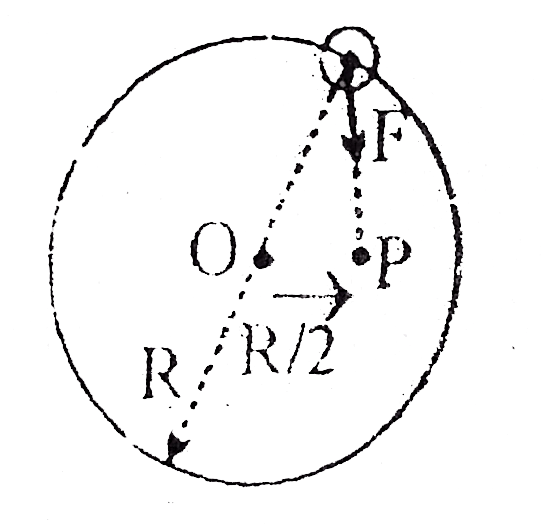
A small bead of mass m can moves on a smooth circular wire (radiusR) under the action of a force `F=(km)/r^(2)` directed (r=position of bead from P&K=constant) towards a point P with in the circle at a distance `R/2` from the centre what should be the minimum velocity of bead at the point of the wire nearest the centre of force (P) so that bead will complete the circle

A

`sqrt((3k)/R`

B

`sqrt((8k)/(3R)`

C

`sqrt((6k)/R`

D

none of these

Text Solution

Verified by Experts

The correct Answer is:
B


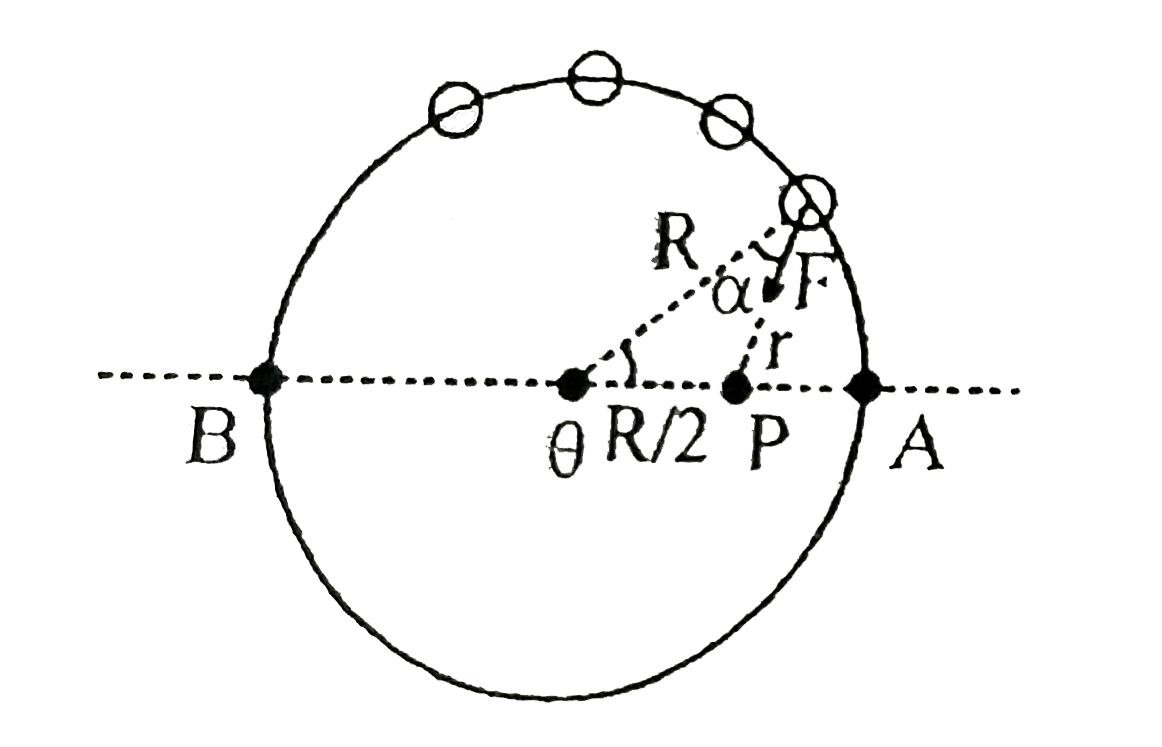
value of A at any angular position 'theta' is given by
`f=(km)/r^(2)` here is given by
`r=sqrt((Rcostheta-R//2)^(2)+(Rsintheta)^(2))=sqrt(R^(2)+R^(2)//4-R^(2)costheta)=R/2sqrt(5-4costheta)`
`Also (2sinalpha)/R=sin 0/r i.e sinalpha =sintheta/sqrt(5-4costheta)`
for small angular displacement 'dtheta' work done by this force dw =-frd0cos(9theta-alpha)=-fR sin alpha dtheta
`(4kmR)/(R^(2)(5-4costheta)) sintheta/sqrt(5-4costheta)dtheta`
work done in moving bead from AtoB
`Deltaw=-(4km)/R underset(theta)overset(pi)(int) (sin theta d theta)/(5-4costheta)^(3//2)=-(km)/R underset(theta)overset(pi)(int)(4sin theta d theta)/(5-4costheta)^(3//2)`
`=(km)/R underset(theta) overset(9)(int) (dt)/t^(3//2)=-(km)/R|t^(-1//2)/-(1//2)|_(1)^(9)`
`=+(2km)/R(1/3-1)=-4/3(km)/R`
:.Energy provided at point A most be equal to this work done
` :. 1/2mv_(m)^(2)=4/3(km)/R Rightarrow v_(min)= sqrt((8k)/(3R))`
Promotional Banner

Topper's Solved these Questions

  • MASTER PRACTICE PROBLEM

    BANSAL|Exercise Comphrehension|134 Videos
  • MASTER PRACTICE PROBLEM

    BANSAL|Exercise Reasoning|75 Videos
  • FLUID MECHANICS

    BANSAL|Exercise PYQS AIEEE|10 Videos
  • SEMICONDUCTORS

    BANSAL|Exercise CBSE Question|32 Videos

Similar Questions

Explore conceptually related problems

A satellite of mass M is moving in a circle of radius R under a centripetal force given by (-K//R^(2)), where k is a constant. Then

A block of mass m is lying at rest at point P of a wedge having a smooth semi-circular track of radius R. What should be the minimum value of a_0 so that the mass can just reach point Q

A uniform circular plate of radius 2R has a circular hole of radius R cut out of it. The centre of the smaller circle is at a distance of R/3 from the centre of the larger circle. What is the position of the centre of mass of the plate?

P is a point at a distance r from the centre of a spherical shell of mass M and radius a, where r lt a . The gravitational potential at P is

A particle of mass m moves under the action of a central force. The potential energy function is given by U(r)=mkr^(3) Where k is a positive constant and r is distance of the particle from the centre of attraction. (a) What should be the kinetic energy of the particle so that it moves in a circle of radius a0 about the centre of attraction? (b) What is the period of this circualr motion ?

A small bead of mass m moving with velocity v gets threaded on a stationary semicircular ring of mass m and radius R kept on a horizontal table. The ring can freely rotate about its centre. The bead comes to rest relative to the ring. What will be the final angular velocity of the system?

A solid sphere of mass M and radius R has a spherical cavity of radius R/2 such that the centre of cavity is at a distance R/2 from the centre of the sphere. A point mass m is placed inside the cavity at a distanace R/4 from the centre of sphere. The gravitational force on mass m is

A small bead of mass M slides on a smooth wire that is bent in a circle of radius R. It is released at the top of the circular part of the wire (point A in the figure) with a negligibly small velocity. Find the height H where the bead will reverse direction

Two beads A and B of masses m_(1) and m_(2) respectively, are threaded on a smooth circular wire of radius a fixed in a vertical plane. B is stationary at the lowest point when A is gently dislodged from rest at the highest point. A collided with B at the lowest point. The impulse given to B due to collision is just great enough to carry it to the level of the centre of the circle while A is immediately brought to rest by the impact. What is the coefficient of restituting between the beads?

BANSAL-MASTER PRACTICE PROBLEM-Additional topic
  1. A small bead of mass m can moves on a smooth circular wire (radiusR) u...

    Text Solution

    |

  2. The manifestation of band structure in solids is due to

    Text Solution

    |

  3. When p-n junction diode is forward biased then

    Text Solution

    |

  4. If the ratio of the concentration of electron to that of holes in a se...

    Text Solution

    |

  5. If the lattice constant of this semiconductor is decreased, then which...

    Text Solution

    |

  6. In the following, which one of the diodes is reverse biased ?

    Text Solution

    |

  7. The circuit has two oppositively connected ideal diodes in parallel wh...

    Text Solution

    |

  8. If a p-n junction diode, a square input signal of 10 V is applied as s...

    Text Solution

    |

  9. In the circuit below, A and B represents two inputs and C represents t...

    Text Solution

    |

  10. A p-n junction (D) shown in the figure can act as a rectifier. An alte...

    Text Solution

    |

  11. The logic circuit shown below has the input waveforms ‘A’ and ‘B’ as s...

    Text Solution

    |

  12. The combination of gates shown below yields .

    Text Solution

    |

  13. Truth table for system of four NAND gates as shown in figure is : .

    Text Solution

    |

  14. In semiconductor the concentrations of electron and holes are 8xx10^(1...

    Text Solution

    |

  15. A potential difference of 2V is applied between the opposite faces of ...

    Text Solution

    |

  16. The main cause of avalence breakdown is

    Text Solution

    |

  17. A cube of germanium is placed between the poles of a magnet and a volt...

    Text Solution

    |

  18. In the given figure, which of the diodes are forward biased?

    Text Solution

    |

  19. Current in the circuit will be

    Text Solution

    |

  20. The diode used in the circuit shown in the figure has a constant volta...

    Text Solution

    |

  21. In the following circuits PN-junction diodes D(1), D(2) and D(3) are i...

    Text Solution

    |

