Home
Class 12
PHYSICS
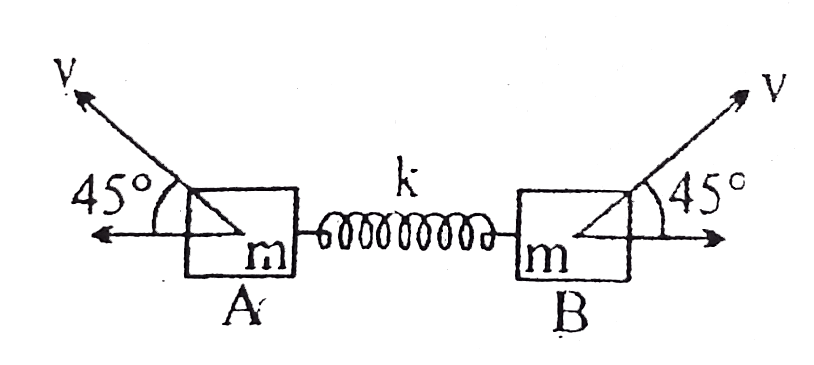
Blocks A&B of mass m each are connected ...

Blocks A&B of mass m each are connected with spring of constant k both blocks lie on frictionless ground and are imparted horizontal velocity v as shown when spring is unstretched find the maximum stretch of spring.

A

`vsqrt(m/k)`

B

`vsqrt(m/2k)`

C

`vsqrt(2m)/k`

D

none

Text Solution

Verified by Experts

The correct Answer is:
A

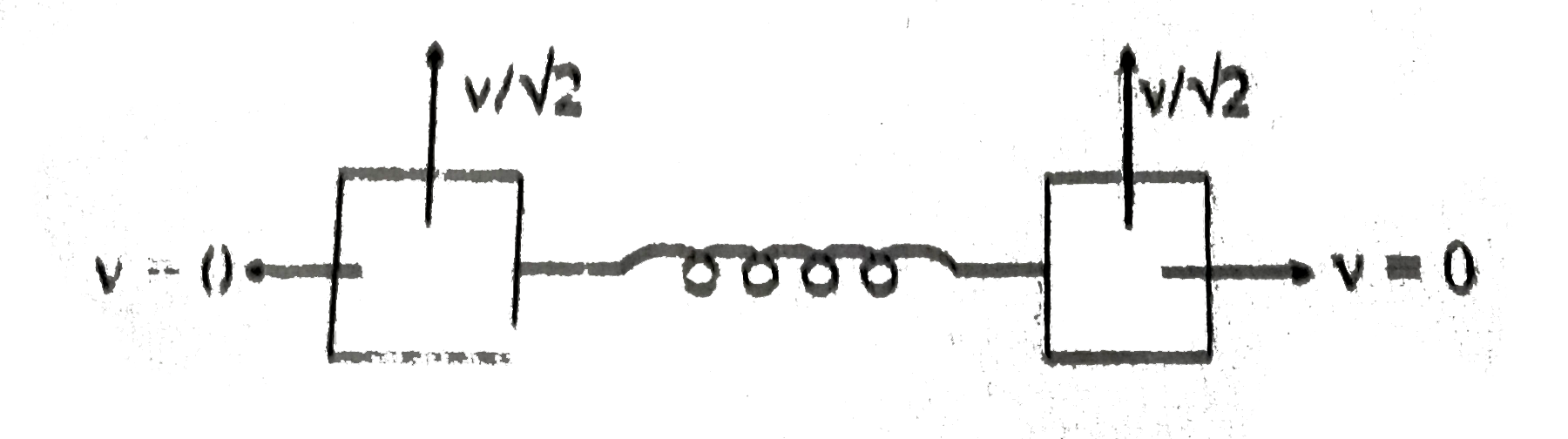
There is no change in velocity `bot` to the spring at the moment of maximum extension relative velocity along the spring is zero due to symmetry velocity of blocks is zero along spring at the moment of maximum extension

let extention be x Applying conservation of energy
`2[1/2m(v/sqrt(2))^(2)]+1/2kx^(2)=2(1/2mv^(2))`
`kx^(2)=mv^(2) Rightarrow x=v sqrt(m/k)`
Promotional Banner

Topper's Solved these Questions

  • MASTER PRACTICE PROBLEM

    BANSAL|Exercise Comphrehension|134 Videos
  • MASTER PRACTICE PROBLEM

    BANSAL|Exercise Reasoning|75 Videos
  • FLUID MECHANICS

    BANSAL|Exercise PYQS AIEEE|10 Videos
  • SEMICONDUCTORS

    BANSAL|Exercise CBSE Question|32 Videos

Similar Questions

Explore conceptually related problems

The figure shows two blocks of mass m each, connected by an ideal unstretched spring and then placed on a frictionless floor. If the blocks are given velocities v_(0) and 2v_(0) as shown, then the maximum extension in the spring is

A block of mass m is connected to another block of mass M by a massless spring of spring constant k . the blocks are kept of a smooth horizontal plane and are at rest. The spring is unstretched when a constant force F starts acting on the block of mass M of pull it. Find the maximum extension of the spring

A block of mass m is connect to another block of mass M by a massless spring of spring constant k. The blocks are kept on a smooth horizontal plane. Initially the blocks are at rest and the spring is unsrtretched when a constnt force F starts acting on the block of mass M to pull it. Find the maximum extension of the spring.

Two blocks A and B of masses m and 2m are connected by a massless spring of natural length L and spring constant k . The blocks are intially resting on a smooth horizontal floor with the spring at its natural length , as shown . A third identical block C of mass m moves on the floor with a speed v_(0) along the line joining A and B and collides elastically with A . FInd (a) the velocity of c.m. of system (block A + B + spri ng) and (b) the minimum compression of spring.

Two blocks A and B of mass m and 2m respectively are connected by a light spring of force constant k. They are placed on a smooth horizontal surface. Spring is stretched by a length x and then released. Find the relative velocity of the blocks when the spring comes to its natural length

Two blocks A and B of masses m & 2m placed on smooth horizontal surface are connected with a light spring. The two blocks are given velocities as shown when spring is at natural length. (i) Find velocity of centre of mass (b) maximum extension in the spring

Two blocks A and B of masses m and 2m, respectively , are connected by a massless spring of force constant k and are placed on a smooth horizontal plane. The spring is stretched by an amount x and then released . The relative velocity of the blocks when the spring comes to its natural length is

A block of mass m having charge q is attached to a spring of spring constant k . This arrangement is placed in uniform electric field E on smooth horizontal surface as shown in the figure. Initially spring in unstretched. Find the extension of spring in equilibrium position and maximum extension of spring.

BANSAL-MASTER PRACTICE PROBLEM-Additional topic
  1. Blocks A&B of mass m each are connected with spring of constant k both...

    Text Solution

    |

  2. The manifestation of band structure in solids is due to

    Text Solution

    |

  3. When p-n junction diode is forward biased then

    Text Solution

    |

  4. If the ratio of the concentration of electron to that of holes in a se...

    Text Solution

    |

  5. If the lattice constant of this semiconductor is decreased, then which...

    Text Solution

    |

  6. In the following, which one of the diodes is reverse biased ?

    Text Solution

    |

  7. The circuit has two oppositively connected ideal diodes in parallel wh...

    Text Solution

    |

  8. If a p-n junction diode, a square input signal of 10 V is applied as s...

    Text Solution

    |

  9. In the circuit below, A and B represents two inputs and C represents t...

    Text Solution

    |

  10. A p-n junction (D) shown in the figure can act as a rectifier. An alte...

    Text Solution

    |

  11. The logic circuit shown below has the input waveforms ‘A’ and ‘B’ as s...

    Text Solution

    |

  12. The combination of gates shown below yields .

    Text Solution

    |

  13. Truth table for system of four NAND gates as shown in figure is : .

    Text Solution

    |

  14. In semiconductor the concentrations of electron and holes are 8xx10^(1...

    Text Solution

    |

  15. A potential difference of 2V is applied between the opposite faces of ...

    Text Solution

    |

  16. The main cause of avalence breakdown is

    Text Solution

    |

  17. A cube of germanium is placed between the poles of a magnet and a volt...

    Text Solution

    |

  18. In the given figure, which of the diodes are forward biased?

    Text Solution

    |

  19. Current in the circuit will be

    Text Solution

    |

  20. The diode used in the circuit shown in the figure has a constant volta...

    Text Solution

    |

  21. In the following circuits PN-junction diodes D(1), D(2) and D(3) are i...

    Text Solution

    |

