Home
Class 12
PHYSICS
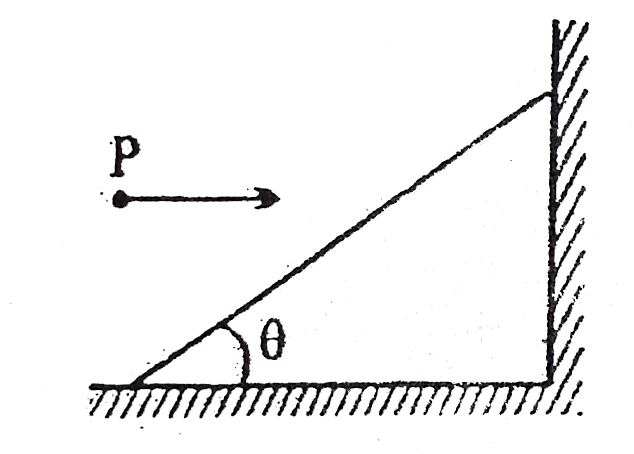
In the figure shown a particle P strikes...

In the figure shown a particle P strikes the inclined smooth plane horizontally and rebounds vertically if the angle `theta` is `60^(@)` then the coefficient of restitution is:

A

`1//3`

B

`1//sqrt(2)`

C

`1//2`

D

`1`

Text Solution

Verified by Experts

The correct Answer is:

A

`tan30^(@)=(eVsin 60^(@))/tan60^(@)`
`e=tan30^(@)/tan60^(@)= tan^(2)30^(@)`
Promotional Banner

Topper's Solved these Questions

  • MASTER PRACTICE PROBLEM

    BANSAL|Exercise Comphrehension|134 Videos
  • MASTER PRACTICE PROBLEM

    BANSAL|Exercise Reasoning|75 Videos
  • FLUID MECHANICS

    BANSAL|Exercise PYQS AIEEE|10 Videos
  • SEMICONDUCTORS

    BANSAL|Exercise CBSE Question|32 Videos

Similar Questions

Explore conceptually related problems

A ball strikes a smooth horizontal floor obliquely and rebounds inelastically.

A particle strikes a smooth horizontal surface at an angle theta gt 0 and it rebounds at an angle phi as shown

A steel ball strikes a fixed smooth steel plate placed on a horizontal surface at an angle theta with the vertical. If the coefficient of restitution is e, the angle at which the rebound will take place is:

A ball is projected in a direction inclined to the vertical and bounces on a smooth horizontal plane. The range of one rebound is R . If the coefficient of restitution is e , then range of the next rebound is

A body is fired from point P and strikes at Q inside a smooth circular wall as shown in the figure. It rebounds to point S (diametrically opposite to P). The coefficient of restitution will be:

A particle moving on a smooth horizontal surface strikes a stationary wall. The angle of strike is equal to the angle of rebound & is equal to 37^(@) and the coefficient of restitution with wall is e = (1)/(5) . Find the friction coefficient between wall and the particle form (X)/(10) and fill value of X :

A ball is thrown onto a smooth floor with speed u at angle theta = 45^(@) . If it rebounds with a speed v at the same angle phi = 45^(@) . Then the coefficient of restitution is

BANSAL-MASTER PRACTICE PROBLEM-Additional topic
  1. In the figure shown a particle P strikes the inclined smooth plane hor...

    Text Solution

    |

  2. The manifestation of band structure in solids is due to

    Text Solution

    |

  3. When p-n junction diode is forward biased then

    Text Solution

    |

  4. If the ratio of the concentration of electron to that of holes in a se...

    Text Solution

    |

  5. If the lattice constant of this semiconductor is decreased, then which...

    Text Solution

    |

  6. In the following, which one of the diodes is reverse biased ?

    Text Solution

    |

  7. The circuit has two oppositively connected ideal diodes in parallel wh...

    Text Solution

    |

  8. If a p-n junction diode, a square input signal of 10 V is applied as s...

    Text Solution

    |

  9. In the circuit below, A and B represents two inputs and C represents t...

    Text Solution

    |

  10. A p-n junction (D) shown in the figure can act as a rectifier. An alte...

    Text Solution

    |

  11. The logic circuit shown below has the input waveforms ‘A’ and ‘B’ as s...

    Text Solution

    |

  12. The combination of gates shown below yields .

    Text Solution

    |

  13. Truth table for system of four NAND gates as shown in figure is : .

    Text Solution

    |

  14. In semiconductor the concentrations of electron and holes are 8xx10^(1...

    Text Solution

    |

  15. A potential difference of 2V is applied between the opposite faces of ...

    Text Solution

    |

  16. The main cause of avalence breakdown is

    Text Solution

    |

  17. A cube of germanium is placed between the poles of a magnet and a volt...

    Text Solution

    |

  18. In the given figure, which of the diodes are forward biased?

    Text Solution

    |

  19. Current in the circuit will be

    Text Solution

    |

  20. The diode used in the circuit shown in the figure has a constant volta...

    Text Solution

    |

  21. In the following circuits PN-junction diodes D(1), D(2) and D(3) are i...

    Text Solution

    |
