Home
Class 12
PHYSICS
A spherical insulator of radius R is cha...

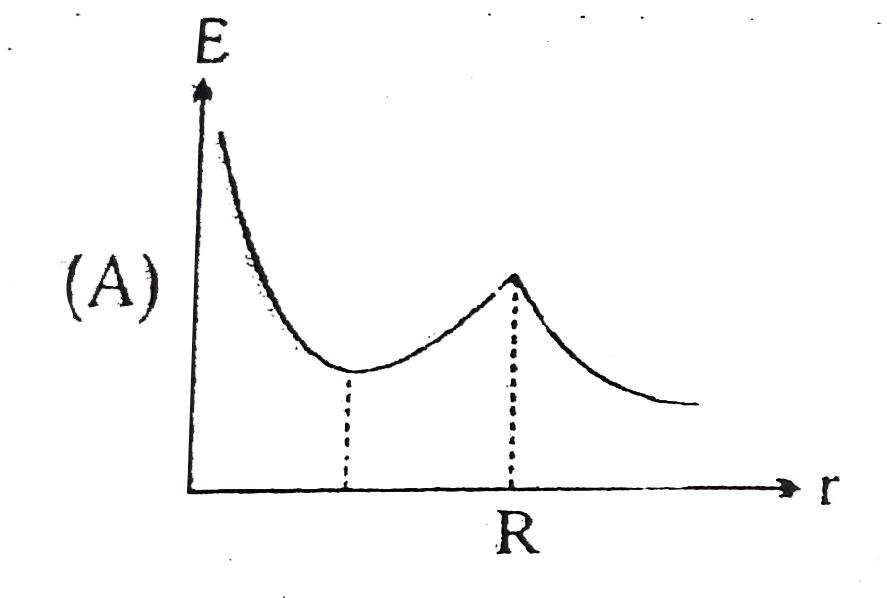
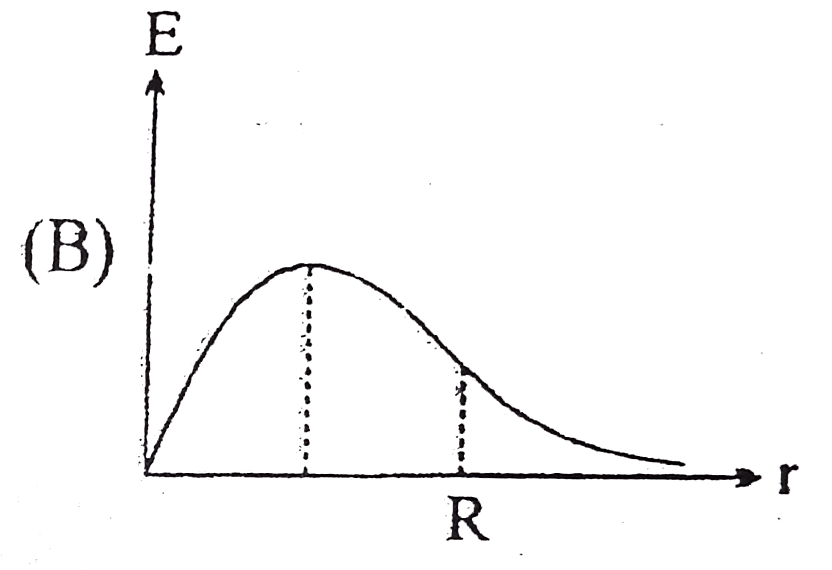
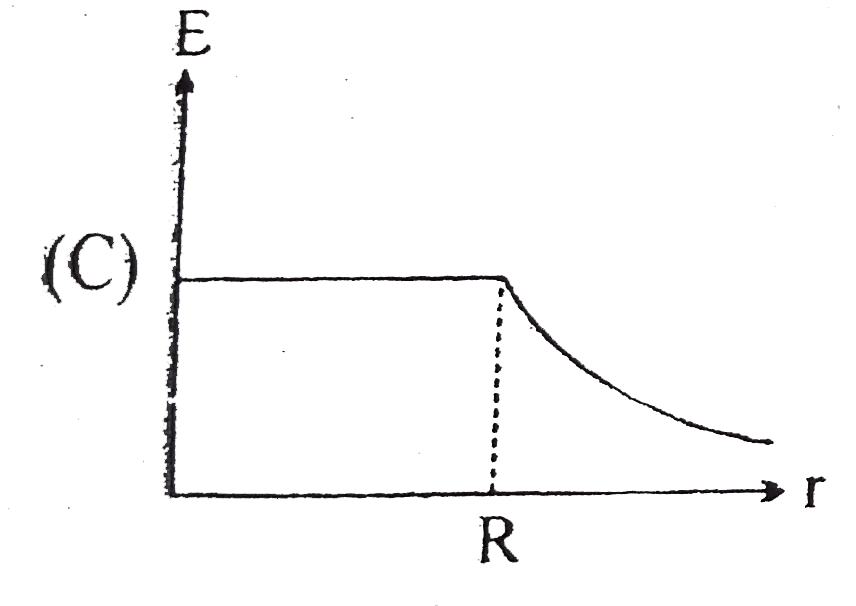
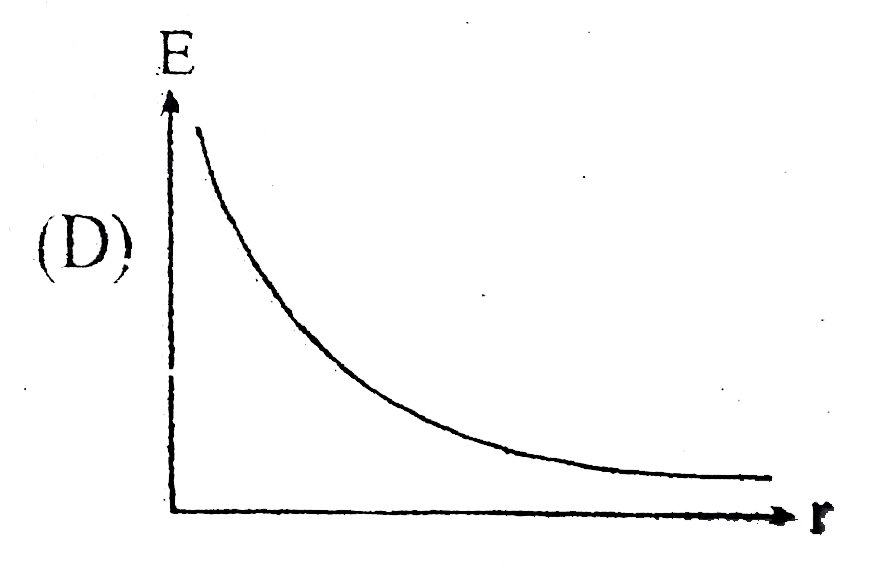
A spherical insulator of radius R is charged uniformly with a charge Q throughout its volume and contains a point charge `Q/16` located at its centre. Which of the following graphs best represent quanlitatively, the variation of electric field intensity E with distance r from the centre.

A

B

C

D

Text Solution

AI Generated Solution

The correct Answer is:

To solve the problem of the electric field intensity \( E \) variation with distance \( r \) from the center of a uniformly charged spherical insulator containing a point charge at its center, we can follow these steps: ### Step 1: Understand the System We have a spherical insulator of radius \( R \) uniformly charged with charge \( Q \) and a point charge \( \frac{Q}{16} \) at its center. The electric field \( E \) will vary based on the distance \( r \) from the center. ### Step 2: Analyze the Electric Field Inside the Sphere For a uniformly charged sphere, the electric field inside the sphere (at a distance \( r < R \)) can be calculated using Gauss's law. The electric field \( E \) at a distance \( r \) from the center is given by: \[ E = \frac{1}{4\pi \epsilon_0} \left( \frac{Q_{\text{enc}}}{r^2} \right) \] Where \( Q_{\text{enc}} \) is the charge enclosed within the Gaussian surface of radius \( r \). The charge enclosed is the charge due to the point charge at the center and the charge distributed in the volume of the sphere. ### Step 3: Calculate the Enclosed Charge The charge enclosed \( Q_{\text{enc}} \) at a distance \( r \) is given by: \[ Q_{\text{enc}} = \frac{Q}{V} \cdot V_{\text{enc}} + \frac{Q}{16} \] Where \( V \) is the total volume of the sphere and \( V_{\text{enc}} \) is the volume of the sphere of radius \( r \): \[ V = \frac{4}{3} \pi R^3, \quad V_{\text{enc}} = \frac{4}{3} \pi r^3 \] Thus, \[ Q_{\text{enc}} = \left( \frac{Q}{\frac{4}{3} \pi R^3} \cdot \frac{4}{3} \pi r^3 \right) + \frac{Q}{16} = Q \frac{r^3}{R^3} + \frac{Q}{16} \] ### Step 4: Electric Field Inside the Sphere Substituting \( Q_{\text{enc}} \) back into the electric field equation gives: \[ E = \frac{1}{4\pi \epsilon_0} \left( \frac{Q \frac{r^3}{R^3} + \frac{Q}{16}}{r^2} \right) \] This shows that the electric field inside the sphere will increase with \( r \) until it reaches the surface. ### Step 5: Electric Field Outside the Sphere For \( r > R \), the entire charge \( Q + \frac{Q}{16} \) can be treated as a point charge at the center. Therefore, the electric field outside the sphere is given by: \[ E = \frac{1}{4\pi \epsilon_0} \left( \frac{Q + \frac{Q}{16}}{r^2} \right) = \frac{1}{4\pi \epsilon_0} \left( \frac{17Q/16}{r^2} \right) \] ### Step 6: Graphical Representation 1. **Inside the Sphere (0 < r < R)**: The electric field starts from zero, increases as \( r \) increases, and reaches a maximum at \( r = R \). 2. **At the Surface (r = R)**: The electric field will have a maximum value. 3. **Outside the Sphere (r > R)**: The electric field decreases as \( \frac{1}{r^2} \). ### Conclusion The graph that best represents the variation of electric field intensity \( E \) with distance \( r \) from the center will show an increase in \( E \) from \( r = 0 \) to \( r = R \), followed by a decrease for \( r > R \).

To solve the problem of the electric field intensity \( E \) variation with distance \( r \) from the center of a uniformly charged spherical insulator containing a point charge at its center, we can follow these steps: ### Step 1: Understand the System We have a spherical insulator of radius \( R \) uniformly charged with charge \( Q \) and a point charge \( \frac{Q}{16} \) at its center. The electric field \( E \) will vary based on the distance \( r \) from the center. ### Step 2: Analyze the Electric Field Inside the Sphere For a uniformly charged sphere, the electric field inside the sphere (at a distance \( r < R \)) can be calculated using Gauss's law. The electric field \( E \) at a distance \( r \) from the center is given by: ...
Promotional Banner

Topper's Solved these Questions

  • MASTER PRACTICE PROBLEM

    BANSAL|Exercise Comphrehension|134 Videos
  • MASTER PRACTICE PROBLEM

    BANSAL|Exercise Reasoning|75 Videos
  • FLUID MECHANICS

    BANSAL|Exercise PYQS AIEEE|10 Videos
  • SEMICONDUCTORS

    BANSAL|Exercise CBSE Question|32 Videos

Similar Questions

Explore conceptually related problems

Which one of the following graphs represents the variation of electric field with distance r from the centre of a charged spherical conductor of radius R?

Figure shows two concentric shells of radii a and b uniformly distributed charges q and -q. Which of the following graphs gives correct variation of electric field intensity E with the distance r from the centre?

A metallic spherical shell of radius R has a charge -Q on it. A point charge +Q is placed at the centre of the shell. Which of the graphs shown below may correctly represent the variation of electric field E with distance r from the centre of shell ?

For a uniformly charged non conducting sphere of radius R which of following shows a correct graph between the electric field intensity and the distance from the centre of sphere –

A ring of radius R is charged uniformly with a charge +Q . The potential at a point on its axis at a distance 'r' from any point on ring will be-

A sphere of radius R, is charged uniformly with total charge Q. Then correct statement for electric field is (r = distance from centre): -

BANSAL-MASTER PRACTICE PROBLEM-Additional topic
  1. A spherical insulator of radius R is charged uniformly with a charge Q...

    Text Solution

    |

  2. The manifestation of band structure in solids is due to

    Text Solution

    |

  3. When p-n junction diode is forward biased then

    Text Solution

    |

  4. If the ratio of the concentration of electron to that of holes in a se...

    Text Solution

    |

  5. If the lattice constant of this semiconductor is decreased, then which...

    Text Solution

    |

  6. In the following, which one of the diodes is reverse biased ?

    Text Solution

    |

  7. The circuit has two oppositively connected ideal diodes in parallel wh...

    Text Solution

    |

  8. If a p-n junction diode, a square input signal of 10 V is applied as s...

    Text Solution

    |

  9. In the circuit below, A and B represents two inputs and C represents t...

    Text Solution

    |

  10. A p-n junction (D) shown in the figure can act as a rectifier. An alte...

    Text Solution

    |

  11. The logic circuit shown below has the input waveforms ‘A’ and ‘B’ as s...

    Text Solution

    |

  12. The combination of gates shown below yields .

    Text Solution

    |

  13. Truth table for system of four NAND gates as shown in figure is : .

    Text Solution

    |

  14. In semiconductor the concentrations of electron and holes are 8xx10^(1...

    Text Solution

    |

  15. A potential difference of 2V is applied between the opposite faces of ...

    Text Solution

    |

  16. The main cause of avalence breakdown is

    Text Solution

    |

  17. A cube of germanium is placed between the poles of a magnet and a volt...

    Text Solution

    |

  18. In the given figure, which of the diodes are forward biased?

    Text Solution

    |

  19. Current in the circuit will be

    Text Solution

    |

  20. The diode used in the circuit shown in the figure has a constant volta...

    Text Solution

    |

  21. In the following circuits PN-junction diodes D(1), D(2) and D(3) are i...

    Text Solution

    |
