Home
Class 12
PHYSICS
Refer to the circuit diagram and the cor...

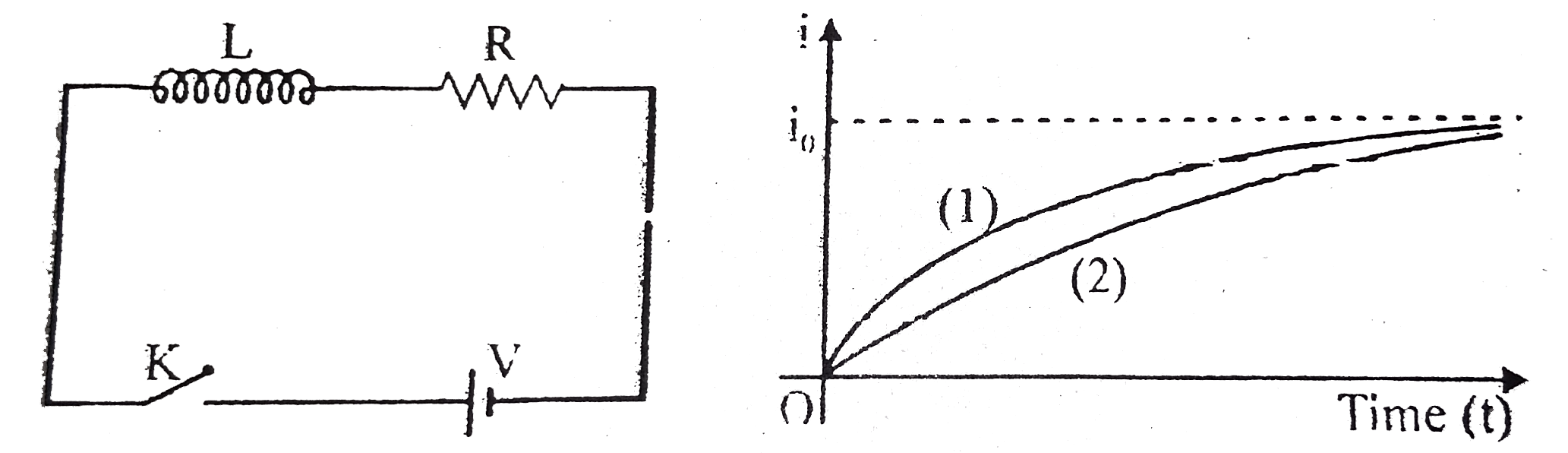
Refer to the circuit diagram and the corresponding graphs. The current rises when key K is pressed. With R=`R_(1) and L=L_(1)` the rise of current is shown by curve(1), while curve(2) shows the rise of current when `R=R_(2) and L = L_(2)`. The maximum current is same for both curves, then:

A

`R_(1)= R_(2),L_(1)gtL_(2)`

B

`R_(1)gt R_(2),L_(1) = L_(2)`

C

`R_(1)gtR_(2),L_(1)ltL_(2)`

D

`R_(1)=R_(2),L_(1)ltL_(2)`

Text Solution

Verified by Experts

The correct Answer is:

D

Consider the expression for the current rising exponentially in the LR circuit. The time constant is `(L//R)`. In this case the curve (1) is rising faster than curve (2) indicating that `(L_(1)//R_(1))lt(L_(2)//R_(2))`. However, in both the cases the maximum current is the same and equal to `(V//R_(1)) or (V//R_(2))`. which means `R_(1) = R_(2)`
Promotional Banner

Topper's Solved these Questions

  • MASTER PRACTICE PROBLEM

    BANSAL|Exercise Comphrehension|134 Videos
  • MASTER PRACTICE PROBLEM

    BANSAL|Exercise Reasoning|75 Videos
  • FLUID MECHANICS

    BANSAL|Exercise PYQS AIEEE|10 Videos
  • SEMICONDUCTORS

    BANSAL|Exercise CBSE Question|32 Videos

Similar Questions

Explore conceptually related problems

In the given diagram find the current through R_(1) , when key K is open.

The current in the series L-C-R circuit is

In the circuit shown, the current I will be zero when R is

Growth and decay of current In L-R Circuit

A series L-C-R circuit is given in figure . The current through the circuit is

Two inductors L_(1) and L_(2) are connected in parallel and a time varying current flows as shown. the ratio of current i-(1)//i_(2)

Asseration: The growth of current in (R_L) circuite is uniform. Reason: Inductor (L) opposes the growth of current.

In the circuit diagram shown in Figure, R=10 Omega, L=l5H, E=20v, i=2A . This current is decreasing at a rate of -1.0A//s. Find V_(ab) at this instant.

During current growth in an L-R circuit the time constant is the time in which the magnitude of current becomes

BANSAL-MASTER PRACTICE PROBLEM-Additional topic
  1. Refer to the circuit diagram and the corresponding graphs. The current...

    Text Solution

    |

  2. The manifestation of band structure in solids is due to

    Text Solution

    |

  3. When p-n junction diode is forward biased then

    Text Solution

    |

  4. If the ratio of the concentration of electron to that of holes in a se...

    Text Solution

    |

  5. If the lattice constant of this semiconductor is decreased, then which...

    Text Solution

    |

  6. In the following, which one of the diodes is reverse biased ?

    Text Solution

    |

  7. The circuit has two oppositively connected ideal diodes in parallel wh...

    Text Solution

    |

  8. If a p-n junction diode, a square input signal of 10 V is applied as s...

    Text Solution

    |

  9. In the circuit below, A and B represents two inputs and C represents t...

    Text Solution

    |

  10. A p-n junction (D) shown in the figure can act as a rectifier. An alte...

    Text Solution

    |

  11. The logic circuit shown below has the input waveforms ‘A’ and ‘B’ as s...

    Text Solution

    |

  12. The combination of gates shown below yields .

    Text Solution

    |

  13. Truth table for system of four NAND gates as shown in figure is : .

    Text Solution

    |

  14. In semiconductor the concentrations of electron and holes are 8xx10^(1...

    Text Solution

    |

  15. A potential difference of 2V is applied between the opposite faces of ...

    Text Solution

    |

  16. The main cause of avalence breakdown is

    Text Solution

    |

  17. A cube of germanium is placed between the poles of a magnet and a volt...

    Text Solution

    |

  18. In the given figure, which of the diodes are forward biased?

    Text Solution

    |

  19. Current in the circuit will be

    Text Solution

    |

  20. The diode used in the circuit shown in the figure has a constant volta...

    Text Solution

    |

  21. In the following circuits PN-junction diodes D(1), D(2) and D(3) are i...

    Text Solution

    |
