Home
Class 12
PHYSICS
A thin perfectly transparent glass sheet...

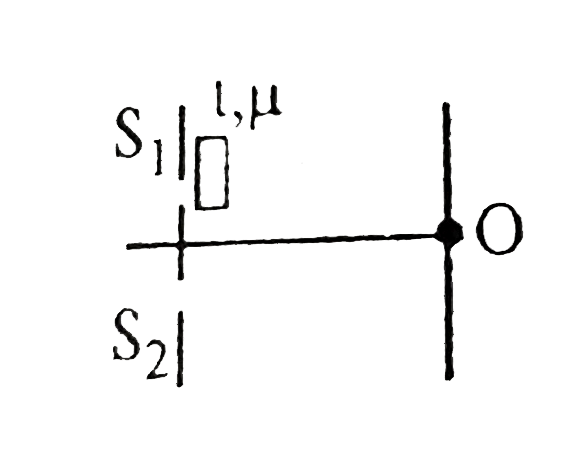
A thin perfectly transparent glass sheet of thickness t and refractive index mu is pasted on one of the two identical slits. If the intensity of light at the centre of the screen is `I_(0)` in the absence of glass sheet, the intensity at O as a function of thickness of the glass plate is

A

`I_(0)cos((mut)/lambda)`

B

`I_(0)cos^(2)((mut)/lambda)`

C

`I_(0)cos^(2)((pi(mu-I)t)/lambda)`

D

`I_(0)cos((pi(mu-I)t)/lambda)`

Text Solution

Verified by Experts

The correct Answer is:
C

`S_(1)O-S_(2)O=(mu-1)t`
`Deltaphi=(2pi)/lambda(mu-1)t`
`I=I_(max)cos^(2)(Deltaphi//2)`
`:.I=I_(0)cos^(2)((pi(mu-1)t)/lambda)`
Promotional Banner

Topper's Solved these Questions

  • MASTER PRACTICE PROBLEM

    BANSAL|Exercise Comphrehension|134 Videos
  • MASTER PRACTICE PROBLEM

    BANSAL|Exercise Reasoning|75 Videos
  • FLUID MECHANICS

    BANSAL|Exercise PYQS AIEEE|10 Videos
  • SEMICONDUCTORS

    BANSAL|Exercise CBSE Question|32 Videos

Similar Questions

Explore conceptually related problems

A thin glass plate of thickness t and refractive index mu is inserted between screen and one of the slits in a young's experiment. If the intensity at the centre of the screen is I, what was the intensity at the same point prior to the introduction of the sheet.

When a thin transparent plate of thickness t and refractive index mu is placed in the path of one the two interfering waves of light, then the path difference changes by

A thin glass plate of thickness t and refractive index mu is between screen &one of the slits in young's experiment.if the intensity at the center of the screen is I ,was the intenstity at the same point prior to the introduction of the sheet. (b) One slit of a young's experiment is covered by a glass plate (mu_(1)=1.4) and the other by another glass plate (mu_(2)=1.7) of the same thickness. The point of central maxima of the screen,before the plates were introduced is now occupied by the third bright fringe.Find the thicknes of the thickness of the plates.the wavelength of light used in 4000Å .

A monochromatic light of lambda=500 nm is incident on two identical slits separated by a distance of 5xx10^(-4)m . The interference pattern is seen on a screen placed at a distance of 1 m from the plane of slits. A thin glass plate of thickness 1.5xx10^(-6)m and refractive index mu=1.5 is placed between one of the slits and the screen. Find the intensity at the centre of the screen if the intensity is I_(0) in the absence of the plate. Also find the lateral shift of the central maxima and number of fringes crossed through centre.

Monochromatic light of lamba=5000Å is incident on two slits separately by a distance of 5xx10^(-4)m . The interference patteren is seen on a screen placed at a distance of 1m form the slits. A thing glass plate of thicknes 1.5xx10^(-6)m and refractive index mu=1.5 is placed between one of the slits and the screen. Find the intensity at the centre of the screen if the density there is I_(0) in the absence of the plate. Also find the lateral shift of the central maximum. '

In Young’s double slit experiment a monochromatic light of wavelength lambda from a distant point source is inci- dent upon the two identical slits.The interference pattern is viewed on a distant screen. Intensity at a point P is equal to the intensity due to individual slits (equal to I_(0) ). A thin piece of glass of thickness t and refractive index mu is placed in front of the slit which is at larger distance from point P, perpendicular to the light path. Assume no absorption of light energy by the glass. (a) Write intensity at point P as a function of t. (b) Write all values of t for which the intensity at P is minimum.

Light travels through a glass plate of thickness t and refractive index mu. If c is the speed of light in vacuum, the time taken by light to travel this thickness of glass is

Light travel through a glass place of thickness t and refractive index 'n'. If c is the velocity of light in vacuum, then the time taken by light to travel the thickness of the plate will be

If a thin mica sheet of thickness 't' and refractive index mu is placed in the path of one of the waves producing interference , then the whole interference pattern shifts towards the side of the sheet by a distance

BANSAL-MASTER PRACTICE PROBLEM-Additional topic
  1. A thin perfectly transparent glass sheet of thickness t and refractive...

    Text Solution

    |

  2. The manifestation of band structure in solids is due to

    Text Solution

    |

  3. When p-n junction diode is forward biased then

    Text Solution

    |

  4. If the ratio of the concentration of electron to that of holes in a se...

    Text Solution

    |

  5. If the lattice constant of this semiconductor is decreased, then which...

    Text Solution

    |

  6. In the following, which one of the diodes is reverse biased ?

    Text Solution

    |

  7. The circuit has two oppositively connected ideal diodes in parallel wh...

    Text Solution

    |

  8. If a p-n junction diode, a square input signal of 10 V is applied as s...

    Text Solution

    |

  9. In the circuit below, A and B represents two inputs and C represents t...

    Text Solution

    |

  10. A p-n junction (D) shown in the figure can act as a rectifier. An alte...

    Text Solution

    |

  11. The logic circuit shown below has the input waveforms ‘A’ and ‘B’ as s...

    Text Solution

    |

  12. The combination of gates shown below yields .

    Text Solution

    |

  13. Truth table for system of four NAND gates as shown in figure is : .

    Text Solution

    |

  14. In semiconductor the concentrations of electron and holes are 8xx10^(1...

    Text Solution

    |

  15. A potential difference of 2V is applied between the opposite faces of ...

    Text Solution

    |

  16. The main cause of avalence breakdown is

    Text Solution

    |

  17. A cube of germanium is placed between the poles of a magnet and a volt...

    Text Solution

    |

  18. In the given figure, which of the diodes are forward biased?

    Text Solution

    |

  19. Current in the circuit will be

    Text Solution

    |

  20. The diode used in the circuit shown in the figure has a constant volta...

    Text Solution

    |

  21. In the following circuits PN-junction diodes D(1), D(2) and D(3) are i...

    Text Solution

    |

