Home
Class 11
PHYSICS
Shown in the diagram is a system of two ...

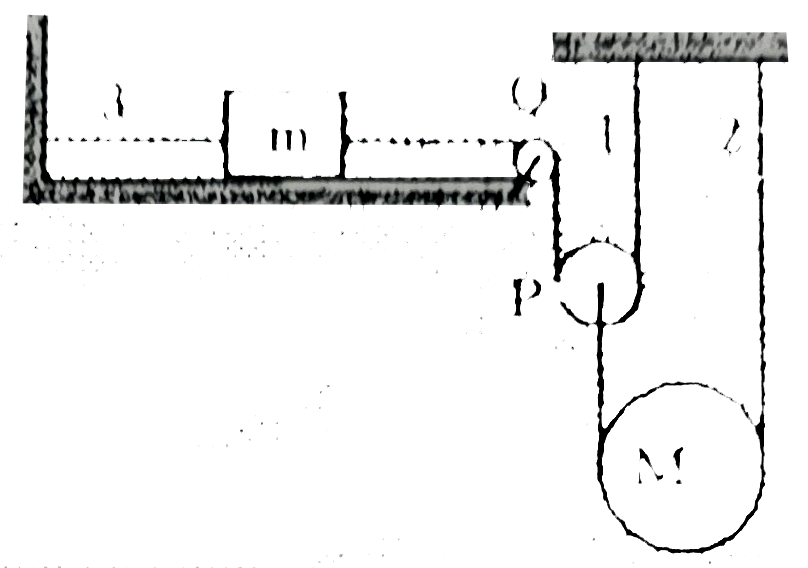
Shown in the diagram is a system of two bodies, a block of mas `m` and a disc of mass `M`, held in equilibrium. If the string `3` is burnt, find the acceleration of the disc. Neglect the masses of the pulleys `P` and `Q`. (The coefficient of friction between the block and horizontal surface is `mu`)

Text Solution

Verified by Experts
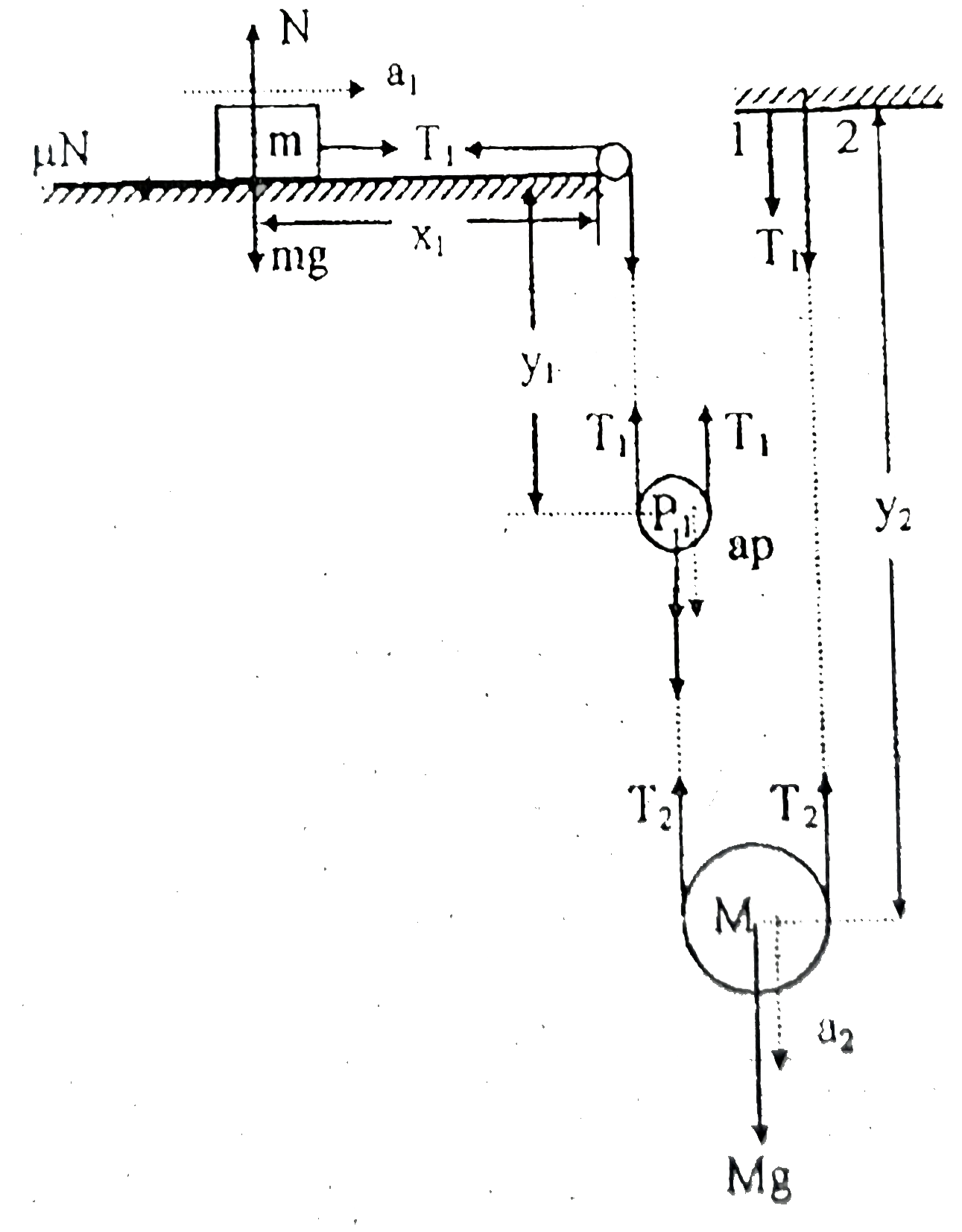
Referring to the free-body diagram we write the equation of motion.
For the block `m` :
`T_(1)-muN=ma_(1)`……(`1`)
and `N-mg=0`…(`2`)
For pulley `P` :
`m_(p)g+T_(2)-2T_(1)=m_(p)a_(p)`
Since the pulley is light,
`:. m_(p)~~0`
`rArr T_(2)=2T_(1)`.....(`3`)
For disc `M`.
`Mg-2T_(2)=Ma_(2)`......(`4`)
From the geometry of the figure the positions of the parts `m`, `P` and `M` are related as `x_(1)+2y_(1)=l_(1)` and `(y_(2)-y_(1))+y_(2)=l_(2)`, where `l_(1)` and `l_(2)` are the lengths of the strings `1` and `2`, respectively. Eliminating `y_(1)` from these two equations, we obtain,
`x_(1)+4y_(2)=l_(1)+2l_(2)` ,
Differntiating both sides twice w.r.t. time, we obtain `(d^(2)x_(1))/(dt^(2))+4(d^(1)y_(2))/(dt^(2))=0`
`rArra_(1)=4a_(2)`.....(`5`)
From Eqs. (`1`) and (`2`), we get
`T_(1)-mumg=ma_(1)`.......(`6`)
From Eqs. (`3`) and (`4`), we get
`Mg-4T_(1)=Ma_(2)`.....(`7`)
Eliminating `T_(1)` from Eqs. (`6`) and (`7`) and putting `a_(1)=4a_(2)`, we obtain
`a_(2)=(M-4mum)/(M+16m)g`.
Promotional Banner

Topper's Solved these Questions

Similar Questions

Explore conceptually related problems

Determine the acceleration of the 5 kg block A . Neglect the mass of the pulley and cords . The block B has a mass of 10 kg , The coefficient of kinetic friction between block B and the surface is mu _(k) = 0.1 (take g = 10 m//s^(2))

In the arrangement shown in fig neglect the masses of pulleys and string and also friction Calculate acceleration of blocks A and B

A force F accelerates a block of mass m on horizontal surface. The coefficient of friction between the contact surface is . The acceleration of m will be -

In the figure shown a ring of mass M and a block of mass m are in equilibrium. The string is light and pulley P does not offer any friction and coefficient of friction between pole and M is mu. The frictional force offered by the pole to M is

A block of mass m = 2kg is accelerating by a force F = 20N applied on a smooth light pulley as shown in the figure. If the coefficient of kinetic friction between the block and the surface is mu=0.3 , find its acceleration.

In terms of masses m_(1),m_(2) and g, find the acceleration of both the blocks shown in Fig. Neglect all friction and masses of the pulley.

A block of mass m slides over a smooth wedge of mass M which is placed over a rough horizontal surface . The centre of mass of the system will move towards left Here mu = coefficient of friction between the wedge and the ground .

A block of mass m is pulled by a force of constant power P placed on a rough horizontal plane. The friction coefficient between the block and the surface is mu . Then

find the acceleration of the block of mass M in the situation shown in figure. All the surfaces are frictionless and the pulleys and the string are light.

