Home
Class 11
PHYSICS
Two blocks of mass 10 kg and 30 kg are k...

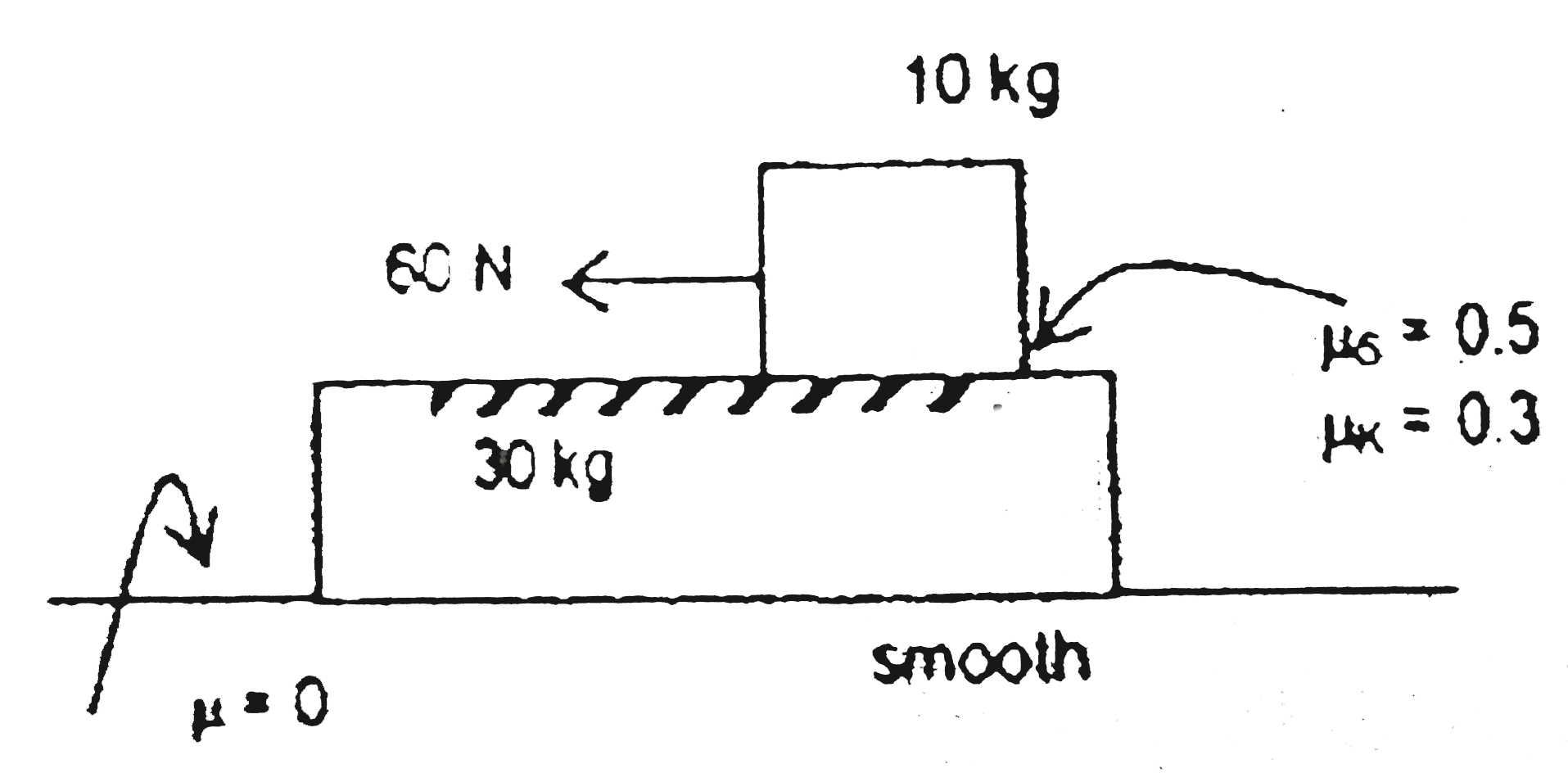
Two blocks of mass `10 kg` and `30 kg` are kept as shown in the figure. The surface between the block is fricitional while the ground is smooth. A horizontal force of magnitude `60 N` is applied horizontally on the upper block. Find the frictional force on block of mass `30 kg` ?

A

`20 N`

B

`30 N`

C

`45 N`

D

`50 N`

Text Solution

Verified by Experts

Let the both blocks are moving together, then
`a=(60)/(40)=1.5 m//s^(2)`.
thus, force on lower block has to be `F=Ma=30xx1.5=45N`
Next, `f_(L)=mu N=0.5xx10xx10=50N`
Since `F lt f_(L)` , both the blocks will move together, thus force of friction `=45 N`
Promotional Banner

Topper's Solved these Questions

Similar Questions

Explore conceptually related problems

A block of mass 10 kg is moving on a rough surface as shown in figure. The frictional force acting on block is :-

Two blocks of masses 4 kg and 6 kg are kept on a rough horizontal surface as shown. If the acceleration of 6 kg block is 5n , then n is :

If the mass of block is 1 kg and a force of 10 / sqrt3 N is applied horizontally on the block as shown in the figure . The frictional force acting on the block is :

Two block of mass 5 kg and 10 kg respectively are connected by a massless string as shown in the figure. The whole system is kept on a frictionless surface. A force of 50 N is applied horizontally as shown in the figure. The tension T in the string will be

Two blocks of masses 2 kg and 4 kg are kept on a frictionless and smooth inclined plane. The angle of inclination with horizontal is 30^(@) . A force of 60 N is applied parallel to the plane in upward direction. Find out the normal force in between two blocks.

A block A of mass 4 kg is kept on ground. The coefficient of friction between the block and the ground is 0.8 . The exernal force of magnitude 30 N is applied applied parallel to the ground. The resultant force exernal by the ground on the block is (g = 10 m//s^(2))

Block A of mass 5 kg is resting on a frictionless floor. Another block B of mass 7kg is resting on it as shown in the figure. The coefficient of friction between the blocks is 0.5 while kinetic friction is 0.4. If a force of 100 N is applied to block B, the acceleration of the block A will be ( g =10 ms^(-2)) :

A block of mass 4 kg is kept on ground. The co-efficient of friction between the block and the ground is 0.80. an external force of magnitude 30 N is applied parallel to the ground. The resultant force exerted by the ground on the block is (g=10m//x^(2))

A plank of mass 10 kg and a block of mass 2 kg are placed on a horizontal plane as shown in the figure. There is no friction between plane and plank. The coefficient of friction between block and plank is 0.5 .A force of 60 N is applied on plank horizontally. In first 2 s the work done by friction on the block is

