Home
Class 11
PHYSICS
A source of sound is moving along a circ...

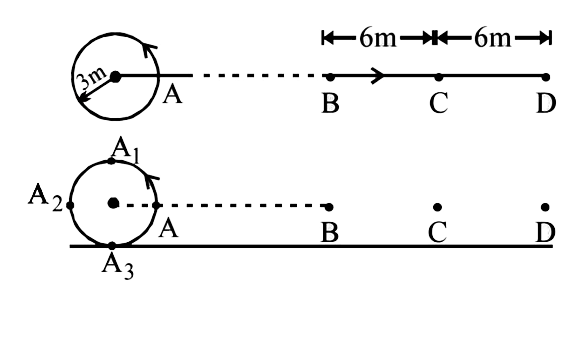
A source of sound is moving along a circular orbit of radius `3 meter` with an angular velocity of `10 rad//s`. A sound detector located far away from the source is executing linear simple harmonic motion along the line `BD` with an amplitude `BC = CD = 6 meters`. The frequency of oscillation of the detector is `(5)/(pi)` per second. The source is at the point `A` when the detector is at the point `B`. If the source emits a continuous sound wave of frequency `340 Hz`, Find the maximum and the minimum frequencies recorded by the detector.

Text Solution

Verified by Experts

The speed of sound in air `=340 m//s`
`r=3m`, `omega=10rad//s`. The linear speed of the source along the circular orbit is
`v_(s)-romega=3xx10m//s`
The detector is executing `SHM` of amplitude `a=6m` and frequency `n=5//pi Hz`. The angular velocity of the detector is
`omega'=2pin=2pixx5//pi=10rad//s`
and the linear velocity of the detector is
`u_(0)=aomega'=6xx10=60m//s`
Since the source and the detector have the same angular velocity (i.e. `omega=omega'`), they have the same time period `T`. At time `t=T//4`, the source will be at point `P` and the detector will be at point `C`.
Since they are receding from each other at the maximum relative velocity, the recorded frequency will be minimum which is given by
`n_(min)=n((v-u_(0))/(v+u_(s)))=340xx((340-60)/(340+30))=257Hz`
At a time `t=3T//4`, the source will be at point `Q` and the detector will be at point `C` approaching the source with the maximum relative. Hence the recorded frequency will be maximum which is given by
`n_(max)=n((v+u_(0))/(v-u_(s)))=340xx((340+60)/(340-30))=485.7Hz`

Promotional Banner

Topper's Solved these Questions

  • CONSERVATION OF MOMENTUM

    FIITJEE|Exercise Example|15 Videos
  • FLUID MECHANICS

    FIITJEE|Exercise Example|14 Videos

Similar Questions

Explore conceptually related problems

A source of sound of frequency 256 Hz is rotating in a circle of radius 3 m with angular speed of 20 rad/s. A listener is standing at rest along the line of centre of the circle. Under which position of the source of sound the listener will hear sound of (a) maximum frequency (b) minimum frequency (c) same frequency as the frequency of source.

A source of sound moves towards a listener with a velocity equal to that of sound. If the source emits n waves per second, then the listener moving away from the source with the same velocity receives

A small source of sound oscillates in simple harmonic motion with an amplitude of 17 cm. A detector is placed along the line of motion of the source. The source emits a sound of frequency 800 Hz which travels at a speed of 340 ms^-1 If the width of the frequency band detected by the detector is 8 Hz, find the time period of the source.

A source of sound emitting a 1200 Hz note travels along a straight line at a speed of 170 m s^-1 . A detector is placed at a distance of 200 m from the line of motion of the source. (a) Find the frequency of sound received by the detector at the instant when the source gets closest to it. (b) Find the distance between the source and the detector at the instant it detects the frequency 1200 Hz. Velocity of sound in air = 340 m s^-1 .

A body is executing simple harmonic motion with an angular frequency s rad/2 . The velocity of the body at 20 mm displacement, when the amplitude of motion is 60 mm , is

A stationary motion detector sends sound waves of frequency 3.00 MHz toward a truck approaching at a speed of 61.0 m/s. What is the frequency of the waves reflected back to the detector?

A source of sound emitting a note of frequency 200 Hz moves towards an observer with a velocity v equal to the velocity of sound. If the observer also moves away from the source with the same velocity v, the apparent frequency heard by the observer is

if the speed of a sound source is equal to the speed fo sound and the source is moving away from the observer, then the ratio of apparent frequency to the original frequency is

