Home
Class 11
PHYSICS
A glass tube of uniform internal radius ...

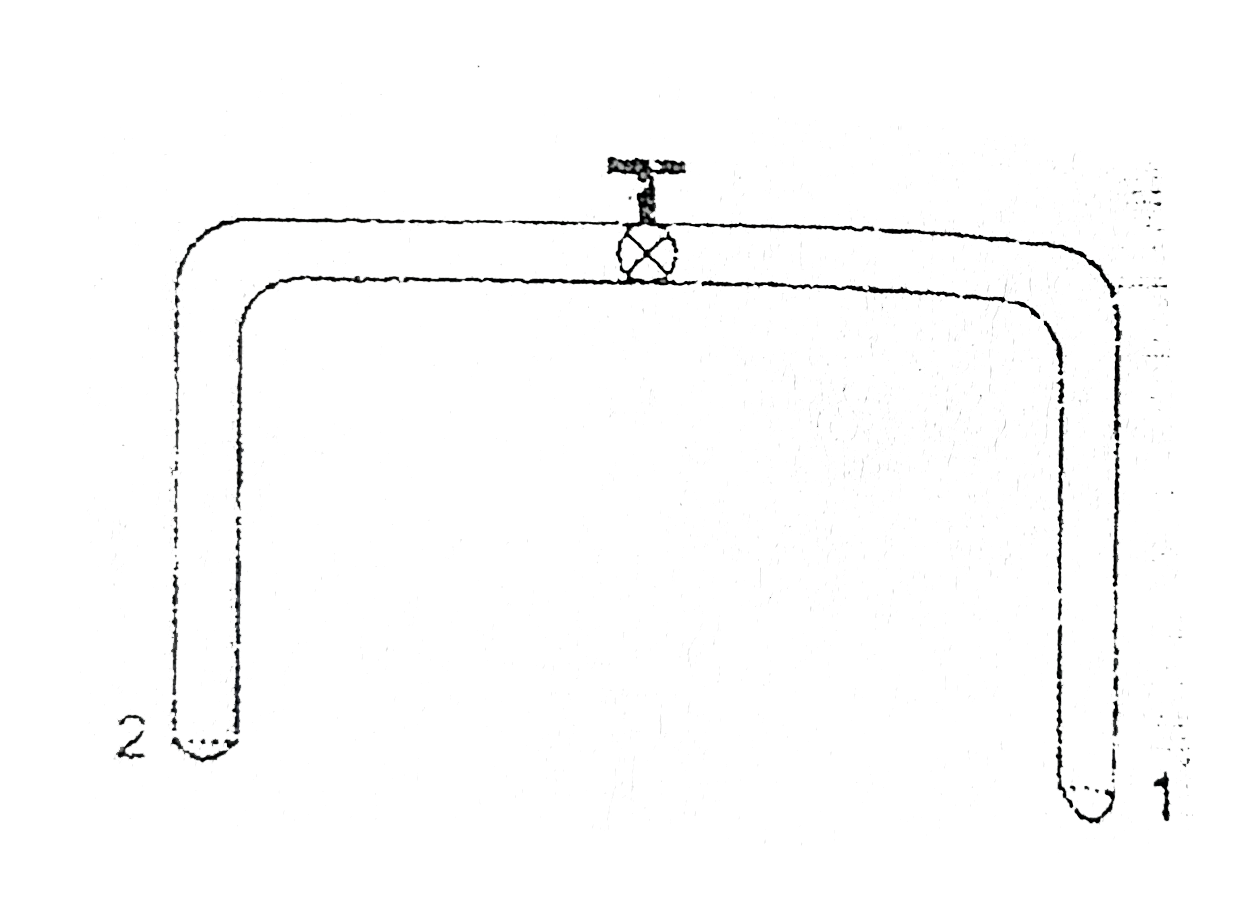
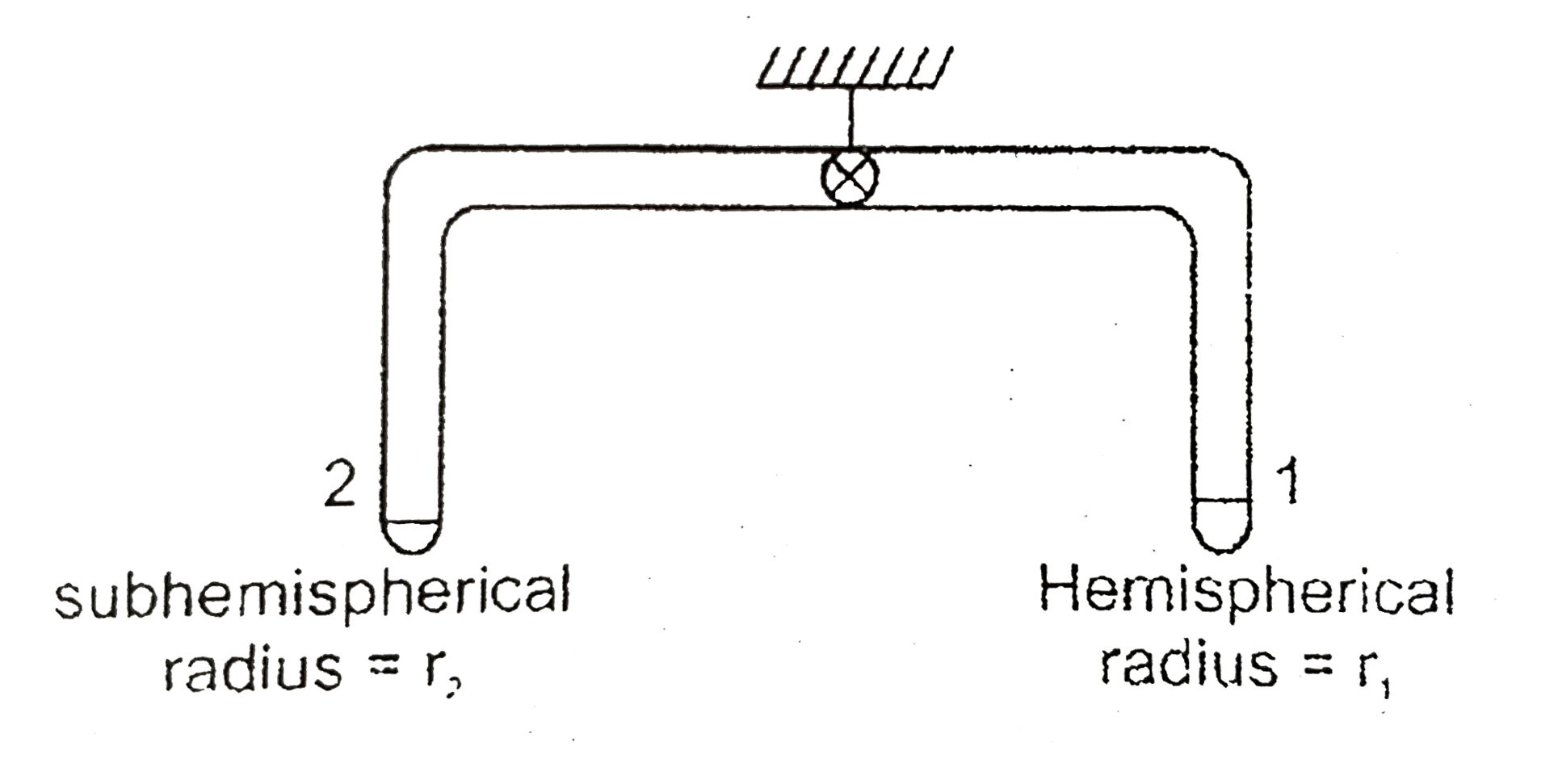
A glass tube of uniform internal radius `(r)` has a valve separating the two identical ends. Initially, the valve is in a tightly closed position. End `1` has a hemispherical soap bubble of radius `r`. End `2` has sub-hemispherical soap bubble as shown in figure. Just after opening the valve.

A

air from end `1` flows towards `2`. No change in the volume of the soap bubbles

B

air from end `1` flows towards end `2`. Volume of the soap bubble at end `1` decreases

C

no change occurs

D

air form end `2` flows towards end `1`. Volume of the soap bubble at end `1` increases.

Text Solution

Verified by Experts

The correct Answer is:
B

Pressure inside tube `= P = P_(0) + (4T)/(r)`
`:. P_(2) lt P_(1)` (since `r_(2) gt r_(1)`)
Hence pressure on side `1` will be greater than side `2`. So air from end `1` flows towards end `2`.
Promotional Banner

Topper's Solved these Questions

  • SURFACE TENSION

    RESONANCE|Exercise Exercise- 3 PART - II|7 Videos
  • SURFACE TENSION

    RESONANCE|Exercise Advanced Level Problems|18 Videos
  • SURFACE TENSION

    RESONANCE|Exercise Exercise- 2 PART - IV|5 Videos
  • STRING WAVES

    RESONANCE|Exercise Exercise|32 Videos
  • UNITS, DIMENSION & MEASUREMENT

    RESONANCE|Exercise Exercise|27 Videos

Similar Questions

Explore conceptually related problems

A glass tube of uniform internal radius(r) has a valve separating the two identical ends. Intially, the valve is in a tightly closed position. End 1 has a hemispherical soap bubble or radius r. End 2 has sub-hemispherical soap bubble as shown in figure. Just after opening the valve,

Two soap bubbles of radius R_1 and R_2 combine isothermally to form a new soap bubble. Find radius of new soap bubble

Two soap bubbles of radii r_(1) and r_(2) are attached as shown. Find the radius of curvature of the common film ACB.

Two spherical soap bubbles of radii r_1 and r_2 in vacuume collapse under isothermal condition. The resulting bubble has radius R such that

Two soap bubbles of radius r_(1) and r_(2) combine. Find radius of curvature of the common surface separating them.

Two spherical soap bubbles of a radii 1 cm and 2 cm vacuum coalesce under isothermal conditions . The resultant bubble has a radius of

An isolated and charged spherical soap bubble has a radius 'r' and the pressure inside is atmospheric. If 'T' is the surface tension of soap solution, then charge on drop is:

A soap bubble A of radius 0.03 m and another bubble B of radius 0.04 m are brought together, so that the combined bubble has a common interface of radius r, then the value of r is

A solid sphere having radius R and uniform charge density rho has a cavity of radius R/2 as shown in figure.Find the value of |E_A /E_B|

