Home
Class 11
PHYSICS
A circular disc of a diameter 'd' slowly...

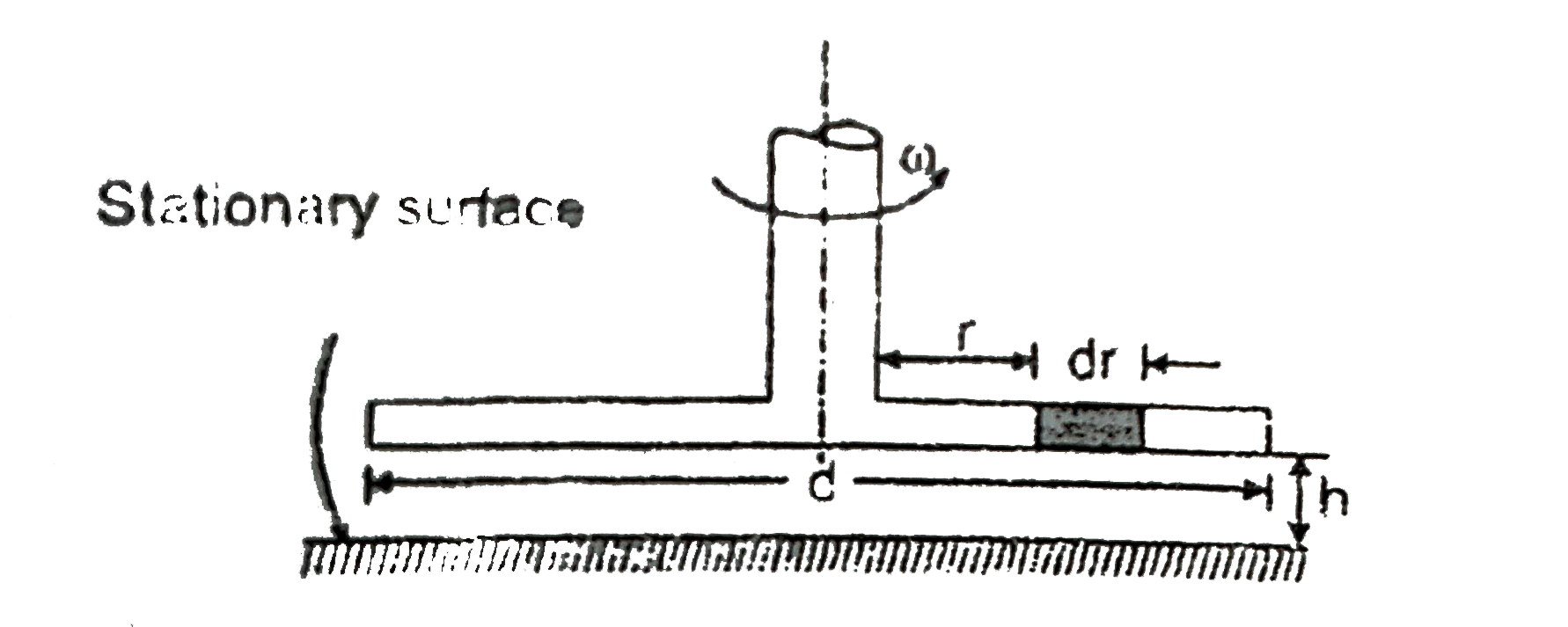
A circular disc of a diameter `'d'` slowly rotated in a liquid of large `'eta'` at a small distance `'h'` from a fixed surface as shown in figure. If an expression for torque `'tau'` necessary to maintain an angular velocity `'omega'` is `(pietad^(4))/(lambdah)` then fidn `lambda`.

Text Solution

Verified by Experts

The correct Answer is:

`32`

`dt = eta(2pirdr(omegar)/(h))`
`t = overset(r)underset(0)(int) (eta)/(h)2piomegar^(3)dr rArr t = int_(0)^(d//2)(etaomega)/(h)2pir^(3)dr`
`t = [(2pietaomega)/(h)(r^(4))/(4)]_(0)^(d//2) rArr t = (2pietaomega)/(h) (d^(4))/(4 xx 16)`
`t = ((pietaomegad^(4))/(32h))`
Promotional Banner

Topper's Solved these Questions

  • ELASTICITY AND VISCOCITY

    RESONANCE|Exercise Exercise- 2 PART - III|11 Videos
  • ELASTICITY AND VISCOCITY

    RESONANCE|Exercise Exercise- 3 PART - I|7 Videos
  • ELASTICITY AND VISCOCITY

    RESONANCE|Exercise Exercise- 2 PART - I|11 Videos
  • DAILY PRACTICE PROBLEMS

    RESONANCE|Exercise dpp 92 illustration|2 Videos
  • ELECTROMAGNETIC INDUCTION

    RESONANCE|Exercise Exercise|43 Videos

Similar Questions

Explore conceptually related problems

A liquid of density rho is in a vessel rotating with angular velocity omega as shown in figure. If P_0 is the atmospheric pressure, find pressure at a radial distance r from the axis. .

Select ALL correct answer : A disc of radius R is placed over a horizontal table in such a way that plane of the disc is horizontal and rotated about its vertical axis passing through its center with angular velocity omega . A layer of grease of thickness l is present between the table and the disc.Coefficient of viscosity of grease is eta .Then, (A) torque needed to rotate the disc with constant angular velocity is (pi eta omega R^(4))/(4l) (B) torque needed to rotate the disc with constant angular velocity is (pi eta omega R^(4))/(2l) (C) power needed to rotate the disc with constant angular velocity is (pi eta omega^(2)R^(4))/(2l) (D) power needed to rotate the disc with constant angular velocity is (pi n omega^(2)R^(4))/(4l)

A large rectangular box has been rotated with a constant angular velocity omega_(1) about its axis as shown in the figure. Another small box kept inside the bigger box is rotated in the same sense with angular velocity omega_(2) about its axis (which is fixed to floor of bigger box). A particle P has been identified, its angular velocity about AB would be

A thin rod of mass M and length a is free to rotate in horizontal plane about a fixed vertical axis passing through point O. A thin circular disc of mass M and of radius a/4 is pivoted on this rod with its center at a distance a/4 from the free end so that it can rotate freely about its vertical axis. Assume that both rod and disc have uniform density and they remain horizontal during motion. An outside stationary observer finds the rod rotating with an angular velocity Omega and the disc rotating about its vertical axis with angular velocity 4 Omega . Total angular momentum of system about point O is ((M a^2 Omega)/(48)) n . The value of n is

A small block of mass m is tied to the top of a smooth inclined plane with the help of a string of length L as shown in the figure. The inclined plane of inclination theta with horizontal is rotated with an angular velocity omega about a verticle axis passing through the end of the string fixed to the plane. (a) Find the maximum value of omega so that the block maintains contact with the inclined plane. (b) Find the ratio of the tension in the string and the normal reaction between the block and the plane.

A disc of mass 'm' and radius R is free to rotate in horizontal plane about a vetical smooth fixed axis passing through is centre. There is a smooth groove along the diameter of the disc and two small balls of mass m/2 each are placed in it on either side of the centre of the disc as shown in fig. The disc is given initial angular velocity omega_(0) and released. The angular speed of the disc when the balls reach the end of the disc is -

A disc of mass m and radius R is free to rotate in a horizontal plane about a vertical smooth fixed axis passing through its centre. There is a smooth groove along the diameter of the disc and two small balls of mass m//2 each are placed in it on either side of the centre of the disc as shown in Fig. The disc is given an initial angular velocity omega_(0) and released. The angular speed of the disc when the balls reach the end of the disc is
