Home
Class 12
CHEMISTRY
Reimer-Tiemann reaction introduces an al...

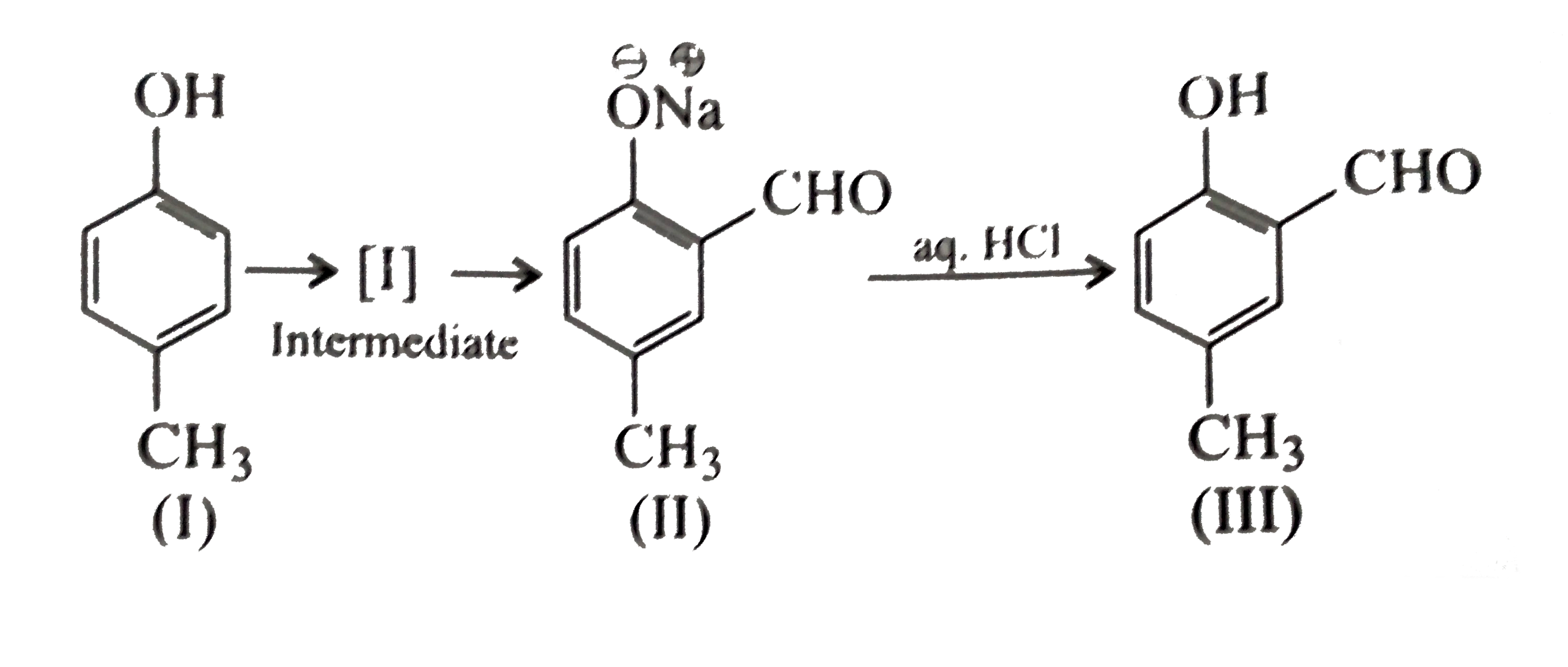
Reimer-Tiemann reaction introduces an aldehyde group on to the aromatic ring of phenol, ortho to the hydroxyl group. This reacrtion involves electrophilic aromatic subsititution. It is a general method for the synthesis of subsituted salicyladehydes as depiced below:

The electrophile in this reaction is:

A

`_(**)^(**)CHCl`

B

`^(+)CH Cl_(2)`

C

`_(**)^(**)C Cl_(2)`

D

`^(**)CH Cl_(2)`

Text Solution

Verified by Experts

The correct Answer is:

C
Promotional Banner

Topper's Solved these Questions

  • AROMATIC COMPOUNDS CONTAINING NITROGEN

    IIT-JEE PREVIOUS YEAR (CHEMISTRY)|Exercise CHAPTER TEST|1 Videos
  • ATOMIC STRUCTURE

    IIT-JEE PREVIOUS YEAR (CHEMISTRY)|Exercise Match the Columns|4 Videos

Similar Questions

Explore conceptually related problems

Reimer -Tiemann reaction introduces an aldehyde group on to the aromatic ring of phenol, ortho to the hydroxyl group. This reaction involves electrophilic aromatic substitution. This is a general method for the synthesis of substituted salicyladehydes as depicted below. The electrophile in this reaction is

Reimer-Tiemann reaction introduces an aldehyde group on to the aromatic ring of phenol, ortho to the hydroxyl group. This reacrtion involves electrophilic aromatic subsititution. It is a general method for the synthesis of subsituted salicyladehydes as depiced below: The structure of the intremediate (I) is:

Reimer-Tiemann reaction introduces an aldehyde group on to the aromatic ring of phenol, ortho to the hydroxyl group. This reacrtion involves electrophilic aromatic subsititution. It is a general method for the synthesis of subsituted salicyladehydes as depiced below: Which one of the following reagents is used in the above reaction ?

Reimer -Tiemann reaction introduces an aldehyde group on to the aromatic ring of phenol, ortho to the hydroxyl group. This reaction involves electrophilic aromatic substitution. This is a general method for the synthesis of substituted salicyladehydes as depicted below. The structure of the intermediate I is

IIT-JEE PREVIOUS YEAR (CHEMISTRY)-ARYL HALIDE AND PHENOLS-JEE Main And Advanced
  1. Assertion: Aryl halides undergoes nucleophilic substitution with ease...

    Text Solution

    |

  2. Reimer-Tiemann reaction introduces an aldehyde group on to the aromati...

    Text Solution

    |

  3. Reimer-Tiemann reaction introduces an aldehyde group on to the aromati...

    Text Solution

    |

  4. Reimer-Tiemann reaction introduces an aldehyde group on to the aromati...

    Text Solution

    |

  5. The number of resonannce structure for N is

    Text Solution

    |

  6. Amongst the three isomers of the nitrophenol, the one that is least so...

    Text Solution

    |

  7. Phenol is acidic because of the resonance stabilisation of its conjuga...

    Text Solution

    |

  8. Formation of phenol from chlorobenzene is an example of …. Aromatic ...

    Text Solution

    |

  9. The acidity of phenol is due to the ….. Of its anion.

    Text Solution

    |

  10. Carry out the following conversation. Phenol to aspirin Benzoic ac...

    Text Solution

    |

  11. How would you synthesise 4-methoxyphenol from bromobenzene in not mo...

    Text Solution

    |

  12. What would be the major product in the following reaction?

    Text Solution

    |

  13. Explain briefly the formation of the products giving the structures ...

    Text Solution

    |

  14. Complete the following, giving the structures of the principal orga...

    Text Solution

    |

  15. How will you prepare m-bromoiodobenzene from benzene (in not more t...

    Text Solution

    |

  16. Explain the following in one or two sentence only: 'Phenol is an acid...

    Text Solution

    |

  17. Complete the following with appropriate structures:

    Text Solution

    |

  18. Compound A,C(7)H(8)O, is insoluble in water, dilute HCl, and aquenous ...

    Text Solution

    |

  19. Give reason in one or two sentences form the following: 'o-nitrophenol...

    Text Solution

    |

  20. Which of the following compounds undergoes nucleophilic substitutio...

    Text Solution

    |
