Home
Class 11
PHYSICS
A circular ring of mass M and radius R i...

A circular ring of mass M and radius R is placed in YZ plane with centre at origin. A particle of mass m is released from rest at a point x = 2R. Find the speed with which it will pass the centre of ring .

Text Solution

Verified by Experts
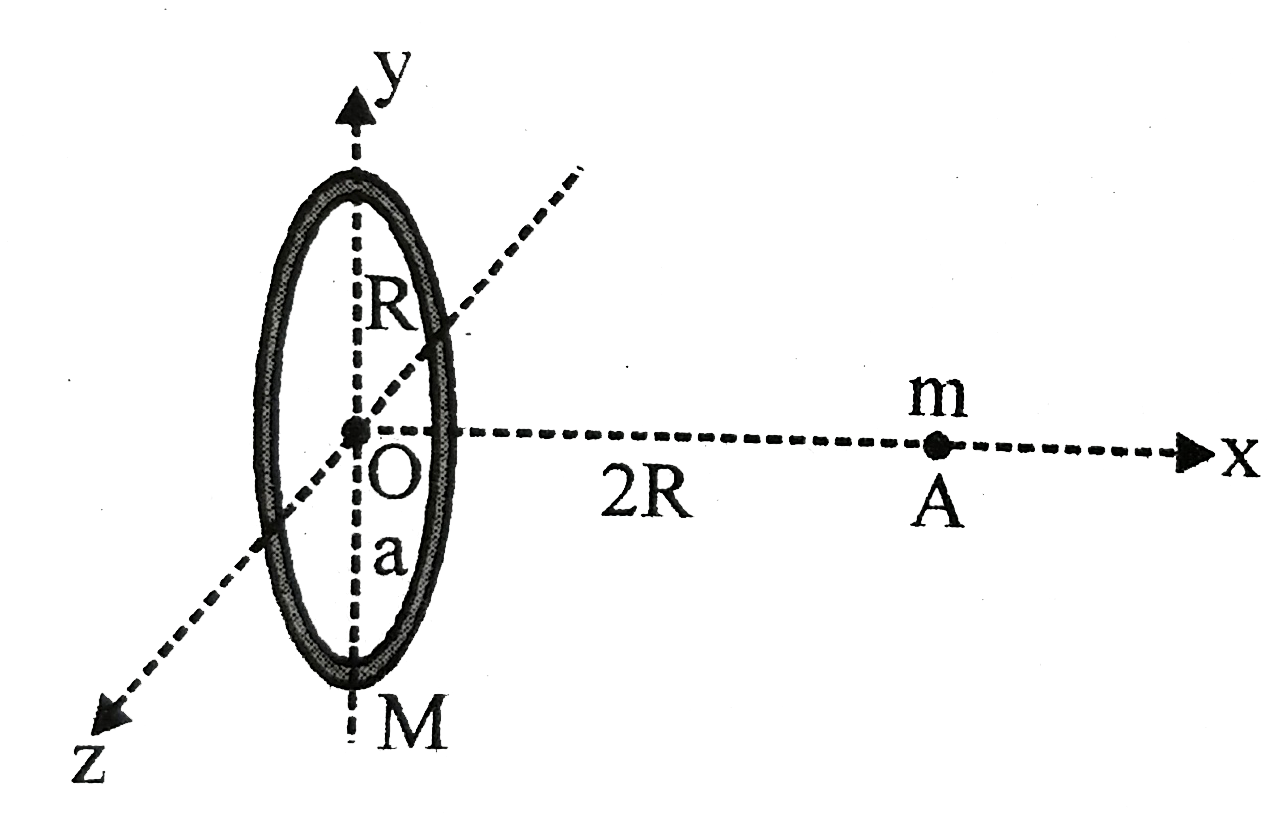

As shown in figure, first we find potential at A due to the ring, it is given as
`V_(A) = -(GM)/(sqrt(R^(2)+(2R)^(2))) = - (GM)/(sqrt(5R))`
Now potential at origin O due to ring is
`V_(0) = -(GM)/(R )`
When m moves from A to O, work done on it due to gravitational force is
`W = m(V_(A)-V_(0))=m(-(GM)/(sqrt(5)R)+(GM)/(R ))`
`= (GMm)/(R )((sqrt(5)-1)/(sqrt(5)))`
This work done gravitational force on m must be equal to the increase in kinetic energy of the mass m, thus we have
`(1)/(2) mv^(2) = ((sqrt(5)-1)/(sqrt(5)))(GMm)/(R )`
or `v = [(2(sqrt(5)-1)GM)/(sqrt(5)R)]^(1//2)`
This problem can also be solved simply by using energy conservation. Thus initially when m was at rest at point `A_(2)` the total energy of system is only gravitational potential energy given as
`E_(i) = m. V_(A)= - (GMm)/(sqrt(5)R)`
Finally when m pass through O, the total energy of system is
`E_(f) = (1)/(2) mv^(2)+mV_(0)`
`= (1)/(2)mv^(2)-(GMm)/(R )`
As no external work is done on the system in this case, the total energy of system must be conserved, thus according to energy conservation we have
`E_(i) = E_(f)`
`-(GMm)/(sqrt(5)R) = (1)/(2) mv^(2) - (GMm)/(R )`
`v = [(2(sqrt(5)-1)GM)/(sqrt(5)R)]^(1//2)`
Promotional Banner

Topper's Solved these Questions

  • GRAVITATION

    BANSAL|Exercise Solved Example|8 Videos
  • GRAVITATION

    BANSAL|Exercise Practice Exercise|18 Videos
  • CENTRE OF MASS & MOMENTUM CONSERVATION

    BANSAL|Exercise EXERCISE-4 (SECTION-B) (JEE-ADVANCED Previous Year Questions)|8 Videos
  • HEAT TRANSFER

    BANSAL|Exercise Exercise|89 Videos

Similar Questions

Explore conceptually related problems

The gravitational force vec(F) upon an object of mass m placed in external gravitational field vec(E )_("ext") is given by vec(F)=m vec(E )_("ext") . Consider a fixed mass ring (of mass M, radius R) in y-z plane, with centre at (0,0) and axis of ring along x direction. If the particle (mass m) is released from rest from a point distant x = R sqrt(3) , then it will pass through the centre of ring with speed

A point P(Rsqrt(3),0,0) lies on the axis of ring of mass M and radius R the ring is located in YZ plane with its centre at origin O A small particle of mass m starts from P and reaches O under gravitatinal attracton only its speed at O will be

A ring with a uniform charge Q and radius R , is placed in the yz plane with its centre at the origin

A point P(R sqrt(3),0,0) lies on the axis of a ring of mass M and radius R. The ring is located in yx-plane with its centre at origin O. A small particle of mass m starts from P and reaches O under gravitational attraction only. Its speed at O will be

A point P (Rsqrt(3)m,0,) lies on the axis of a ring of mass M and radius R. The ring is located in y -z plane with its centre at origin. A small particle of mass m start from P and reaches O under gravitational attraction only. Its speed at O will be.

A circular ring of mass M and radius 'a' is placed in a gravity free space. A small particle of mass m placed on the axis of the ring at a distance sqrt(3)a from the center of the ring, is released from rest. The velocity with which the particle passes through the center of the ring is

For a uniform ring of mass M and radius R at its centre

A circular ring of mass m and radius R rests flat on a horizontal smooth surface as shown in figure. A particle of mass m , and moving with a velocity v . Collides inelastically (e=0) with the ring the angular velocity with which the system rotates after the particle strikes the ring is

Consider two identical rings of mass M and radius R fixed on a horizontal axis in a gravity - free space. A particle of mass m is held at rest at the centre of 1^("st") ring and projected along the axis towards 2^("nd") ring. The minimum speed of projection so that the particle reaches the centre of 2^("nd") ring is

