Home
Class 11
PHYSICS
A planet of mass m moves along an ellips...

A planet of mass `m` moves along an ellipse around the sun so that its maximum and minimum distance from the sun are equal to `r_(1)` and `r_(2)` respectively. Find the angular momentum of this planet relative to the centre of the sun. mass of the sun is `M`.

Text Solution

Verified by Experts
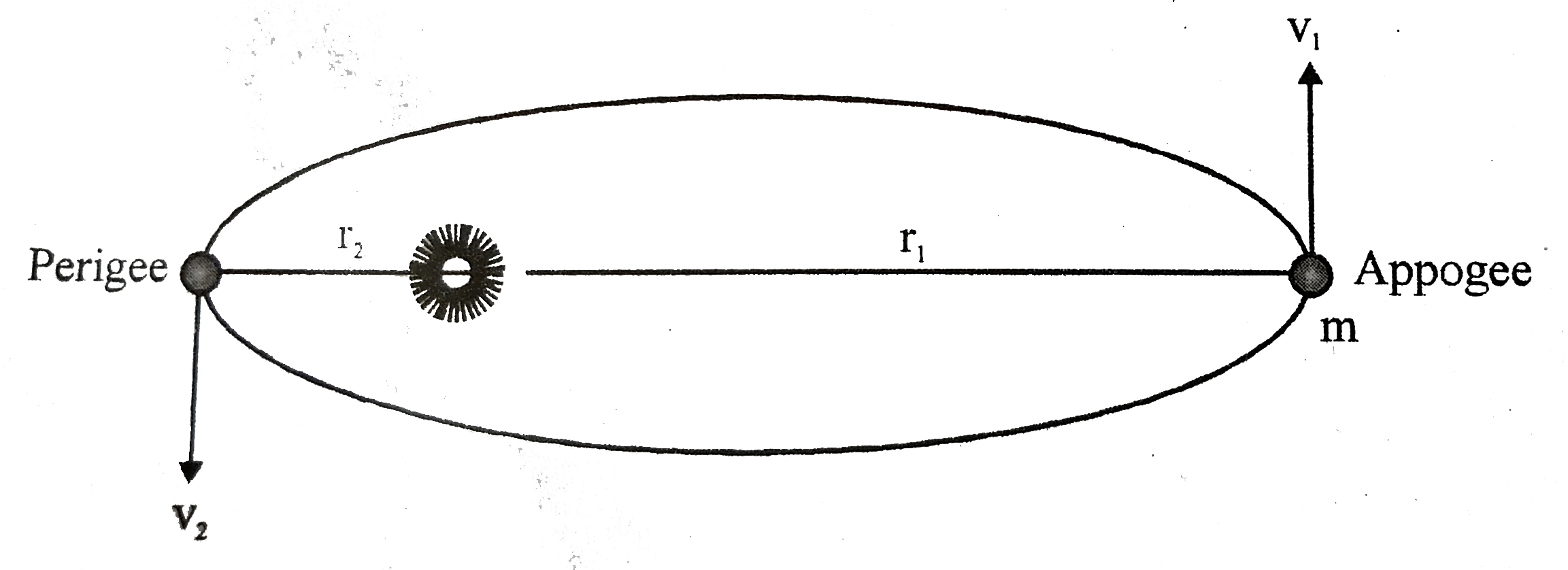
If `v_(1)` and `v_(2)` are the velocity of planet at its apogee and perigee respectively then according to conservation of angular momentum, we have
`mv_(1) r_(1) = m v_(2) r_(2)`
or `v_(1) r_(1) = v_(2) r_(2)`

As the total energy of the planet is also constant, we have
`-(GMm)/(r_(1))+(1)/(2)mv_(1)^(2)=-(GMm)/(r_(2))+(1)/(2)mv_(2)^(2)`
Where M is the mass of the sun.
or `G M[(1)/(r_(1))-(1)/(r_(2 ))]=(v_(2)^(2))/(2)-(v_(1)^(2))/(2)`
or `G M((r_(1)-r_(2))/(r_(1)r_(2)))=(v_(1)^(2)r_(1))/(2r_(2)^(2))-(v_(1)^(2))/(2)`
or `G M((r_(1)-r_(2))/(r_(1)r_(2)))=(v_(1)^(2))/(2)((r_(1)^(2))/(r_(2)^(2))-1)`
`= (v_(1)^(2))/(2)((v_(1)^(2)-v_(2)^(2))/(v_(2)^(2)))`
or `= v_(1)^(2)=(2GM(r_(1)-r_(2))r_(2)^(2))/(r_(1)r_(2)(r_(1)^(2)-r_(2)^(2)))=(2Gr_(2))/(r_(1)(r_(1)+r_(2)))`
or `v_(1) = sqrt([(2GMr_(2))/(r_(1)(r_(1)+r_(2)))])`
Now Angular momentum of planet is given as
`L = mv_(1) r_(1)`
`= m sqrt([(2GMr_(1)r_(2))/((r_(1)+r_(2)))])`
Promotional Banner

Topper's Solved these Questions

  • GRAVITATION

    BANSAL|Exercise Practice Exercise|18 Videos
  • GRAVITATION

    BANSAL|Exercise EXERCISE -1 [Single Correct Choice Type]|21 Videos
  • GRAVITATION

    BANSAL|Exercise EXERCISE -4 Section - B|6 Videos
  • CENTRE OF MASS & MOMENTUM CONSERVATION

    BANSAL|Exercise EXERCISE-4 (SECTION-B) (JEE-ADVANCED Previous Year Questions)|8 Videos
  • HEAT TRANSFER

    BANSAL|Exercise Exercise|89 Videos

Similar Questions

Explore conceptually related problems

A planet of mass m moves along an ellipse around the Sun so that its maximum and minimum distances from the Sun are equal to r_1 and r_2 respectively. Find the angular momentum M of this planet relative to the centre of the Sun.

A planet of mass m revolves in elliptical orbit around the sun of mass M so that its maximum and minimum distance from the sun equal to r_(a) and r_(p) respectively. Find the angular momentum of this planet relative to the sun.

A planet of mass moves alng an ellipes around the sun so that its maximum distance from the sum are equal to r_(1) and r_(2) respectively . Find the angular momenture L of this planet relative to the centre of the sun. [Hint :L Rember that at the maximum and minimum distance velocity is perpendicular to tthe position vectors of the planet . Apply the princples of conservation of angula r momenture and energy .]

A planet of mass m moves along an ellipse around the sum of mass M so that its maximum and minimum distances from sum are a and b respectively. Prove that the angular momentum L of this planet relative to the centre of the sun is L=msqrt((2GGMab)/((a+b)))

A comet of mass m moves in a highly elliptical orbit around the sun of mass M the maximum and minium distacne of the comet from the centre of the sun are r_(1) and r_(2) respectively the magnitude of angular momentum of the comet with respect to the centre of sun is

A planet of mass m is moving in an elliptical orbit about the sun (mass of sun = M). The maximum and minimum distances of the planet from the sun are r_(1) and r_(2) respectively. The period of revolution of the planet wil be proportional to :

A planet of mass m moves around the Sun of mass Min an elliptical orbit. The maximum and minimum distance of the planet from the Sun are r_(1) and r_(2) , respectively. Find the relation between the time period of the planet in terms of r_(1) and r_(2) .

A planet of small mass m moves around the sun of mass M along an elliptrical orbit such that its minimum and maximum distance from sun are r and R respectively. Its period of revolution will be:

