

Home
Class 11
PHYSICS
On a cold winter day, the atmospheric te...

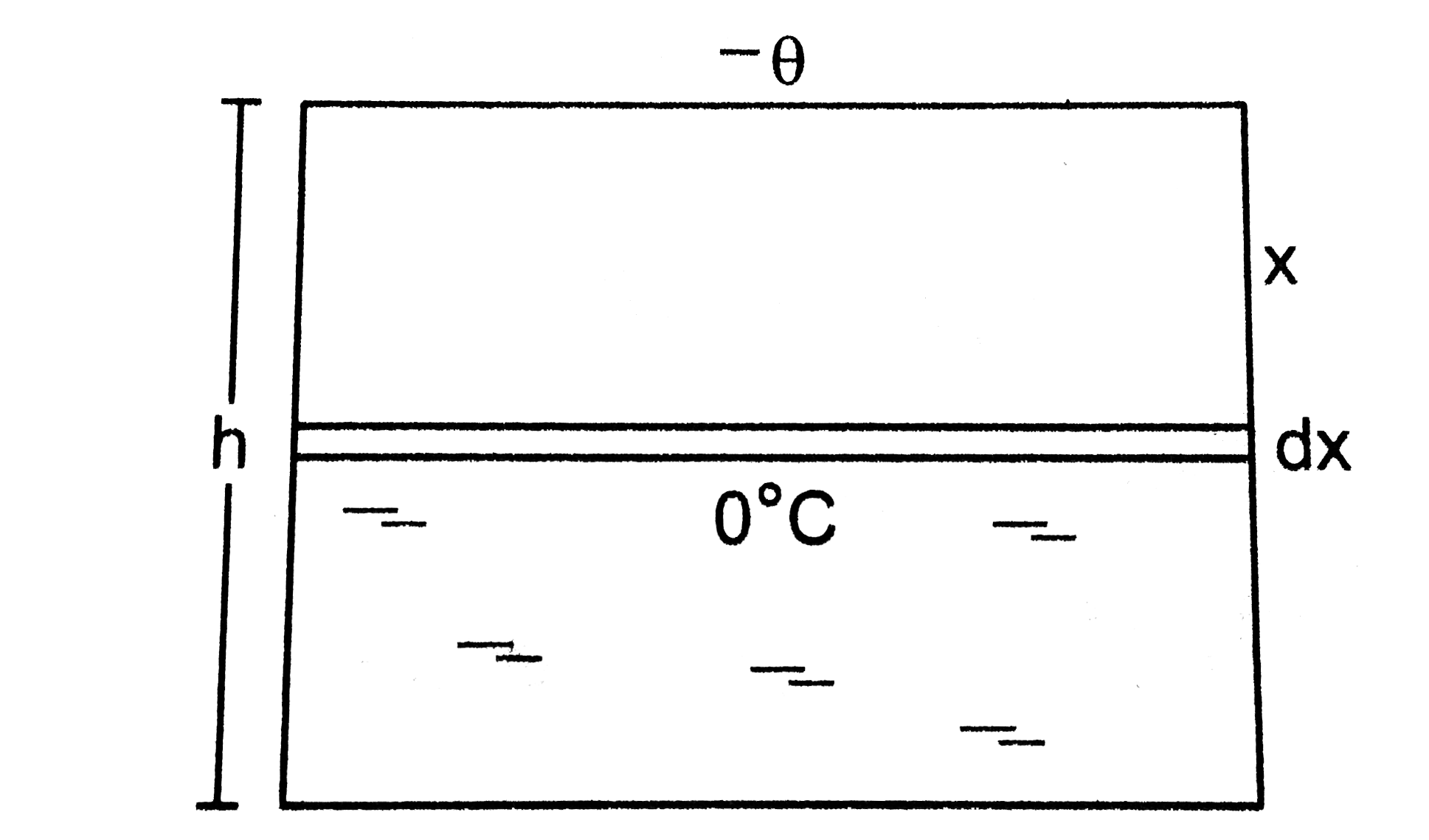
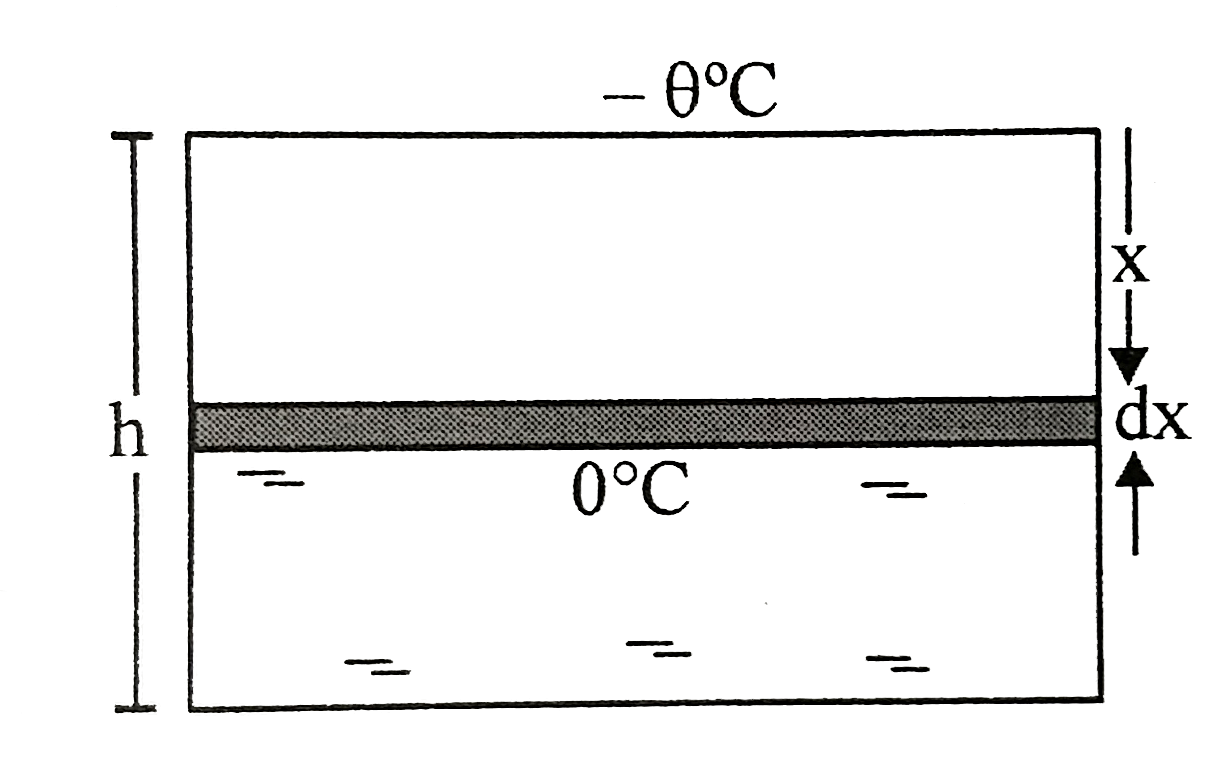
On a cold winter day, the atmospheric temperature is -theta (on celsius scale) which is below `0^(@)C`. A cylindrical drum of height `h` made of a bad conductor is completely filled with water at `0^(@)C` and is kept outside without any lid. Calculate the time taken for the whole mass of water to freeze. Thermal conductivity of ice is `K` and its latent heat of fusion is `L`. Neglect expansion of water on freezing.

Text Solution

Verified by Experts


Suppose, the ice starts forming at time `t=0` and a thickness `x` is formed at time `t`. The amount of heat flown from the water to the surrounding in the time interval `t` to `t=dt` is
`DeltaQ=(Katheta)/(x)dt`
The mass of the ice formed due to the loss of this amount of heat is
`dm=(DeltaQ)/(L)=(KAtheta)/(xL)dt`.
The thickness `dx` of ice formed in time `dt` is
`dx=(dm)/(Arho)=(Ktheta)/(rhoxL)dt`
or, `dt=(rhoL)/(Ktheta)xdx`
Thus, the time `T` taken for the whole mass of water to freeze is given by
`int_(0)^(T)dt=(rhoL)/(Ktheta)int_(0)^(h)xdx`
`T=(rhoLh^(2))/(2Ktheta)`
Promotional Banner

Topper's Solved these Questions

  • HEAT TRANSFER

    BANSAL|Exercise Exercise|89 Videos
  • GRAVITATION

    BANSAL|Exercise EXERCISE -4 Section - B|6 Videos
  • KINETIC THEORY OF GASES

    BANSAL|Exercise Section-B|13 Videos

Similar Questions

Explore conceptually related problems

On a cold winter day, the atmosheric temperature is -theta (on celsium scale) which is below 0^(@)C. A cylindrical drum oof height h made of a bad conductor is completely filled with water at 0^(@)C and is kept outside without any lid. Calculate the time taken for the whole mass of water to freeze. Thermal conductivity of ice is K and its laternt heat of fusion is L. Neglect expansion of water on freezing.

On a cold winter dry, the temperature of atmosphere is -T^(@)C . The cylindrical dram shown is made of insultating material and it contains water at 0^(@)C . If L is latent heat of fusion of ice, rho is density of ice and K_(R) is thermal conductivity of ice, the time taken for total mass of water to freeze is

Calculate the amount of heat energy to be supplied to convert 2 kg of ice at 0^@C completely into water at 0^@C if latent heat of fusion for ice is 80 cal/g.

Calculate the amount of heat energy to be supplied to convert 4 kg of ice at 0^@C completely into water at 0^@C if latent heat of fusion for ice is 80 cal/g.

An ice layer of thickness d_1 is floating on a pond of water. The atmospheric temperature is - T^@C . What is the time taken for the thickness of the layer to increase from d_1 to d_2 if L, rho and K are the latent heat of fusion of water, density of ice and thermal conductivity of ice, respectively?

In an 20 m deep lake, the bottom is at a constant temperature of 4^(@)C . The air temperature is constant at -10 ^(@)C . The thermal conductivity of ice in 4 times that water. Neglecting the expansion of water on freezing, the maximum thickness of ice will be

A metallic cylindrical vessel whose inner and outer radii are r_1 and r_2 is filled with ice at 0^@C . The mass of the ice in the cylinder is m. Circular portions of the cylinder is sealed with completely adiabatic walls. The vessel is kept in air. Temperature of the air is 50^@C . How long will it take for the ice to melt completely. Thermal conductivity of the cylinder is K and its length is l. Latent heat of fusion of L.

The temperature of the water of pond is 0^@ C while that of the surrounding atmosphere is -20^@ C . If the density of ice is p, coefficient of thermal conductivity is k and latent heat of melting is L then the thickness Z of ice layer formed increases as function of time t as

BANSAL-HEAT TRANSFER-Exercise
  1. On a cold winter day, the atmospheric temperature is -theta (on celsiu...

    Text Solution

    |

  2. Three metal rod A, B and C of same length and cross-section are placed...

    Text Solution

    |

  3. Two identical rectangular rods of metal are welded end to end in serie...

    Text Solution

    |

  4. A composite cylinder is made of two materials having thermal conductiv...

    Text Solution

    |

  5. A metal sphere with a black surface and radius 30 min, is cooled to -7...

    Text Solution

    |

  6. A pan filled with hot food cools from 94^(@)C to 86^(@)C in 2 minutes ...

    Text Solution

    |

  7. A body cools from 50^(@)C to 40^(@)C in 5 minutes. The surrounding tem...

    Text Solution

    |

  8. One end of a 2.35m long and 2.0cm radius aluminium rod (K=235W.m^(-1)K...

    Text Solution

    |

  9. The rate of emission of radiation of a black body at 273^(@)C is E, th...

    Text Solution

    |

  10. Stars S(1) emits maximum radiation of wave length 420nm and the star S...

    Text Solution

    |

  11. A black body calorimeter filled with hot water cools from 60^(@)C to 5...

    Text Solution

    |

  12. From Kirchoff's law the ratio of emissive power and absorption power o...

    Text Solution

    |

  13. If at temperature T, the emissive power and absorption power of a body...

    Text Solution

    |

  14. During total solar eclipse Fraunhoffer's lines appear bright because -

    Text Solution

    |

  15. A polished metal plate with a rough black spot on it is heated to abou...

    Text Solution

    |

  16. The temperature of a body is increased by 50%. The amount of radiation...

    Text Solution

    |

  17. Radius of a shere is R density is d and specific heat is s, Is is heat...

    Text Solution

    |

  18. If a body at 27^(@)C emits 0.3 watt of heat then at 627^(@)C, it will ...

    Text Solution

    |

  19. If the rate of emission of radiation by a body at temperature TK is E ...

    Text Solution

    |

  20. A liquid takes 10 minutes to cool from 80^(@)C to 50^(@)C. The tempera...

    Text Solution

    |

  21. A metallic sphere cools from 50^(@)C to 40^(@)C in 300 seconds. If the...

    Text Solution

    |